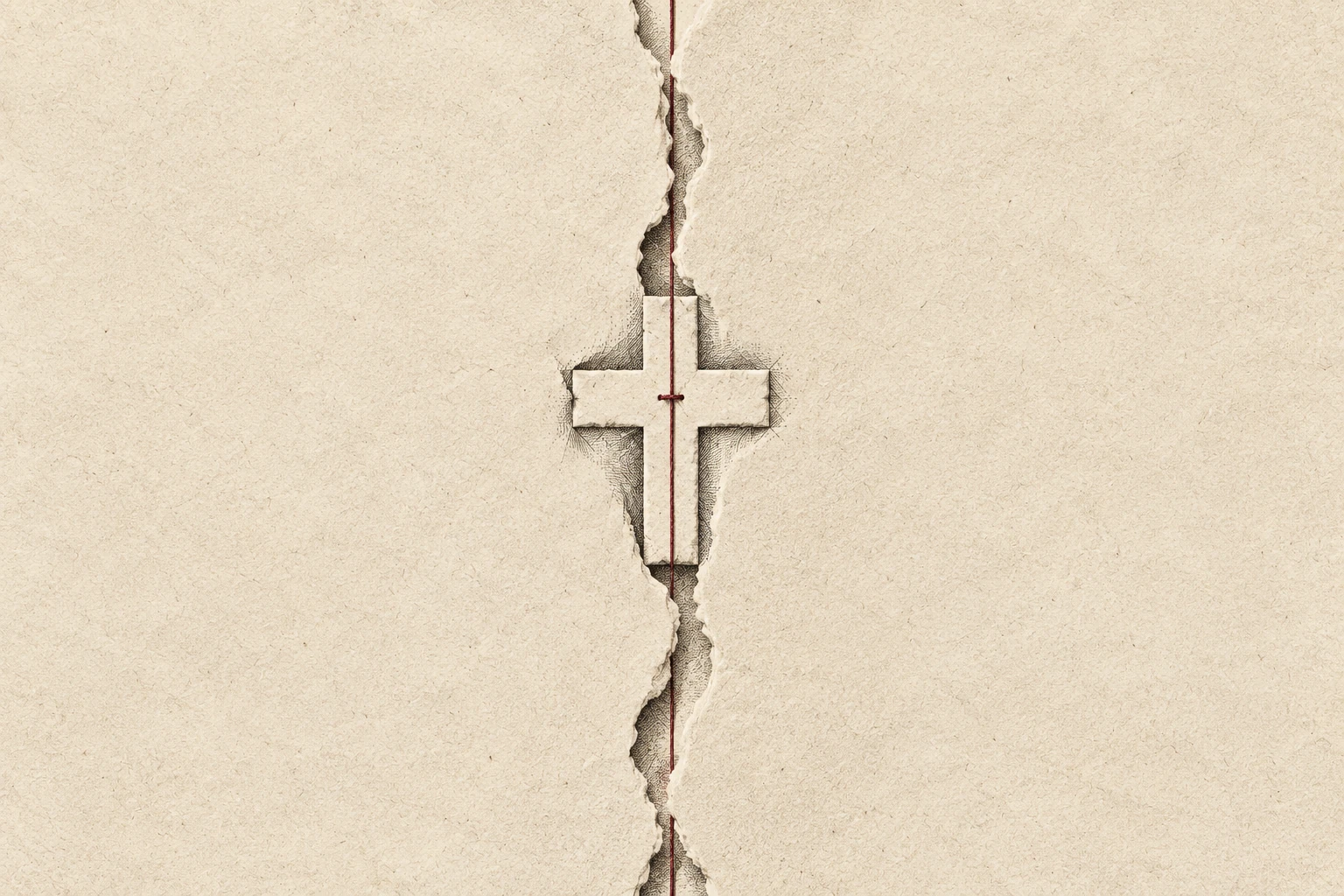
The cross stands at the center of the Christian faith, and yet the question it raises is felt by every honest reader of the Gospels. If God is almighty, and if God is love, why did the Son of God die at all? Could the world not have been forgiven by decree, the way a debt is waved off with a signature? The New Testament does not treat the death of Jesus as a tragedy that interrupted His work. It treats that death as the work itself. He was born, the angel said, to "save his people from their sins," and He Himself declared that He came "to give his life a ransom for many."1 To ask why Jesus had to die is therefore to ask what salvation required, and the answer Scripture gives touches the character of God, the condition of man, and the meaning of love itself.
The Problem the Cross Answers
The death of Christ makes no sense until the problem it answers is taken seriously. That problem is sin, and Scripture describes it not as occasional misbehavior but as a condition that reaches every person and every faculty. "All have sinned, and come short of the glory of God."2 Sin is first of all an offense against God, and its wage is fixed: "the wages of sin is death."3
Here the difficulty sharpens. God is merciful, and He desires to forgive. But God is also just, and justice cannot pretend that evil did not happen. A human judge who acquitted the guilty out of warm feeling would not be praised for his love; he would be removed for corruption. The question of the cross is the question of how God can be both "just, and the justifier of him which believeth in Jesus."4 Forgiveness by mere decree would leave justice unsatisfied. Judgment without mercy would leave no one standing. The cross is where the two meet.
Sacrifice: The Language God Had Already Taught
The death of Christ did not arrive unexplained. For centuries God had schooled His people in the vocabulary of sacrifice. Every offering at the tabernacle and the temple taught the same hard lesson: sin costs life, and "without shedding of blood is no remission."5 The worshiper laid his hand on the head of the animal, identifying himself with it, and the animal died in his place. The ritual was vivid, and it was also confessedly inadequate, "for it is not possible that the blood of bulls and of goats should take away sins."6 The sacrifices were a promissory note, pointing forward to a payment they could not themselves make.
This is why John the Baptist's greeting carries such weight: "Behold the Lamb of God, which taketh away the sin of the world."7 Jesus is not one more offering in the series. He is the reality the whole series had been teaching Israel to expect.
Substitution: In Our Place
At the heart of the biblical explanation stands a simple, staggering exchange. The innocent One took the place of the guilty. Isaiah had written it seven centuries before the event: "he was wounded for our transgressions, he was bruised for our iniquities: the chastisement of our peace was upon him; and with his stripes we are healed. All we like sheep have gone astray; we have turned every one to his own way; and the LORD hath laid on him the iniquity of us all."8 Peter states the same truth in a sentence: Christ "his own self bare our sins in his own body on the tree."9 Paul compresses it further still: "he hath made him to be sin for us, who knew no sin; that we might be made the righteousness of God in him."10
This is why the death of Jesus could not be replaced by His teaching, His example, or His miracles, good as all of these are. A drowning man does not need a swimming lesson from the shore; he needs someone to come down into the water. The debt of sin was death, and only a death could pay it. And no ordinary death would do. Every other man owed the debt for himself. Only One who was without sin, and whose life was of infinite worth, could pay for others. That is why the deity of Christ and the cross belong together: God was in Christ, reconciling the world unto himself.11
Willing, Not Compelled
It must be said plainly that Jesus was not a victim of circumstances. The cross was not an accident of Roman politics that God later turned to good use. It was "the determinate counsel and foreknowledge of God," announced by the prophets and embraced by the Son.12 "No man taketh it from me," Jesus said of His life, "but I lay it down of myself."13 Gethsemane shows what the obedience cost; the empty tomb shows that it was accepted. The death of Christ was the Father's giving and the Son's self giving at once, "God so loved the world, that he gave his only begotten Son."14 Any account of the cross that sets a loving Jesus against a reluctant or vindictive God has misread the text. The love that saves originates in God.
What the Death Accomplished
Scripture describes the achievement of the cross from several angles, and each answers a part of the question. As a sacrifice, it removed guilt. As a substitution, it satisfied justice. As a ransom, it purchased freedom for those enslaved to sin.15 As reconciliation, it made peace between God and man, so that Paul can plead, "be ye reconciled to God."16 As victory, it disarmed death itself, for through death He destroyed "him that had the power of death, that is, the devil."17
The proof that the payment was sufficient is the resurrection. A dead Savior would leave the question open. A risen Savior closes it. He "was delivered for our offences, and was raised again for our justification."18 On the cross He cried, "It is finished," a merchant's word, the stamp on a paid bill.19 Nothing remains owing.
Why It Matters
If Jesus did not have to die, then His death was a waste, and Paul draws exactly that conclusion: "if righteousness come by the law, then Christ is dead in vain."20 But if He did have to die, then two things follow, and both are liberating. First, sin is more serious than we wish to believe, too serious to be mended by effort or sincerity. Second, salvation is more secure than we dare to hope, because it rests on a finished work rather than an ongoing performance. The cross is not a demand. It is an announcement, and it asks not for repayment but for faith. "Believe on the Lord Jesus Christ, and thou shalt be saved."21
Scripture quotations are from the King James Version.
-
Matthew 1:21; Mark 10:45. ↩
-
Romans 3:23. ↩
-
Romans 6:23. ↩
-
Romans 3:26. ↩
-
Hebrews 9:22. ↩
-
Hebrews 10:4. ↩
-
John 1:29. ↩
-
Isaiah 53:5 and 6. ↩
-
1 Peter 2:24. ↩
-
2 Corinthians 5:21. ↩
-
2 Corinthians 5:19. ↩
-
Acts 2:23. ↩
-
John 10:18. ↩
-
John 3:16. ↩
-
Mark 10:45. ↩
-
2 Corinthians 5:20. ↩
-
Hebrews 2:14. ↩
-
Romans 4:25. ↩
-
John 19:30. ↩
-
Galatians 2:21. ↩
-
Acts 16:31. ↩
You May Also Enjoy
 Christ Is the End of the Law
 Lesson 6: Called into His Kingdom and Glory — 1 Thessalonians 2:10-12
 Lesson 2: When the Church Gets It Right — 1 Thessalonians 1:1-5
 The Righteousness of God Revealed: What Paul Means in Romans 1
 Lesson 5: Shepherding with a Tender Heart — 1 Thessalonians 2:7-9
 Lesson 13: The Cross and the New Creation — Galatians 6:11-18