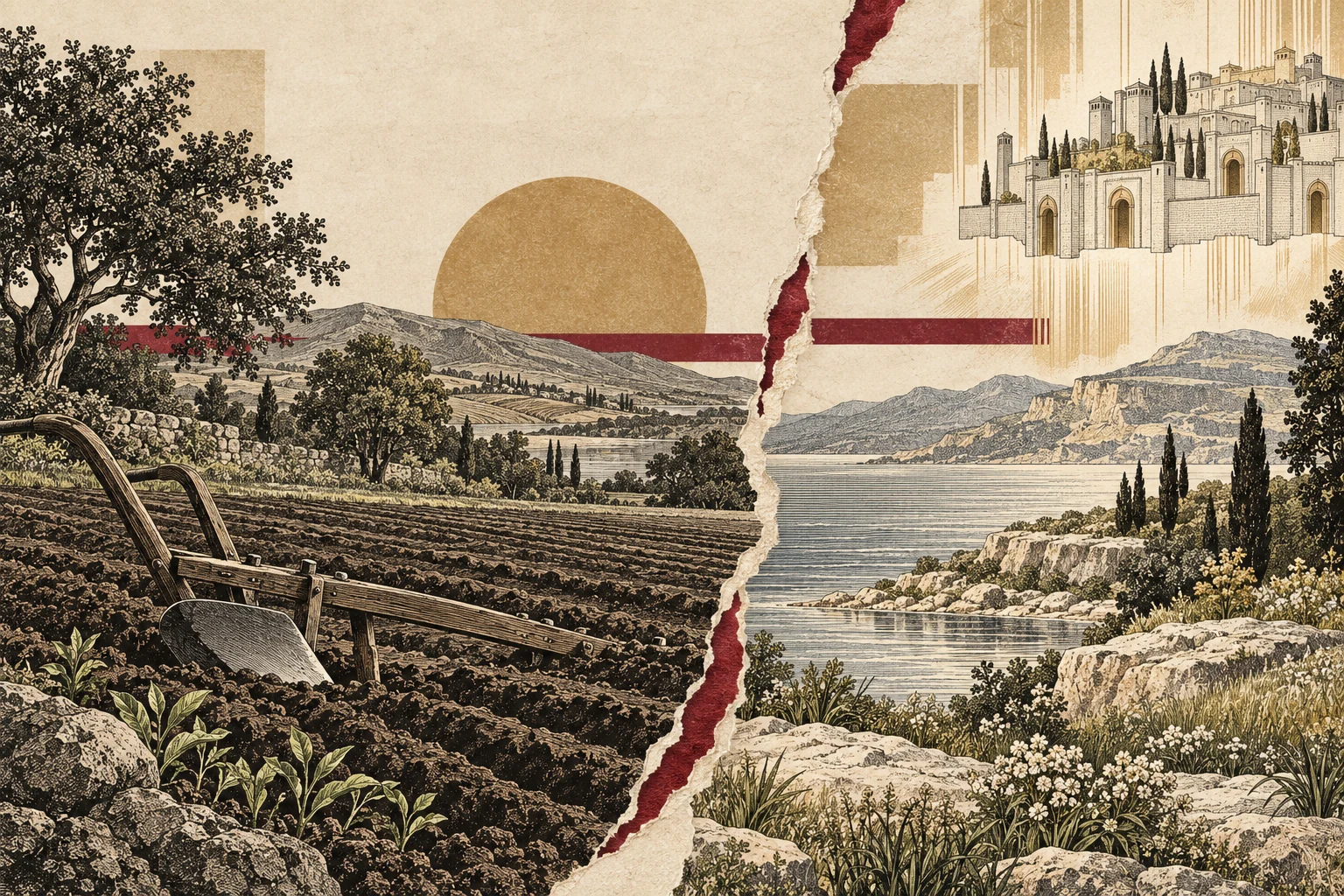
Ask most Christians what heaven is and the answer will describe a destination somewhere above, immaterial and permanent, to which the soul departs at death and remains forever. Scripture does promise that believers who die are immediately with Christ, and that promise is precious. What Scripture does not do is treat that condition as the believer's final hope. The hope the prophets and apostles held out is larger, and it is emphatically physical.
It is also, and this is where most treatments go wrong, not a single event. Scripture describes a purged earth and it describes a brand new one, and the church has spent centuries arguing over which of the two it meant. The argument dissolves once the passages are allowed to sit in their own places on the timeline. Both are true. They are not the same event.
Where the Promise Comes From
The phrase enters Scripture through Isaiah. "For, behold, I create new heavens and a new earth: and the former shall not be remembered, nor come into mind."1 Peter takes up the same words, looking for "new heavens and a new earth, wherein dwelleth righteousness."2 John uses them once more: "And I saw a new heaven and a new earth: for the first heaven and the first earth were passed away."3
Three writers and one phrase, and the ordinary assumption is that all three describe the same thing. Isaiah himself rules that out. Within a few verses of the promise he describes life in the order he has just announced, and death is still in it: "There shall be no more thence an infant of days, nor an old man that hath not filled his days: for the child shall die an hundred years old."4 Long life, and an end to the death of infants, but mortality itself remains. Whatever Isaiah 65 describes, it is not the state in which death is abolished and there is no more pain.5
So the promise carries two referents, and they stand in sequence. Isaiah's word and Peter's expectation belong to the renewed earth of the millennial reign, a real and physical restoration on which men still build and plant and die. John's use in Revelation 21 belongs to what follows the thousand years, and there alone the first heaven and the first earth are said to have passed away. One phrase, used of two things, a thousand years apart.
Isaiah returns to the promise a third time, and what that text asserts is permanence: "For as the new heavens and the new earth, which I will make, shall remain before me, saith the LORD, so shall your seed and your name remain."6 What God makes will stand, and its standing is the measure of the standing of Israel's seed and name.
Alongside these run the dissolution texts. The present heavens and earth wax old like a garment and are changed as a vesture.7 They flee from the face of the Judge.8 They are reserved unto fire against the day of judgment.9
The historic dispute is over how to reconcile the two. Against the Gnostics, who despised matter itself, Irenaeus of Lyon answered around AD 180 that neither the substance nor the essence of the creation is annihilated, but the fashion of this world passes away.10 Augustine and later Thomas Aquinas both taught that the world's corruptible qualities are burned away while its substance endures. Seventeenth-century Lutheran orthodoxy took the opposite view and defended the total destruction and replacement of the world. Each side could point to real texts, which is usually the sign that a distinction has been missed rather than that one side simply misread.
The First Event: Purged, on the Pattern of Noah
Peter supplies his own interpretive key, and it is routinely overlooked. Before he speaks of fire, he speaks of water.
"For this they willingly are ignorant of, that by the word of God the heavens were of old, and the earth standing out of the water and in the water: Whereby the world that then was, being overflowed with water, perished."11
The comparison is deliberate, and it governs everything Peter says afterward. The world that perished in the flood was not annihilated. Noah came out of the ark onto a planet profoundly changed, and life began again on it. That is the pattern Peter sets before he describes the heavens passing away with a great noise and the elements melting with fervent heat.12 The fire does to the present order what the water did to the antediluvian one: it ends a world without ending the earth.
The whole of the chapter belongs to this one event. The Noah pattern and the melting elements are not two judgments but one, given first by analogy and then directly, and the new heavens and new earth Peter looks for are the world that comes out the other side of it.13
Scripture names the complex in which that purging falls. Zechariah gives three chapters to it: the nations gathered against Jerusalem, the city taken, the LORD going forth to fight, and His feet standing in that day upon the mount of Olives.14 Revelation names the instrument, the seven vials of the wrath of God poured out upon the earth, ending in an earthquake "such as was not since men were upon the earth" in which every island flees away and the mountains are not found.15 Zechariah then states the plague upon the nations that fought against Jerusalem: "Their flesh shall consume away while they stand upon their feet, and their eyes shall consume away in their holes, and their tongue shall consume away in their mouth."16 Set beside elements melting with fervent heat and men scorched with great heat, that is a description modern readers can hardly help recognizing, whatever they finally conclude about it, as the language of nuclear-scale warfare.17
And there are survivors. That is the point of the Noah pattern, and Zechariah states it plainly: two parts of the land cut off and dead, "but the third shall be left therein. And I will bring the third part through the fire, and will refine them as silver is refined."18 A third comes through. As Noah and his family walked out of the ark onto a changed planet and began again, so people come through this fire and live on into the age that follows, on this earth, scoured and renewed. Out the other side of it comes the long-promised peace, when men beat their swords into plowshares and their spears into pruninghooks, and learn war no more.19 That is the doorway into the millennial reign: Christ reigning on this earth, Israel restored, and life on a scoured planet beginning again exactly as it began again for Noah.
So the renewal reading is correct, and it is correct about this event. The earth of the millennial reign is this earth, purged.
The Second Event: Everything Made New
The millennial reign is not the end. At the close of the thousand years Satan is loosed, the nations are gathered again under the names Gog and Magog, and fire comes down from God out of heaven and devours them.20 The Great White Throne follows, and before the face of Him who sits upon it "the earth and the heaven fled away; and there was found no place for them."21
Only then does John see the thing itself. "And I saw a new heaven and a new earth: for the first heaven and the first earth were passed away."22 Nothing in the sentence suggests repair. The first order is gone and no place is found for it, and what John sees is not that order restored but another in its place. The announcement from the throne says the same: "Behold, I make all things new."23
That is a new creation in the full sense, a new heavens and a new earth brand new rather than the former ones mended, and to it the holy city descends: "And I John saw the holy city, new Jerusalem, coming down from God out of heaven, prepared as a bride adorned for her husband."24 The seven new things of the closing vision belong here and not to the millennial earth: the new heaven and new earth, the New Jerusalem descending, the tabernacle of God with men, a new temple which is the Lord God Almighty and the Lamb, new light requiring neither sun nor moon, the river of life, and a restored paradise where there shall be no more curse.25
Here also death itself is gone, which is the plainest mark distinguishing this from the order Isaiah described. "And God shall wipe away all tears from their eyes; and there shall be no more death, neither sorrow, nor crying, neither shall there be any more pain: for the former things are passed away."26
So the new-creation reading is also correct, and it is correct about this event. What the long dispute lacked was not evidence but sequence.
What Christ Is Doing Now
There is a further word that belongs here and is seldom connected to it. On the night He was betrayed Christ told His disciples, "I go to prepare a place for you. And if I go and prepare a place for you, I will come again, and receive you unto myself; that where I am, there ye may be also."27
A place is being prepared. The language is of construction rather than of repair, and it sits comfortably with the promise of a creation made wholly new. Whatever else is said about the final state, Scripture presents it as something being made ready now, by Christ Himself, for people He intends to have with Him.
How the Earth Was Eclipsed Altogether
One more distortion needs naming, because it affects both events equally. Under the long influence of Platonic anthropology, which held the soul naturally immortal and the immaterial realm its true home, the church's practical hope migrated away from any earth at all, purged or new, toward the soul's departure elsewhere. The medieval period did not deny the doctrine. It stopped preaching it. Attention concentrated on the vision granted to disembodied souls, formally defined in 1336, and on the geography of the afterlife.
The Reformers recovered the material hope plainly. Luther expected the earth renewed and adorned with a new beauty.28 Calvin wrote that the whole machinery of the world will be renewed.29 Whatever is concluded about sequence, the direction of the biblical hope is not escape from creation but God dwelling with His people in one.
Where Believers Are Now
The question of what happens between death and resurrection is a different question with its own answer. Those who die in Christ are consciously with Him, which Paul calls far better than remaining here. That state is real and blessed, and it is not the end of the story. Scripture never treats it as the goal, which is why the creeds fix on the resurrection of the body and the life of the world to come rather than on the soul's immediate destination.
The distinction matters, because when it blurs the resurrection is correspondingly diminished. A hope that terminates on souls in heaven has quietly dropped the article the church has always confessed.
The Doctrine Stated
Scripture describes two events and the church has often collapsed them into one. The first is a purging, on the pattern Peter draws from Noah, worked through the battle of Zechariah 12 through 14 and the vials of Revelation 16. It ends a world without ending the earth. A remnant comes through that fire as Noah's family came through the water, and lives on into the millennial reign upon this earth, scoured and beginning again, with Christ reigning and Israel restored. The second comes after the thousand years, after Gog and Magog and the fire from heaven, when the first heaven and the first earth flee away and no place is found for them, and God creates a new heaven and a new earth: brand new, not the former ones repaired, and the New Jerusalem descends to it.
The promise of new heavens and a new earth therefore carries two referents in sequence, which is why the argument ran so long with real texts on both sides. Isaiah and Peter speak of the first, the renewed earth on which men still build and plant and die. John in Revelation 21 speaks of the second, where death is abolished and the former things are passed away.
Heaven, in the sense Scripture finally means, is neither an escape from the world God made nor merely that world tidied. It is God dwelling with His people forever, in a creation He has made new, with the curse lifted, death abolished, and righteousness at home in it.
-
Isaiah 65:17, KJV. ↩
-
2 Peter 3:13, KJV. ↩
-
Revelation 21:1, KJV. ↩
-
Isaiah 65:20, KJV. ↩
-
Revelation 21:4. ↩
-
Isaiah 66:22, KJV. ↩
-
Psalm 102:25-26, KJV. ↩
-
Revelation 20:11. ↩
-
2 Peter 3:7, KJV. ↩
-
Irenaeus, Against Heresies V.36.1, citing 1 Corinthians 7:31. ↩
-
2 Peter 3:5-6, KJV. ↩
-
2 Peter 3:10, KJV. ↩
-
2 Peter 3:13. ↩
-
Zechariah 12:2-3; Zechariah 14:1-4, KJV. ↩
-
Revelation 16:1-21, KJV; the phrases quoted are at Revelation 16:18 and 16:20. ↩
-
Zechariah 14:12, KJV. ↩
-
2 Peter 3:10; Revelation 16:9, KJV. ↩
-
Zechariah 13:8-9, KJV. ↩
-
Isaiah 2:4; Micah 4:3, KJV. ↩
-
Revelation 20:7-9, KJV. ↩
-
Revelation 20:11, KJV. ↩
-
Revelation 21:1, KJV. ↩
-
Revelation 21:5, KJV. ↩
-
Revelation 21:2, KJV. ↩
-
Revelation 21:1-22:5; Revelation 22:3. ↩
-
Revelation 21:4, KJV. ↩
-
John 14:2-3, KJV. ↩
-
Martin Luther, Lectures on Genesis, 1535. ↩
-
John Calvin, Institutes of the Christian Religion III.25.11. ↩
You May Also Enjoy
 From One God to Many: Humanity's Drift and God's Response
 Lesson 6: Called into His Kingdom and Glory — 1 Thessalonians 2:10-12
 The Righteousness of God Revealed: What Paul Means in Romans 1
 Lesson 2: When the Church Gets It Right — 1 Thessalonians 1:1-5
 Be Reconciled to God: Why the Finished Work of Christ Must Still Be Received
 Lesson 7: The Priority of the Promise — Galatians 3:10-18