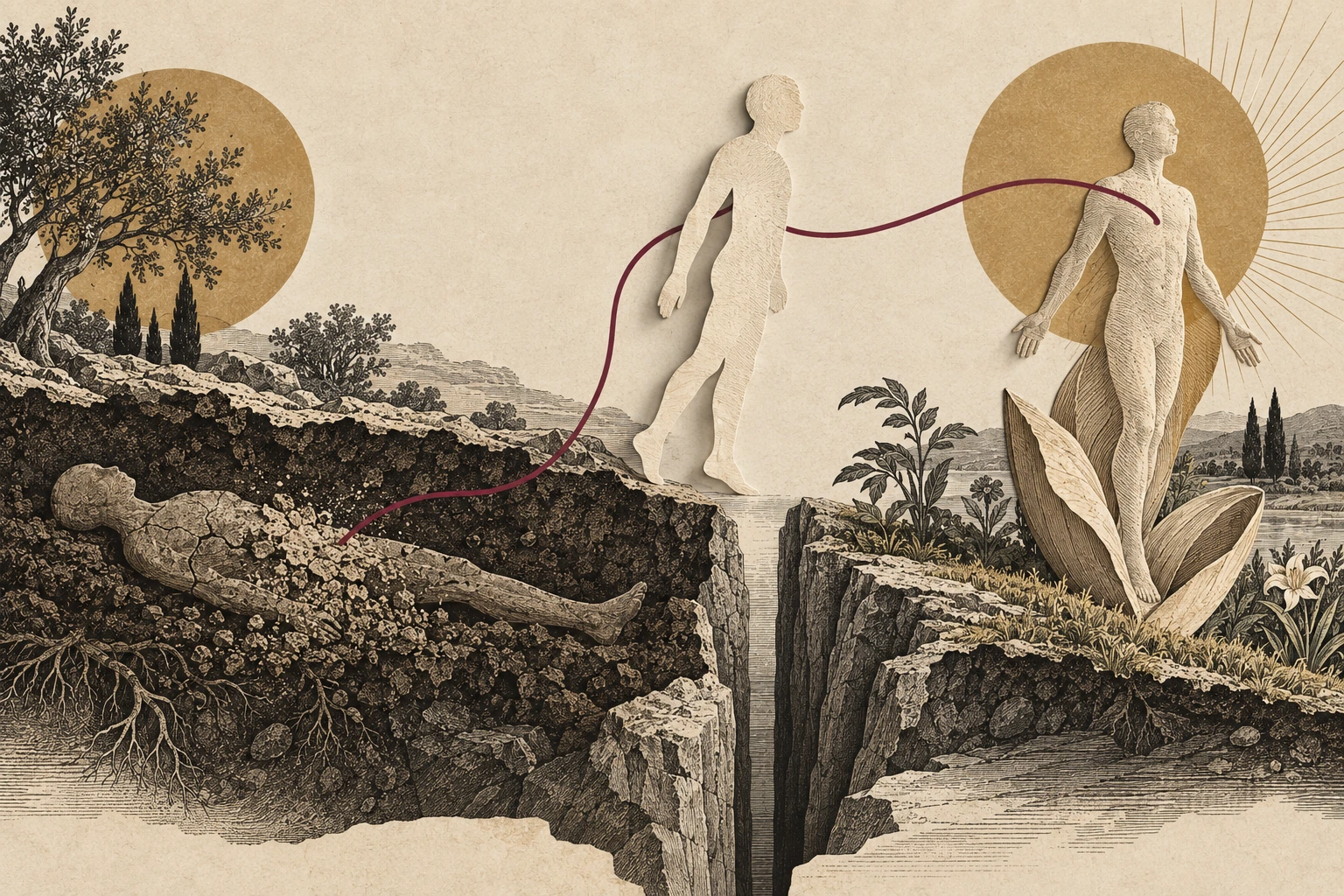
Every other question a person can ask allows for postponement. This one does not. Death comes to philosopher and farmhand alike, and what lies beyond it cannot be tested in advance or reported back by survey. If we are to know anything at all about what follows death, we must be told by One who knows, and the Christian conviction is that we have been told. Scripture does not satisfy every curiosity, and it leaves real questions open, but on the essential matters it speaks with clarity: death is not the end of the person, the dead are not all in the same condition, and the final word belongs to resurrection, not to the grave.
Death Is a Separation, Not a Cessation
The Bible describes death as a parting of what belongs together. "Then shall the dust return to the earth as it was: and the spirit shall return unto God who gave it."1 The body, formed from dust, goes back to dust; the immaterial self persists. Jesus warned against fearing "them which kill the body, but are not able to kill the soul," a warning that would be meaningless if the person simply ceased at the last breath.2 Death is real, and Scripture never minimizes it, calling it an enemy rather than a friend in disguise.3 But it is a separation, first of the soul from the body, and behind that, in its deepest meaning, a separation between man and the God who is life itself. That is why the Bible's account of death cannot be separated from its account of sin, for "the wages of sin is death."4
The Dead Are Not All in One Condition
The Old Testament speaks of the dead descending to Sheol, the realm of the departed, and even there it distinguishes the righteous from the wicked in their expectation.5 By the time of the Lord's earthly ministry that distinction had sharpened, and Jesus Himself draws the picture most plainly in the account of the rich man and Lazarus: two men die, and they arrive in two very different conditions, one comforted and one in torment, with a great gulf fixed between them.6 Whatever else that passage teaches, it teaches that death is not a common dormitory. Consciousness continues, condition differs, and the difference is fixed at death.
For the believer, the New Testament's language is remarkably serene. To the dying thief the Lord promised, "To day shalt thou be with me in paradise."7 Paul, weighing life against death, calls departing "to be with Christ; which is far better," and states his confidence that to be "absent from the body" is "to be present with the Lord."8 The dead in Christ are repeatedly said to sleep, a gentle word that describes the body's rest, not the soul's extinction, for those who sleep in Jesus are the very ones God will bring with Him.9 This intermediate condition, conscious blessedness with Christ while awaiting the resurrection, is the historic comfort of the church. For those who die apart from Christ, the same interval is described in darker terms, a holding under judgment until the final day.10
The Body Has a Future
Here Christianity parts company with every philosophy that treats the body as a shell to be discarded. The hope held out in Scripture is not an eternity as a disembodied spirit but the resurrection of the body. "The hour is coming, in the which all that are in the graves shall hear his voice, and shall come forth."11 The pattern and the guarantee is the resurrection of Jesus Christ, "the firstfruits of them that slept," whose risen body could be seen and touched.12 Paul devotes the longest chapter of his letters to this truth, answering the mockery of Corinth with the promise that what is "sown in corruption" will be "raised in incorruption," sown in weakness and raised in power.13 For the believer, the trumpet of 1 Thessalonians 4 gathers it into one scene: the dead in Christ rise first, the living are caught up together with them, "and so shall we ever be with the Lord."14 Christians differ in good conscience about the timing and order of the last things, and this ministry has surveyed those views elsewhere, but the resurrection itself is not negotiable; it is the hope.
Judgment Is Certain, and So Is Its Standard
"It is appointed unto men once to die, but after this the judgment."15 Scripture rules out both annihilation at death and endless cycles of return; the appointment is single and its sequel is judgment. The judge is Christ Himself, and the dividing question is not whether a life was respectable but how a person stands with Him. "He that believeth on him is not condemned: but he that believeth not is condemned already."16 For those in Christ, judgment holds no terror, for "there is therefore now no condemnation to them which are in Christ Jesus," and their appearing before Him concerns reward and loss, not salvation.17 For those who die in their sins the end is described soberly and repeatedly as destruction, exclusion, and the second death, language the church has understood in differing ways but has never been free to soften into nothing.18
Facing Death Without Fear
Why does Scripture tell us these things? Not to satisfy curiosity, and certainly not to arm us for speculation, but to change how we live and how we die. Because Christ has died and risen, death has been defanged for those who are His: "O death, where is thy sting?"19 Through fear of death, Hebrews says, men are "all their lifetime subject to bondage," and it is exactly that bondage Christ came to break.20 The Christian grieves at the graveside, and rightly, but "not even as others which have no hope."21
The question, then, folds back on the reader. What happens when we die depends entirely on what has happened before we die. "He that hath the Son hath life; and he that hath not the Son of God hath not life."22 Settled now, in Christ, the question loses its terror, and the believer can say with the psalmist, "Yea, though I walk through the valley of the shadow of death, I will fear no evil: for thou art with me."23
Scripture quotations are from the King James Version.
-
Ecclesiastes 12:7. ↩
-
Matthew 10:28. ↩
-
1 Corinthians 15:26. ↩
-
Romans 6:23. ↩
-
On the Old Testament picture of Sheol and the division of the dead, see the fuller treatment published by this ministry, "Sheol Evolved: The Dead Divided," theologyinfocus.org. ↩
-
Luke 16:19 through 31. ↩
-
Luke 23:43. ↩
-
Philippians 1:23; 2 Corinthians 5:8. ↩
-
1 Thessalonians 4:14. ↩
-
2 Peter 2:9. ↩
-
John 5:28 and 29. ↩
-
1 Corinthians 15:20; Luke 24:39. ↩
-
1 Corinthians 15:42 and 43. ↩
-
1 Thessalonians 4:16 through 18. ↩
-
Hebrews 9:27. ↩
-
John 3:18. ↩
-
Romans 8:1; 2 Corinthians 5:10. ↩
-
Revelation 20:14; 2 Thessalonians 1:9. The differing views are surveyed in "Three Christian Views of Hell," theologyinfocus.org. ↩
-
1 Corinthians 15:55. ↩
-
Hebrews 2:15. ↩
-
1 Thessalonians 4:13. ↩
-
1 John 5:12. ↩
-
Psalm 23:4. ↩
You May Also Enjoy
 Why Did Jesus Have to Die?
 The Righteousness of God Revealed: What Paul Means in Romans 1
 Christ Is the End of the Law
 Be Reconciled to God: Why the Finished Work of Christ Must Still Be Received
 Lesson 2: When the Church Gets It Right — 1 Thessalonians 1:1-5
 Lesson 7: The Priority of the Promise — Galatians 3:10-18