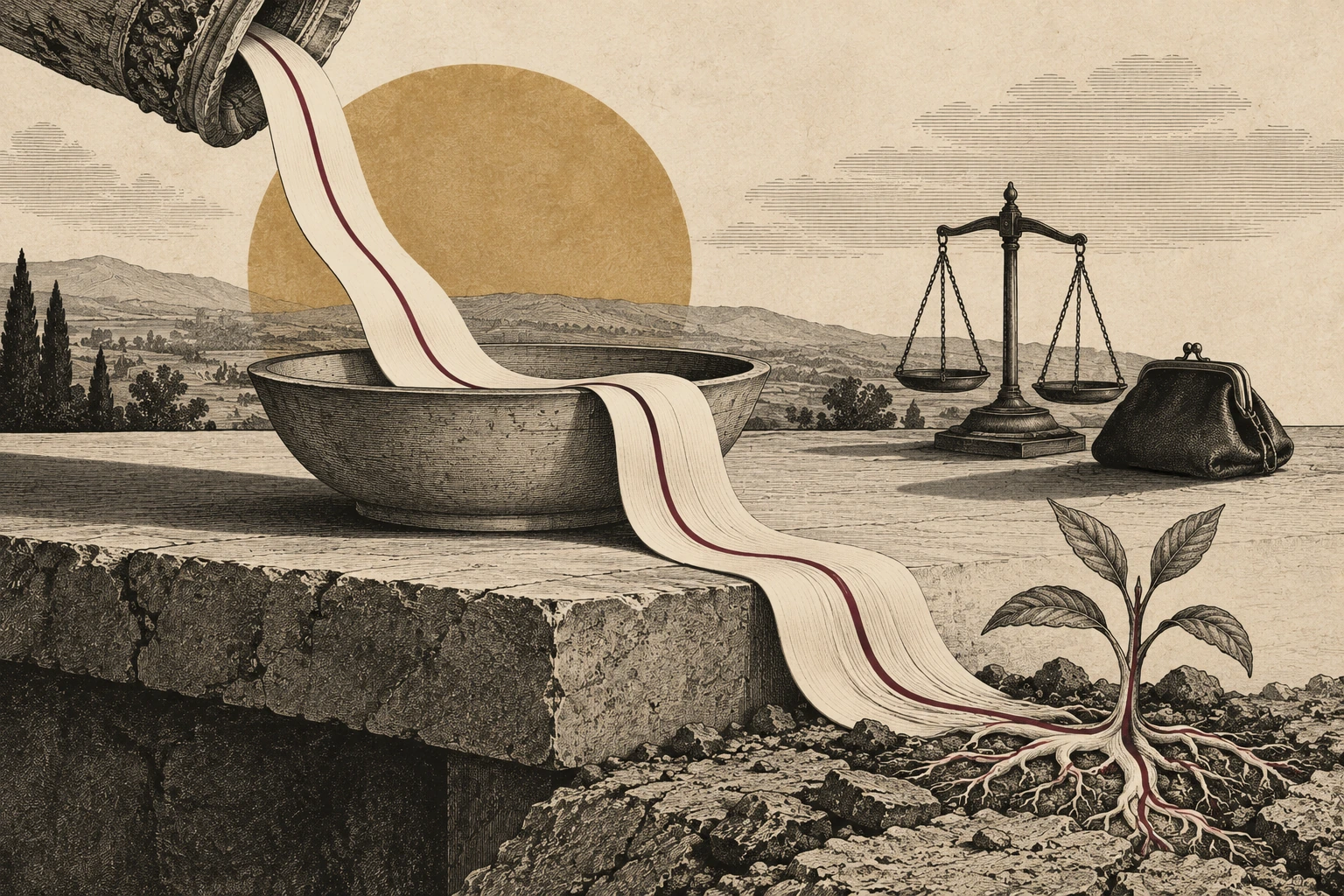
Grace is the most Christian word there is. Other faiths have law, prayer, sacrifice, pilgrimage, and alms; every religion of human construction runs, in the end, on some form of earning. Only the gospel runs on grace. Yet precisely because the word is so common, said before meals, sung in the world's best known hymn, sprinkled through conversation as a synonym for polish or poise, its meaning has gone soft. Ask what grace actually is and many Christians reach for the old acrostic, God's Riches At Christ's Expense, which is true as far as it goes, and stops well short of how far Scripture goes. In the Bible, grace is the free, undeserved favor of God toward those who have earned the opposite, favor that pardons and transforms, and it is the single hinge on which the Christian message turns.
Favor, Free and Undeserved
The Old Testament pictures grace before it defines it. Noah, in a world ripe for judgment, "found grace in the eyes of the LORD."1 Israel was chosen, God tells them flatly, not because they were more in number than any people, "for ye were the fewest of all people," but because the LORD loved them.2 The pattern repeats until it cannot be missed: God sets His favor on those who bring nothing to the transaction. Grace, by definition, is unearnable. The moment it is deserved, it changes its name to wages.
Paul states the logic with precision: "And if by grace, then is it no more of works: otherwise grace is no more grace."3 The two principles cannot be blended. A gift partly paid for is not a gift, and grace with conditions attached is merely law on friendlier terms. This is the point at which the biblical doctrine offends, for it insists that the recipient of grace deserves not neutrality but judgment. Grace is not God overlooking a few flaws in basically good people. It is God setting His love on "the ungodly," on enemies, on those "dead in trespasses and sins."4 The scandal of the word is the measure of its glory.
Grace Has a Face
In Scripture grace is never an abstract principle or a substance dispensed in portions. It is the disposition of a living God, and it took flesh. "The Word was made flesh, and dwelt among us, (and we beheld his glory, the glory as of the only begotten of the Father,) full of grace and truth."5 John continues: "the law was given by Moses, but grace and truth came by Jesus Christ."6 Whatever grace is, Jesus is. His table fellowship with publicans and sinners, His word to the woman taken in adultery, His prayer for His executioners, these are not illustrations of grace; they are grace, in person.
And the cross is its costliest act. "Ye know the grace of our Lord Jesus Christ, that, though he was rich, yet for your sakes he became poor, that ye through his poverty might be rich."7 Grace is free to the receiver precisely because it was not free to the Giver. Every easy use of the word should be measured against that exchange.
Grace Saves, Entirely
The New Testament's central claim about salvation is that it is by grace from first to last. "For by grace are ye saved through faith; and that not of yourselves: it is the gift of God: not of works, lest any man should boast."8 Justification, the sinner's acceptance before God, is "freely by his grace through the redemption that is in Christ Jesus," where the word freely is the same word used of the hatred Jesus endured "without a cause."9 Sinners are justified without a cause in themselves, for cause found wholly in Christ.
This is the boundary line between the gospel and every religion of merit, and Paul patrols it without compromise. To the Galatians, tempted to finish in the flesh what began in the Spirit, he writes that if righteousness comes by law, "then Christ is dead in vain," and warns that the man who seeks justification by law is "fallen from grace," not fallen from salvation into sin, but fallen from the principle of grace back onto the hopeless principle of earning.10 Grace admits no percentages. Salvation is not God's ninety percent meeting our ten. It is Christ's hundred, received empty-handed, "the gift of God."
Grace Does Not Leave a Person as It Found Him
Here a caricature must be answered. If grace is free, does it not license sin? Paul heard the objection in his own day, "shall we continue in sin, that grace may abound?", and answered it with horror: "God forbid."11 The objection misunderstands what grace does. Grace does not merely change a sinner's record; it changes the sinner. "For the grace of God that bringeth salvation hath appeared to all men, teaching us that, denying ungodliness and worldly lusts, we should live soberly, righteously, and godly, in this present world."12 Grace is a tutor, and its curriculum is holiness.
The same grace that pardons also empowers. Paul, hindered by his thorn, was told, "My grace is sufficient for thee: for my strength is made perfect in weakness."13 Grace equips for service, "but by the grace of God I am what I am," and it gives gifts to every believer for the good of the body.14 The Christian life does not begin in grace and continue in effort; it begins, continues, and ends in grace, which is why believers are commanded to "grow in grace, and in the knowledge of our Lord and Saviour Jesus Christ."15
Receiving What Cannot Be Earned
How, then, is grace received? By the only instrument that adds nothing to it: faith. "Therefore it is of faith, that it might be by grace."16 Faith is the empty hand, and even the hand is a gift. The proud find this humiliating, and it is; grace cannot be received while any claim of deserving is still gripped, for "God resisteth the proud, but giveth grace unto the humble."17 But to the one who lets go, the promise is boundless. Where sin abounded, "grace did much more abound."18 There is no daily limit, no rationing, no case too far gone, a truth this ministry has pressed elsewhere and gladly presses again.
The word, in the end, is best defined by looking where John pointed: "of his fulness have all we received, and grace for grace," wave upon wave, grace answering grace.19 What is grace? It is God giving Himself, in Christ, to people who deserved His judgment, and asking nothing in payment because the payment has already been made. The only fitting response was written long ago: "Thanks be unto God for his unspeakable gift."20
Scripture quotations are from the King James Version.
-
Genesis 6:8. ↩
-
Deuteronomy 7:7 and 8. ↩
-
Romans 11:6. ↩
-
Romans 4:5; Romans 5:10; Ephesians 2:1. ↩
-
John 1:14. ↩
-
John 1:17. ↩
-
2 Corinthians 8:9. ↩
-
Ephesians 2:8 and 9. ↩
-
Romans 3:24; John 15:25. The Greek adverb is the same in both places. ↩
-
Galatians 2:21; Galatians 5:4. ↩
-
Romans 6:1 and 2. ↩
-
Titus 2:11 and 12. ↩
-
2 Corinthians 12:9. ↩
-
1 Corinthians 15:10; 1 Peter 4:10. ↩
-
2 Peter 3:18. ↩
-
Romans 4:16. ↩
-
James 4:6. ↩
-
Romans 5:20. ↩
-
John 1:16. ↩
-
2 Corinthians 9:15. ↩
You May Also Enjoy
 Lesson 6: Called into His Kingdom and Glory — 1 Thessalonians 2:10-12
 Lesson 5: Shepherding with a Tender Heart — 1 Thessalonians 2:7-9
 Lesson 2: When the Church Gets It Right — 1 Thessalonians 1:1-5
 The Righteousness of God Revealed: What Paul Means in Romans 1
 Lesson 4: Leading from the Fire — 1 Thessalonians 2:1-6
 Be Reconciled to God: Why the Finished Work of Christ Must Still Be Received