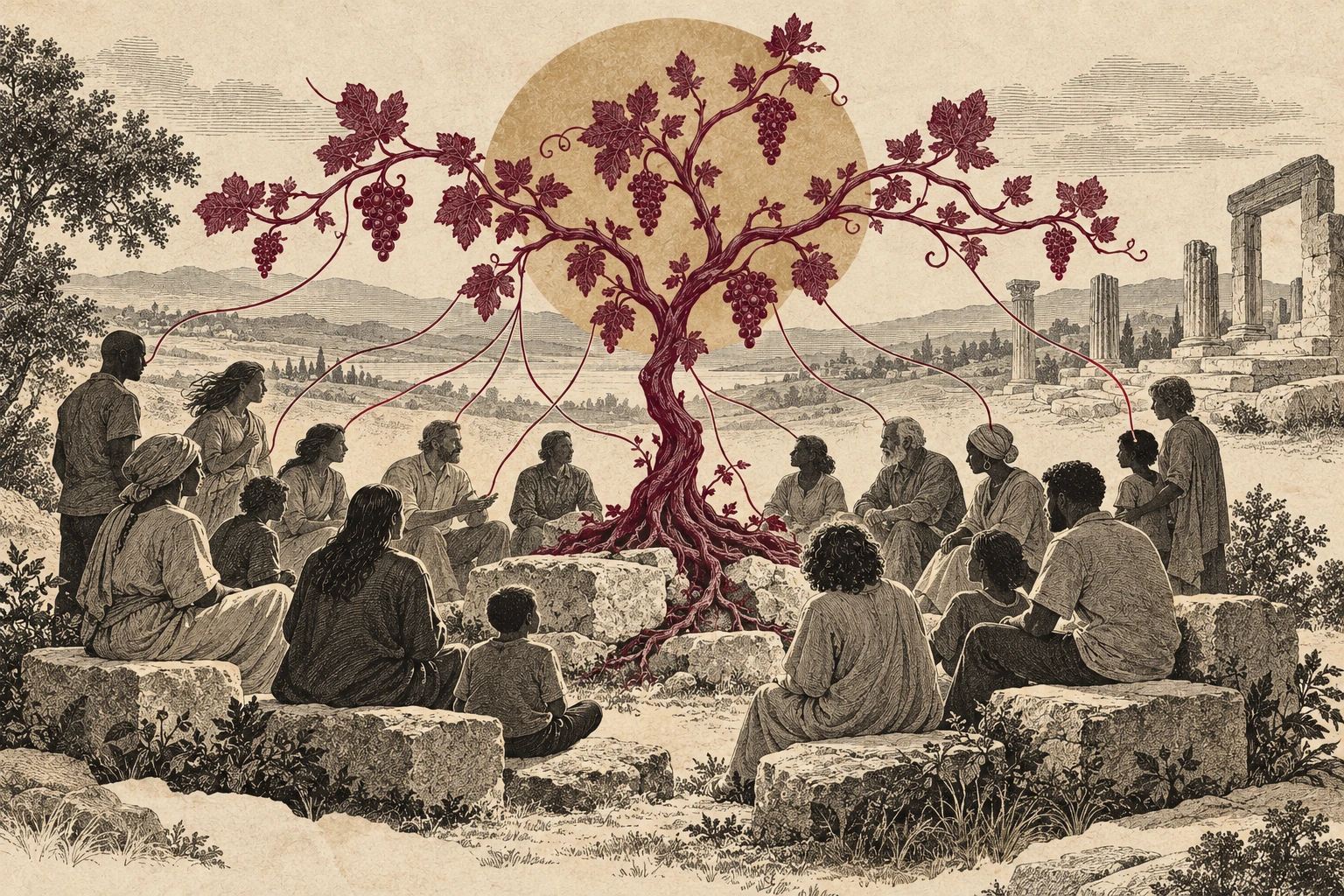
Few words in Christian speech have drifted further from their original meaning. In ordinary use, "church" names a building on a corner, a denomination on a sign, or an hour on Sunday morning. A family says it is going to church, meaning a place. A believer says he has left the church, meaning an institution. Neither sense is what the New Testament word means, and the distance between the two is not a matter of semantics. It governs what the church is for, who leads it, and what may rightly be asked of it. The word the apostles used names a people, and only a people: the gathered assembly of those who confess Jesus as Lord, whose one head is Christ.
A Word That Means an Assembly
The Greek word is ekklesia, and it means a called-out assembly, a company of people summoned and gathered. In classical Greek it named the assembly of citizens called out to conduct the affairs of the city. In the Septuagint it translates the Hebrew qahal, the congregation of Israel assembled before the LORD.1 In the New Testament it names both the local congregation meeting in a particular place2 and the whole company of the redeemed under Christ.3
It never means a building. When Paul greets "the church that is in their house," he is not naming the walls but the congregation inside them.4 The English word "church" descends from a different Greek word, kuriakos, meaning "belonging to the Lord," and the two together give the whole idea. The church is the assembly, and it is the assembly that belongs to the Lord.
The Images Scripture Uses
No single definition exhausts the church, and Scripture does not attempt one. It reaches instead for a cluster of images, each revealing a different dimension of the same reality. The church is the body of Christ, organically united under one Head, diverse in gifts and single in life.5 It is the bride of Christ, loved in covenant and awaiting a consummation.6 It is the temple in which the Spirit dwells, built of living stones.7 It is the flock of Christ under one Shepherd.8 It is the branches of the vine, bearing fruit only by abiding.9 It is the one new man, in whom Jew and Gentile are reconciled in one body through the cross.10
To seize one of these images and discard the rest is to flatten what Scripture presents in three dimensions. Taken together they teach that the church belongs to Christ, that it is alive rather than merely institutional, that it is holy, that it is a family and not an audience, that it is one, and that it is sent.
How the Word Was Redefined
The historical record shows the word's reference drifting, over centuries, away from the assembly and toward an institution, a clergy, and a place.
In the apostolic churches, believers gathered in homes,11 led by a plurality of elders who are also called overseers,12 served by deacons,13 owning no head but Christ.14 The assembly began at Pentecost, when the Spirit was poured out and the first company of confessors was gathered.15
The drift came in stages. Ignatius of Antioch, writing about AD 110, is the first witness to insist that each city have one bishop set over the elders and deacons and distinct from them, with nothing done in the church apart from him. By the time of Cyprian of Carthage, about AD 250, the bishop is spoken of as a sacrificing priest and the ministers as a clerical order distinct from the laici, the people; the royal priesthood of all believers recedes behind an ordained priesthood.16 Cyprian's principle that outside the church there is no salvation ties salvation itself to communion with the bishop. After the Edict of Milan in AD 313 legalized Christianity and basilicas were built across the empire, the people's word attached also to the place of meeting. From Leo I, bishop of Rome from 440 to 461, the Roman see pressed a claim to universal headship over the whole church, read out of Matthew 16:18. The one Head was rivaled by a claimed earthly head.
The Reformation recovered the assembly at the center. The Augsburg Confession of 1530 defined the church as the congregation of saints in which the gospel is rightly taught and the sacraments rightly administered. Christ alone was confessed as head, recovering the plain sense of Colossians 1:18. The priesthood of all believers was restored to every Christian rather than reserved to a caste.17 The Anabaptists of the sixteenth century and the English Baptists of the seventeenth pressed the point further, holding that a church is a gathered company of professed believers rather than a parish of all the baptized. That recovery was real, and it was not universal. The Roman and Eastern communions retain the ancient hierarchy, and for Rome the papal head remains.
What the Church Is
The church is the gathered assembly of those who confess Jesus as Lord. It began at Pentecost. Its one head is Christ and no other, and no bishop, council, or see stands over it as an earthly head.18 When Christ said that upon this rock He would build His church, the rock was the confession that He is the Son of the living God, and the keys given are the preaching of the gospel, ministerial and declarative rather than magisterial.19
There is one saved people of God across the ages, Jew and Gentile alike, gathered into one body by one gospel on one set of terms.20 The church has not displaced Israel, and God has not abandoned His covenant promises to her. Jew and Gentile in one new man, and Israel's promised future, meet in the same Christ rather than in two separate programs.
The ordinances are the two Christ commanded, baptism and the Lord's Supper. They are signs that portray what God has done; they do not perform it. The officers are elders, also called overseers and shepherds, which are three names for one office, together with deacons, following the apostolic pattern of plural elders in each congregation.21 The precise locus of final authority remains disputed across traditions, and honesty requires saying so plainly rather than pretending the question was settled long ago.
What the Church Is Not
Several errors follow directly from losing the meaning of the word. Institutional reductionism equates the church with its organizational structure and misses the living people. Calling the building the church loses the plain sense of ekklesia altogether. Setting a bishop or a pope over the church as an earthly head rivals the one Head. Retreating into a purely spiritual church denies the visible, embodied, gathered community and leaves an abstraction. Consumer ecclesiology treats the church as a service provider arranged around individual preference, which reverses the direction of the whole doctrine.
The church is the gathered assembly of confessors, Christ its only head, begun at Pentecost, one saved people of God across the ages with Israel's future intact. It is richer than any single image can express, and it is not, and has never been, a building.
Scripture quotations are from the King James Version.
-
Deuteronomy 4:10; 9:10, KJV. ↩
-
1 Corinthians 1:2; Revelation 2 and 3. ↩
-
Ephesians 1:22; Matthew 16:18. ↩
-
Romans 16:5, KJV. ↩
-
1 Corinthians 12:12-27; Ephesians 4:15-16. ↩
-
Ephesians 5:25-32; Revelation 19:7-8. ↩
-
1 Corinthians 3:16-17; Ephesians 2:19-22; 1 Peter 2:5. ↩
-
John 10:16; Acts 20:28; 1 Peter 5:2. ↩
-
John 15:1-8. ↩
-
Ephesians 2:14-16. ↩
-
Romans 16:5; 1 Corinthians 16:19; Colossians 4:15; Philemon 2. ↩
-
Acts 20:17 and 20:28; Titus 1:5-7. ↩
-
Philippians 1:1; 1 Timothy 3. ↩
-
Colossians 1:18; Ephesians 1:22-23. ↩
-
Acts 2. ↩
-
1 Peter 2:9. ↩
-
1 Peter 2:9. ↩
-
Colossians 1:18; Ephesians 1:22-23. ↩
-
Matthew 16:16-18. ↩
-
Ephesians 2:14-16. ↩
-
Acts 14:23; Acts 20:17 and 28; Titus 1:5-7; Philippians 1:1. ↩
You May Also Enjoy
 Lesson 2: When the Church Gets It Right — 1 Thessalonians 1:1-5
 Supplemental Study: The Birth of the Thessalonian Church
 The Early Church Councils: How Orthodoxy Was Defined
 The Righteousness of God Revealed: What Paul Means in Romans 1
 Be Reconciled to God: Why the Finished Work of Christ Must Still Be Received
 Three Christian Views of the End Times Explained Clearly