Modern classical Pentecostalism emerged as a distinct movement in the early twentieth century. By 2010, Pentecostal Christians numbered in the hundreds of millions worldwide. [1]
This account follows its American Holiness roots, Topeka and Azusa Street. These were formative developments, but the history of worldwide Pentecostalism has several centres and cannot be reduced to a single founding date. [2]
The Holiness Background
Pentecostalism did not appear from nothing. It grew out of the Wesleyan holiness movement of the nineteenth century. [3]
John Wesley had taught that after conversion a believer might receive a further work of grace, which he called entire sanctification or Christian perfection. American holiness teachers through the 1800s developed this into the expectation of a definite second experience, often called the baptism of the Holy Spirit, subsequent to conversion and evidenced by holiness of life. [3]
By the end of the century, camp meetings across the American South and Midwest were teaching that such an experience was available and should be sought. What was not settled was how a seeker would know it had occurred. Pentecostalism supplied an answer to that question.
Topeka and Azusa Street
Charles Fox Parham (1873 to 1929) opened Bethel Bible School in Topeka, Kansas, in 1900. He set his students the question of what biblical evidence accompanied the baptism of the Holy Spirit. Their conclusion, drawn from the accounts in Acts, was speaking in tongues. On 1 January 1901 a student named Agnes Ozman was reported to have spoken in tongues after prayer, and others followed. [3]
The doctrine that emerged, and that distinguishes classical Pentecostalism, is that speaking in tongues is the initial physical evidence of Spirit baptism. [4]
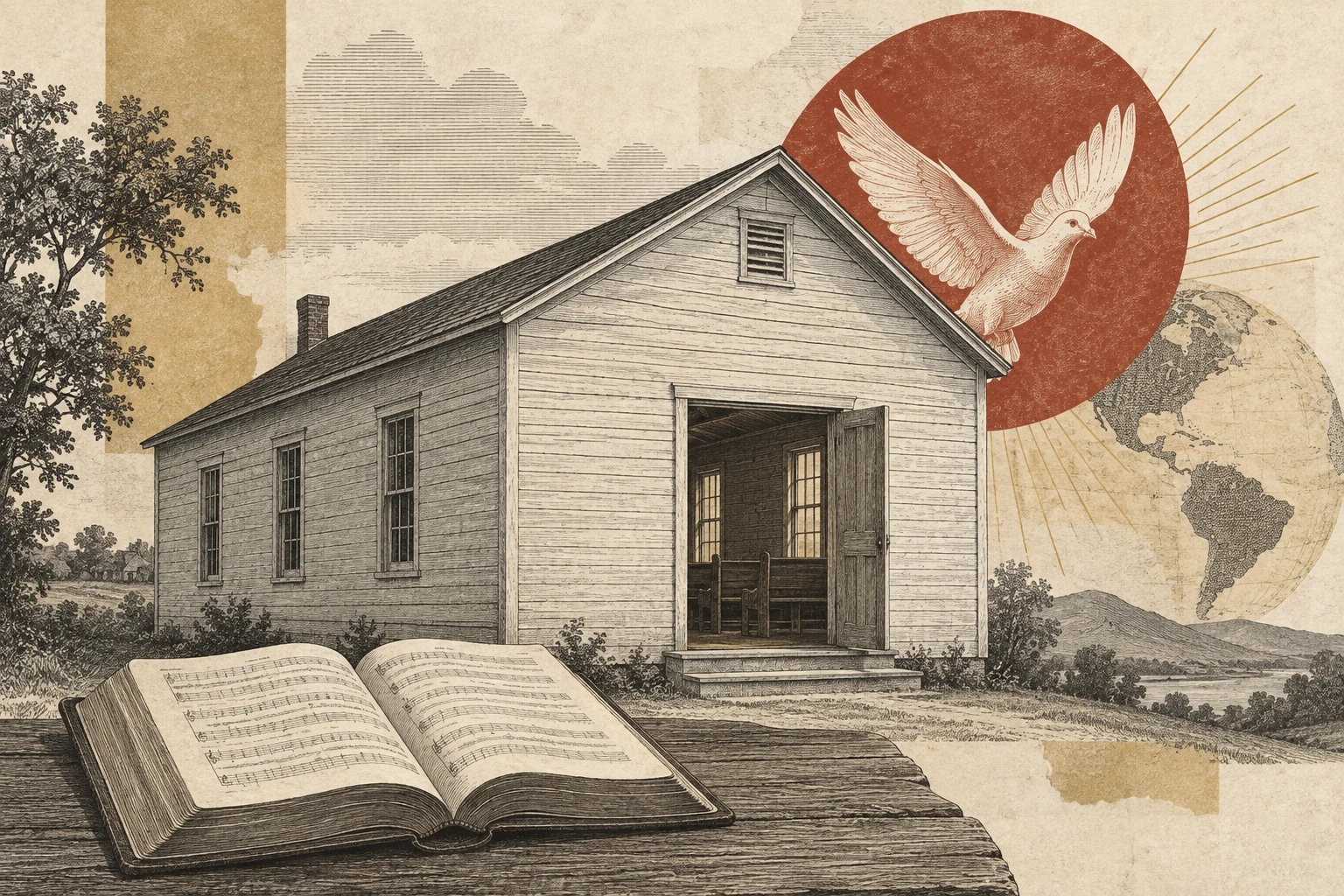
Los Angeles became an important centre of international Pentecostal activity. William J. Seymour (1870 to 1922), the son of formerly enslaved parents, had heard Parham teach in Houston, where he was segregated from the other students and listened from outside the classroom door. Invited to Los Angeles in 1906, he began meetings that moved to a former African Methodist Episcopal building at 312 Azusa Street. [2] [5]
The Azusa Street revival ran from April 1906 for roughly three years. Its racially integrated services brought visitors from across the country and abroad. Returning participants and the mission's newspaper helped spread its teaching internationally. [5]
Early interracial worship did not prevent later institutional segregation. Historian Vinson Synan describes the formation of racially separated Pentecostal fellowships between 1908 and 1924. At the Memphis reconciliation gathering in 1994, participating Pentecostal leaders confessed racism and called for repentance. [6] [7]
Denominations Form
A movement that emphasises direct experience of the Spirit does not organise easily, and early Pentecostals were suspicious of denominational structure. Practical necessity overcame the suspicion. [8]
The Assemblies of God was constituted at Hot Springs, Arkansas, in April 1914, when around three hundred delegates gathered to address common concerns, including missionary work and doctrinal stability. The Church of God in Christ traces its beginnings to 1897; Charles Harrison Mason embraced Pentecostal teaching after visiting Azusa Street in 1907. The Church of God, headquartered at Cleveland, Tennessee, traces its beginnings to 1886, before the Assemblies of God. Aimee Semple McPherson opened Angelus Temple in 1923, the founding year celebrated by the Foursquare movement. [8] [9] [10] [11]
A significant doctrinal division appeared almost immediately. From 1913 a substantial group came to reject the traditional formulation of the Godhead in favour of a unitary understanding, baptising in the name of Jesus alone. The Assemblies of God adopted its Statement of Fundamental Truths in 1916 in part to define its position, and those holding the Oneness view formed separate bodies, including the United Pentecostal Church International, formed by a merger in 1945. [8] [12] [13]
This division is genuine and it is not minor. Readers should understand that Pentecostalism is not doctrinally uniform on this point, and that the bodies concerned regard the question as important.
The Later Waves
Two later developments carried Pentecostal practice far beyond Pentecostal denominations.
The charismatic renewal of the 1960s and 1970s introduced the gifts of the Spirit into Roman Catholic, Anglican, Lutheran, and Presbyterian congregations, whose members generally remained in their own churches. Dennis Bennett, an Episcopal rector in Van Nuys, California, announcing his experience of tongues to his congregation in 1960, is commonly taken as the marker. [1] [14]
The third wave from the 1980s brought similar practice into evangelical churches that declined the Pentecostal label and often rejected tongues as the necessary initial evidence while affirming the continuing operation of spiritual gifts. [15]
Pew Research Center's 2011 report estimated 279 million Pentecostals and 305 million charismatics for 2010. Its charismatic category includes Catholics and Orthodox Christians as well as Protestants. The combined figure therefore describes a movement across Christian traditions; it is not a total for a single Protestant grouping. [1]
What Pentecostals Actually Hold
The common core is a conviction that the events of Acts are normative rather than merely historical. The gifts of the Spirit described in the New Testament did not cease with the apostles and are available now.
Classical Pentecostal bodies teach Spirit baptism as an experience distinct from conversion, evidenced initially by tongues. Divine healing is expected. Worship is participatory and expects the immediate activity of God in the meeting. [4]
The tradition is generally Arminian, holding that grace can be resisted, which reflects its Wesleyan parentage. There are Reformed Christians who affirm continuing gifts, and they are not usually called Pentecostal. [16]
What the Story Actually Shows
Three observations follow from the record.
The first is that Pentecostalism answered a question the holiness movement had raised but not settled. A movement teaching that a definite experience is available will eventually be asked how a person knows it has happened. Tongues supplied a criterion. [3]
The second is that international connections helped the movement spread. Azusa drew visitors who carried its teaching elsewhere, while its newspaper reached readers overseas. The formation of the Assemblies of God also shows how missionary work led early Pentecostals to seek greater cooperation. [5] [8]
The third is that early interracial worship was followed by racial division in Pentecostal institutions. The Memphis reconciliation gathering in 1994 records a later acknowledgement of that failure. [6] [7]
For readers tracing their own tradition, the Pentecostal case is a reminder that church history did not end in the sixteenth century. Topeka and Azusa Street belong to the history of a movement whose influence extends across Christian traditions.
Sources and notes
Historical accounts, demographic research and denominational statements are distinguished below. Denominational statements document the beliefs of the bodies named. Sources checked on 11 September 2026.
- Pew Research Center, "Christian Movements and Denominations" (19 December 2011). Historical estimates for 2010 and definitions of Pentecostals and charismatics. Return 1 Return 2 Return 3
- U-Wen Low, "A brief survey of the Pentecostal tradition through a postcolonial optic" (2025), section "The complex origins of Pentecostalism," PDF pp. 8-9. Return 1 Return 2
- John D. Hannah, "Birth of Classical Pentecostalism," Our Daily Bread University, lesson 7, pp. 1-6. The lecture distinguishes Holiness sanctification from Parham's further experience of Spirit baptism. Return 1 Return 2 Return 3 Return 4
- Assemblies of God, "Statement of Fundamental Truths," sections 7-9 and 12. A primary statement of this denomination's teaching. Return 1 Return 2
- Gary B. McGee, "William J. Seymour and the Azusa Street Revival," Assemblies of God (1999). Return 1 Return 2 Return 3
- Vinson Synan, "Memphis 1994: Miracle and Mandate," pp. 1-3. Return 1 Return 2
- Pentecostal/Charismatic Churches of North America, "Racial Reconciliation Manifesto" (1994), points III-V. Return 1 Return 2
- Assemblies of God, "History." Its account of the 1914 founding and 1916 doctrinal statement. Return 1 Return 2 Return 3 Return 4
- Church of God in Christ, "Our History." Return 1
- Church of God, "A Brief History of the Church of God." Return 1
- Foursquare, "Foursquare celebrates 100 years of ministry on Jan. 1." Return 1
- United Pentecostal Church International, "About the UPCI." Its organisational history, including the 1945 merger. Return 1
- United Pentecostal Church International, "Our Beliefs." A primary account of its understanding of God and baptism. Return 1
- Regent University Library, "Rev. Dennis J. Bennett Papers." The collection description documents the 1960 announcement; the archival papers themselves were not consulted. Return 1
- Fuller Theological Seminary, FULLER magazine, issue 12 (2018), PDF p. 13, on the 1982 "Signs, Wonders, and Church Growth" course. This supports the period and institutional setting of the later wave. Return 1
- Assemblies of God, "A Response to Reformed Theology" (2015). This documents the Assemblies of God position, not a uniform position across every Pentecostal body. Return 1