Pew Research Center's 2023-24 Religious Landscape Study found that nondenominational Protestants accounted for 7% of U.S. adults, the second-largest Protestant denominational family after Baptists. If they were a denomination, they would be an enormous one.
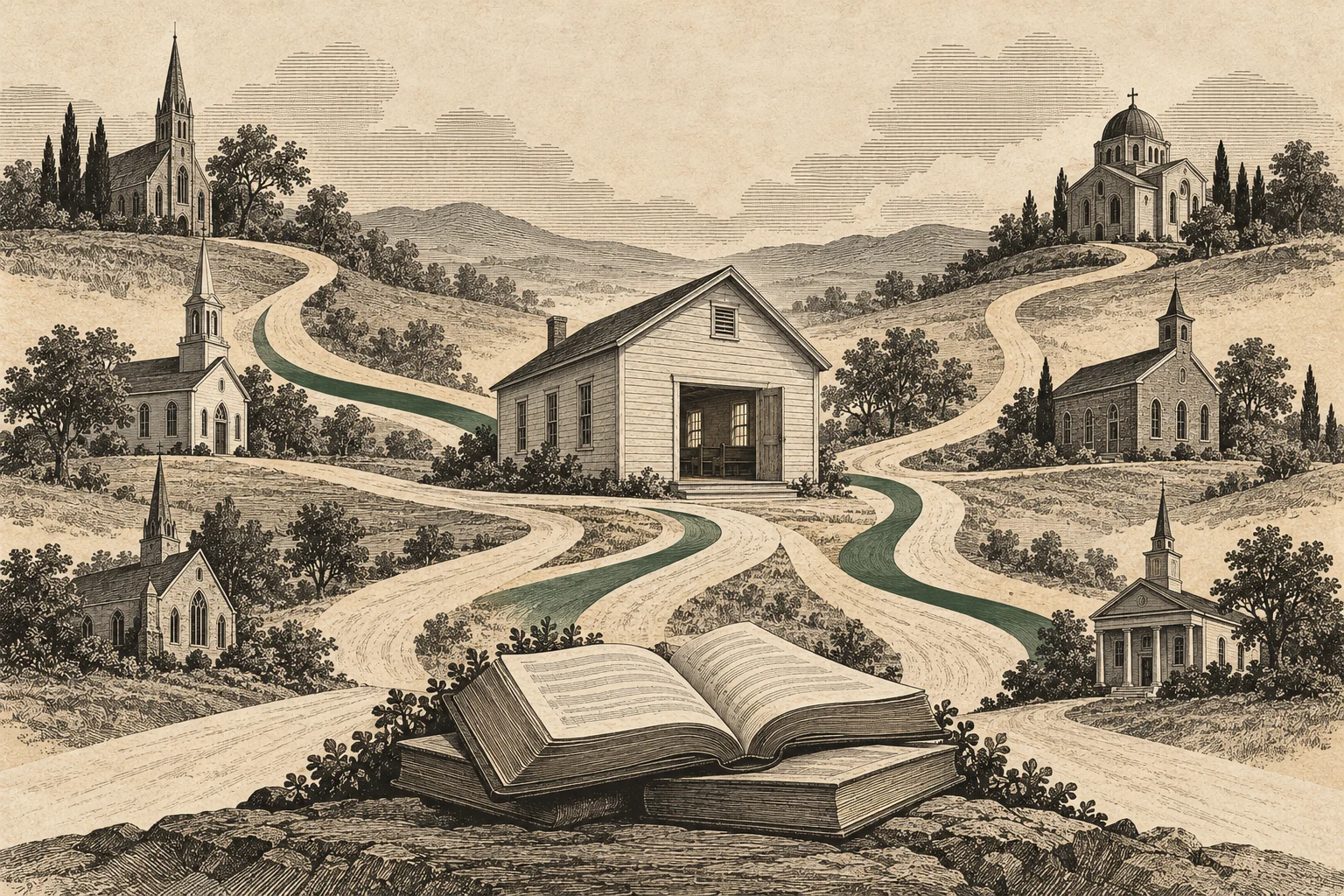
That sentence contains the whole difficulty of describing them. A category defined by what it is not is hard to trace, and the churches in it did not arise together or for the same reasons. They are nonetheless traceable. The independent church did not appear from nowhere in the 1980s. It has at least four ancestors.
Ancestor One: The Restoration Impulse
The conviction that denominations are themselves the problem is older than any church currently using the label.
The Stone-Campbell movement of the early nineteenth century set out to abolish denominational names and restore the church of the New Testament. Congregations in that tradition often took no name beyond a scriptural description, and many independent churches today, whether they know it or not, are drawing on an argument first made on the American frontier in 1809.
Ancestor Two: The Fundamentalist Separations
The doctrinal battles of the 1920s and 1930s produced independent congregations by the hundreds.
As liberal theology gained ground in Presbyterian, Baptist, Methodist, and Congregational bodies, conservatives faced a choice: remain and contend, or leave. Many left, and those who left frequently declined to form a new denomination, having concluded that denominational machinery was what had permitted the drift in the first place.
The result was the Bible church movement, concentrated in the American Midwest and Southwest, together with a network of independent Bible institutes, radio ministries, and mission agencies that supplied the functions a denomination would otherwise have performed. Dallas Theological Seminary opened in 1924 to provide conservative, traditional theological training for pastors and teachers (DTS history).
Ancestor Three: The Jesus Movement
The counterculture of the late 1960s produced a wave of conversions among young people who had no denominational memory and no interest in acquiring one.
Calvary Chapel in Costa Mesa, California, under Chuck Smith, became the model. Informal dress, contemporary music, verse by verse teaching, and an explicit refusal of denominational identity, while functioning through a fellowship of affiliated churches. The Vineyard began under Kenn Gulliksen in West Los Angeles in 1974, planted its first churches in 1975, and recognized John Wimber's leadership with the Association of Vineyard Churches in 1982 (Vineyard USA history).
These bodies illustrate the recurring irony of the category. Calvary Chapel and the Vineyard each developed a recognisable theology, a distinctive worship style, a process for approving pastors, and a network of affiliated congregations. Whether that constitutes a denomination is a question of definition rather than of substance.
Ancestor Four: The Church Growth Movement
The final ancestor is the most visible.
Willow Creek Community Church, founded near Chicago in 1975 by Bill Hybels, was built on survey research into why unchurched people stayed away. Saddleback Church, founded in 1980 in southern California by Rick Warren, applied comparable thinking. Both grew enormously, and both taught their methods to thousands of other pastors through conferences and published material.
The denominational label was treated as an obstacle. It communicated inherited conflict to people who had no stake in it, and it narrowed the audience. Dropping it was, in part, a communications decision.
Church names changed accordingly. Congregations that would once have been First Baptist or Grace Lutheran became single words or place names, and the tradition, where one existed, moved off the sign and into the doctrinal statement on the website.
What They Actually Hold
Generalisation is risky here, but a common profile exists.
Most are broadly evangelical: the authority of Scripture, salvation by grace through faith in Christ, the necessity of personal conversion, and an expectation of evangelism.
On baptism, most practise believer's baptism by immersion, which places them functionally in the Baptist stream whatever the sign says. Most are congregationally governed, often by an elder board with substantial authority delegated to a senior pastor. Many are broadly charismatic in worship style, having absorbed contemporary worship music from Pentecostal and charismatic sources, while declining the Pentecostal insistence on tongues as necessary evidence.
Doctrinally they tend to state a short list of essentials and remain deliberately silent on the questions that historically divided Protestants, including the extent of the atonement, the mode and subjects of baptism, and eschatology.
What the Story Actually Shows
Three observations follow, and the third is the one worth sitting with.
The first is that the impulse is genuinely old. The desire to be simply Christian, without a party name, runs from the Anabaptists through the Stone-Campbell movement to the present. It is not a modern marketing invention, even where modern marketing has adopted it.
The second is that no church is actually free of tradition. A congregation that practises believer's baptism by immersion, governs itself congregationally, and preaches from the Bible alone is standing in a tradition with a long history and identifiable ancestors. It has simply removed the label. Whether that is honest simplicity or an obscuring of one's own lineage is a fair question, and members of these churches ask it themselves.
The third is that dropping the label removes accountability along with the baggage. A denomination, for all its bureaucracy, provides an external body that can examine a minister's fitness, adjudicate a dispute a congregation cannot settle, and remove someone who should be removed. An independent church has to construct that from scratch, and a number of well-publicised failures over recent decades have involved churches that had no external structure capable of intervening.
For readers tracing their own tradition, the non-denominational case is worth thinking through carefully. The absence of a name is not the absence of a history. It usually means the history has stopped being taught.