The Churches of Christ arose from a movement that set out to abolish denominations, and which produced three of them.
That is not a cheap observation. It is the central fact of the tradition's history, and members of it have written about the difficulty with more honesty than most.
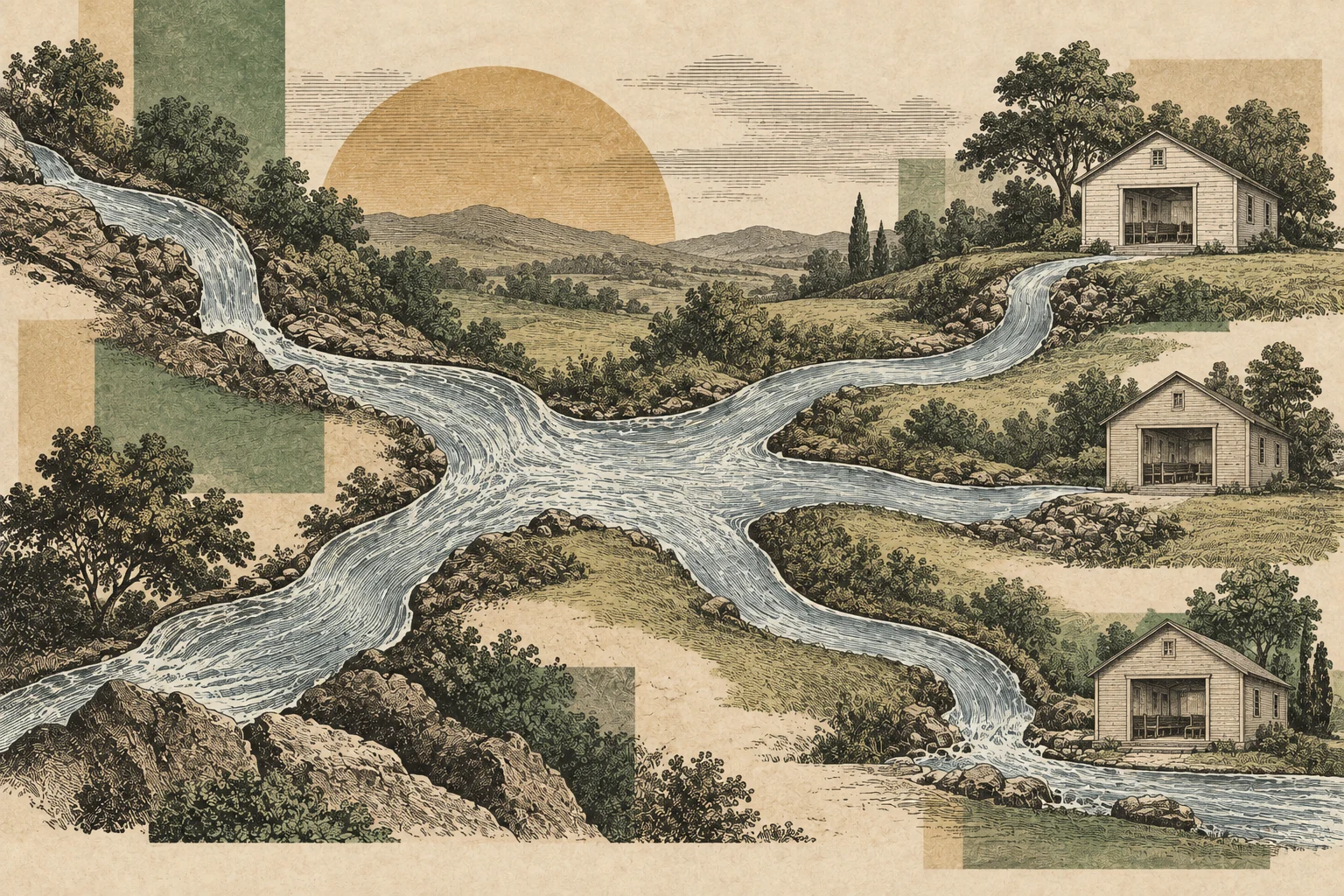
The movement began on the American frontier in the early nineteenth century, among people exhausted by the sectarian quarrels they had brought from Europe, who concluded that the way past division was to abandon every human creed and restore the church described in the New Testament.
Two Beginnings
The movement had two independent starting points that later joined.
Barton W. Stone (1772 to 1844) was a Presbyterian minister in Kentucky who presided over the Cane Ridge camp meeting in August 1801, an extraordinary gathering estimated at ten to twenty thousand people. Disciplined afterward for departing from the Westminster Confession, Stone and several colleagues withdrew and in 1804 issued the Last Will and Testament of the Springfield Presbytery, a document that dissolved their own governing body. They resolved to be known simply as Christians and to take the Bible alone as their standard.
Thomas Campbell (1763 to 1854) was a Scottish Presbyterian minister who arrived in western Pennsylvania in 1807 and was censured for admitting Presbyterians of other synods to communion. He formed the Christian Association of Washington and in 1809 published the Declaration and Address, the movement's founding statement. Its most quoted principle is the rule that where the Scriptures speak, we speak, and where the Scriptures are silent, we are silent.
His son Alexander Campbell (1788 to 1866) arrived the following year and became the movement's dominant figure: editor, debater, college founder, and its most formidable mind.
The two streams recognised their kinship and merged in 1832 at Lexington, Kentucky, sealed by a handshake between Barton Stone and John Smith.
The Restoration Principle
The governing conviction is that the church of the New Testament can be reproduced by following the New Testament pattern, without the accumulated additions of later centuries.
This is a stronger claim than the Reformation made. The reformers sought to correct the existing church by Scripture. The restorers held that the existing churches were so encrusted that the task was to start again from the text.
Several practices follow directly. Creeds are rejected, not because their contents are necessarily false, but because binding anyone to a human formulation is held to be the mechanism by which division occurs. Congregations are autonomous, governed by their own elders, with no regional or national authority. Communion is observed weekly, on the pattern understood from Acts 20:7. Baptism is by immersion of believers, and is understood as the point at which sins are forgiven rather than as a symbol of a forgiveness already received. That last point is a real difference from most evangelical bodies and readers should be aware of it.
The name itself follows the principle. Churches of Christ do not regard it as a denominational title but as a scriptural description, taken from Romans 16:16.
The Divisions
The movement divided twice, and neither division was about the doctrine of God.
The first concerned instrumental music in worship and the formation of missionary societies. Those who held the silence of Scripture to be prohibitive argued that since the New Testament nowhere mentions instruments in Christian worship, they may not be used, and that a missionary society is an organisation the New Testament does not authorise. Those who held silence to be permissive argued that both were matters of expedience.
Tension grew through the second half of the nineteenth century, sharpened by the poverty of the South after the Civil War and the relative prosperity of the North. In 1906 the United States Religious Census listed Churches of Christ separately from the Disciples of Christ, at the request of the editor David Lipscomb, formally recognising a separation that had already occurred.
The second division came in the twentieth century, as the Disciples of Christ moved toward a formal denominational structure, completed in 1968. Congregations declining that restructure became known as the independent Christian Churches and Churches of Christ.
Three bodies therefore descend from one movement. Churches of Christ sing without instruments and have no organisational structure above the congregation. Christian Churches and Churches of Christ use instruments and remain congregationally independent. The Christian Church, Disciples of Christ, is an organised mainline denomination. They share an origin and differ considerably.
What the Tradition Actually Holds
Scripture is the only authority, and the New Testament in particular is treated as a pattern to be followed rather than merely a record to be studied.
Baptism by immersion, for the remission of sins, upon a confession of faith.
Weekly communion.
Congregational autonomy under a plurality of elders.
No creed, no synod, no headquarters. In the strictest bodies there is no denominational office of any kind, which makes counting members difficult and central pronouncements impossible.
What the Story Actually Shows
Two observations follow.
The first is the irony the tradition itself has long acknowledged. A movement founded to end denominationalism became a denomination, and then three. The reason is instructive rather than merely amusing. Once a movement determines that the New Testament supplies a binding pattern, it must decide what the pattern requires, and people who read carefully will disagree about that. The instrument question is a genuine hermeneutical dispute: does the silence of Scripture forbid, or permit? Nothing in the restoration principle itself settles it.
The second is that the movement's central instinct has been widely absorbed even by those who never joined it. Weekly communion, congregational autonomy, suspicion of denominational bureaucracy, and the appeal to the New Testament over confessional tradition are now common far beyond the Stone-Campbell churches. The restorers lost the argument about creeds and won a great deal of the argument about practice.
For readers tracing their own tradition, the Churches of Christ present the sharpest test in this series of a question every Christian body must answer: when Scripture is silent, is that silence a prohibition or a liberty?