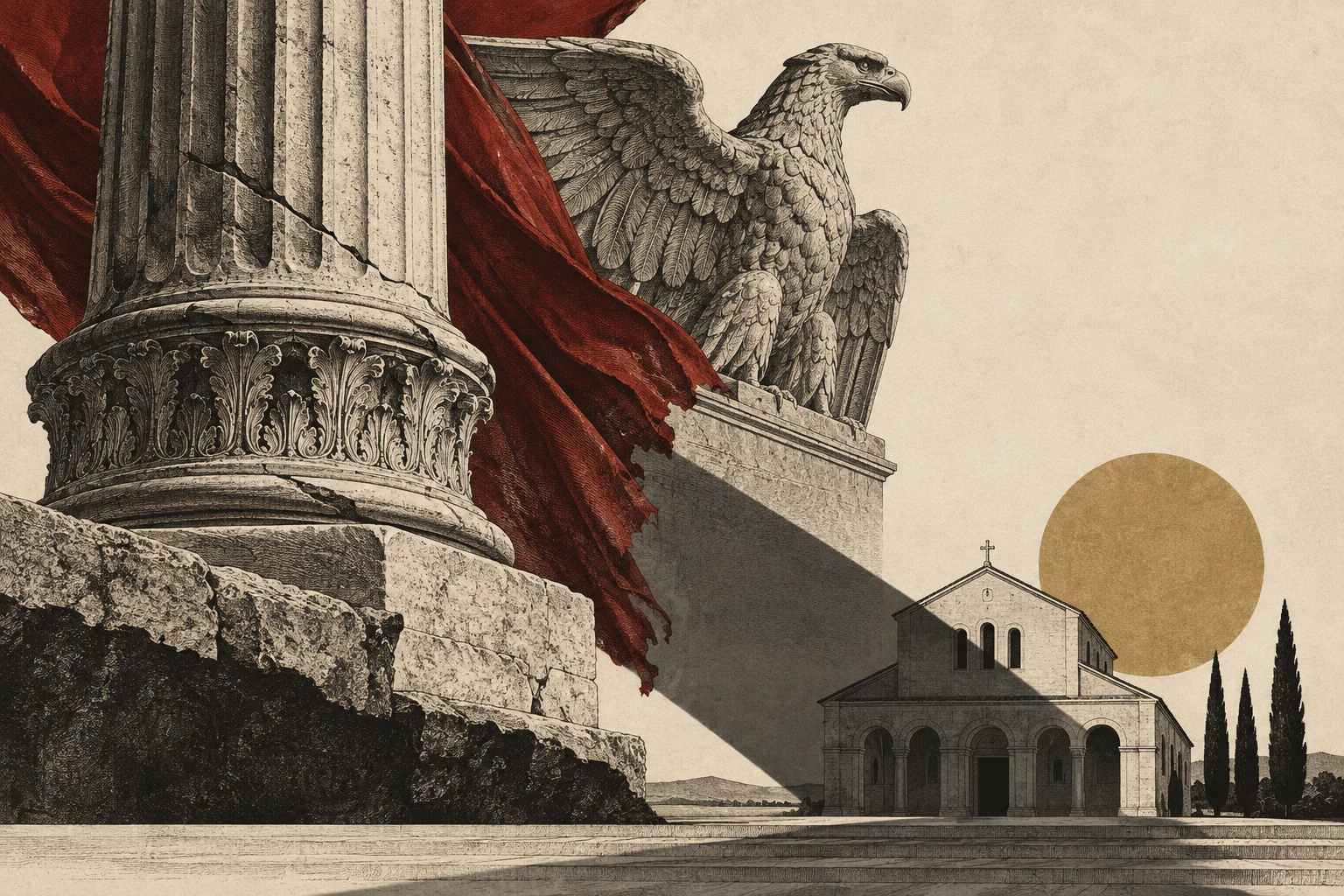
Any movement that lasts long enough will eventually draw the attention of power, and power seldom takes an interest in something it does not intend to use. The pattern is not peculiar to religion. Parties, guilds, universities, charitable foundations, and reform movements of every kind have been founded on a purpose and then captured by interests that had no share in the founding. What survives under the old name is frequently not the old thing.
Much of the modern case against Christianity rests on the conduct of the church in the Middle Ages. Inquisition, forced conversion, the sale of pardons, the wealth of prelates, and the wars fought under a cross are all part of the public record, and the record is not in dispute. Any honest account has to concede it rather than explain it away.
What follows is an argument about where that record came from. The Christianity that produced it was no longer the movement that began with Jesus and the apostles. It had been taken up by an empire and bent toward that empire's ends, and the corruption belongs in the first instance to the institution that did the bending.
The Empire That Went Looking for a Religion
The Roman world of the early fourth century had recently survived something close to dissolution. Between 235 and 284 the empire endured a half century of usurpation, invasion, plague, and currency collapse, with more than twenty men claiming the purple and few of them dying in bed. Diocletian arrested the decline by reorganising the administration and dividing the rule among four emperors, and one part of his settlement was a demand for religious conformity, enforced from 303 in the most severe persecution the church had yet faced.1
That settlement did not hold. The four rulers fell to fighting among themselves, and Constantine reached sole authority only after defeating Maxentius in 312 and Licinius in 324. The empire he governed was therefore not a ruin, but it was fractured, and it had no common allegiance binding its provinces, armies, and cities to one another. Diocletian had understood the problem and had tried to solve it by compelling reverence for the old gods. The attempt had failed within a decade.
Constantine appears to have judged that the unifying force the empire lacked might be supplied by the very body his predecessor had tried to destroy.
Why That Religion and No Other
This is the question on which the whole matter turns, because the empire was full of religions and any of them might have been chosen.
None of the others would have answered. The cults of the Roman world were mutually accommodating almost without exception. A new god could be received without any old god being dismissed, and Rome had absorbed the rites of Isis, Cybele, and Mithras on precisely those terms. The state asked for participation and not for belief. The younger Pliny, writing to Trajan around AD 112 about Christians brought before him in Bithynia, describes the test he applied: those who invoked the gods, made offering to the emperor's image, and cursed Christ were released, and he regarded the matter as settled by their conformity rather than by their conviction.2
A religion built on that principle can be added to a list. It cannot unify anything, because it has no means of excluding what competes with it.
Christianity had that means. It held that there is one God, that he had come into the world in Jesus Christ, and that every rival worship was therefore false. Peter states the ground of the exclusion before the Sanhedrin: "Neither is there salvation in any other: for there is none other name under heaven given among men, whereby we must be saved."3 A body making that claim could not be added to a list, and for two centuries the refusal had been the reason for its prosecution. Tacitus records that the Christians Nero punished were convicted less of arson than of what he calls hatred of the human race.4
Judaism was equally exclusive and equally refused the imperial cult, and Rome accommodated it by granting an exemption on the ground of ancient national custom. The temple offered sacrifice on the emperor's behalf rather than to him, and the arrangement held until the revolt.5 The exemption was extended to an ancestral nation, however, and not to a conviction, so it could not be claimed by a movement that was gathering Greeks, Syrians, and Romans out of every nation at once. Christianity was consequently the one body in the empire that both refused all rival worship and possessed no legal shelter for the refusal.
There was a second quality, and it completed the case. The church was not an insurrection. It armed no one and plotted against no throne. Justin Martyr told Antoninus Pius that the kingdom Christians looked for was not a human kingdom, and that the emperor had nothing to fear from men who expected it.6 Tertullian went further and said that Christians prayed for the emperors and for the stability of the empire.7 The teaching behind both statements is plain enough in the Gospels: "My kingdom is not of this world: if my kingdom were of this world, then would my servants fight, that I should not be delivered to the Jews: but now is my kingdom not from hence."8
For a ruler seeking an instrument, the combination was singular. Here was a body that would tolerate no rival allegiance in religion and offered no armed threat in politics.
The Instrument Acquired
The taking up was gradual, and its stages are documented.
In 313 Constantine and Licinius issued from Milan a grant of liberty in religion and ordered confiscated church property restored.9 Toleration is not establishment, and the more consequential measures came afterward and by degrees: exemption of clergy from civic burdens, the hearing of certain suits before bishops, public money for basilicas, and the right of churches to receive bequests. In 325 Constantine summoned the bishops to Nicaea, paid their travel, opened the proceedings himself, and enforced the result with imperial sanction.10 The doctrinal outcome of that council is a separate subject. The precedent set by the manner of it is the subject here, and the precedent was that the settlement of Christian teaching now carried the weight of the state, and that the state had an interest in what was settled.
Whether Constantine believed what he protected is disputed among historians and cannot be recovered with certainty. He deferred baptism until 337 and received it on his deathbed.11 The argument does not require an answer, because the institutional effect was the same either way.
The legal completion came under a later emperor. In 380 Theodosius I commanded from Thessalonica that all peoples under his rule hold the faith confessed at Nicaea, naming those who complied Catholic Christians and declaring the remainder heretics liable to divine and imperial punishment.12 From that point, error in doctrine was an offence at civil law. The fuller sequence, running from the local congregations of the second century to the territorial claims of the medieval papacy, is set out in a companion article on the origins of the Roman Catholic Church.13
What Becomes of a Message Inside a Corrupt Institution
The rest follows with a certain grim logic.
A message placed inside an organisation is transmitted by that organisation, and it is transmitted in the interest of whoever governs it. Where the governing interest is the maintenance of power, the parts of the message that serve the maintenance of power will be amplified, the parts that threaten it will be muted, and the whole will be gradually re-formed around the requirement. No conspiracy is needed to produce this. Institutions do it by their nature, and men who believe themselves faithful do it without noticing.
The church that entered the fourth century as a prosecuted minority left the sixth with property, courts, revenue, and the ear of kings, and the centuries that followed produced what the arrangement made probable. Christ had warned against this very shape of authority: "Ye know that the princes of the Gentiles exercise dominion over them, and they that are great exercise authority upon them. But it shall not be so among you: but whosoever will be great among you, let him be your minister."14 By 1302 the papacy was asserting in Unam Sanctam that both swords, spiritual and temporal, belong to the church, and that submission to the Roman pontiff is necessary to salvation for every human creature.15 Whatever that claim is, it is the reverse of the sentence in Matthew.
The Message and the Vessel
The conclusion is the point of the whole account, and it needs stating carefully, because it is easily heard as an evasion.
It is not a denial of the record. The excesses were real, they were committed by men holding office in the church, and the church of that period is answerable for them. What the account denies is the inference commonly drawn from the record: that because the institution was corrupt, the message it carried is discredited.
The two are not the same thing. The message came first and had been in the world for three centuries before any emperor took an interest in it, and it was the message that made the movement worth capturing. A corrupt custodian is evidence about the custodian. Paul put the distinction plainly: "But we have this treasure in earthen vessels, that the excellency of the power may be of God, and not of us."16 The vessel is expressly not the treasure, and the apostle expects the vessel to be poor.
Nothing an empire did in the fourth century, and nothing done in the name of the church in the centuries after it, altered a word of what Jesus and the apostles taught. The message survived its custodians, as it had survived its persecutors, and it remains the greatest message the world has ever received.
-
Lactantius, On the Deaths of the Persecutors 12-13, on the edict of February 303 and the destruction of the church at Nicomedia. ↩
-
Pliny the Younger, Letters X.96, to Trajan, c. AD 112. ↩
-
Acts 4:12, KJV. ↩
-
Tacitus, Annals XV.44, on the punishments following the fire of AD 64. ↩
-
Josephus, Jewish War II.197, on the sacrifices offered twice daily for Caesar, and Antiquities XIV.185-267, collecting the Roman decrees protecting Jewish observance. ↩
-
Justin Martyr, First Apology 11, addressed to Antoninus Pius, c. AD 155. ↩
-
Tertullian, Apology 30-32, c. AD 197. ↩
-
John 18:36, KJV. ↩
-
The rescript issued from Milan in 313, preserved in Lactantius, On the Deaths of the Persecutors 48, and Eusebius, Ecclesiastical History X.5. ↩
-
Eusebius, Life of Constantine III.6-14, on the summoning of the council and the emperor's part in it. ↩
-
Eusebius, Life of Constantine IV.61-62. ↩
-
Codex Theodosianus XVI.1.2, the Edict of Thessalonica, 27 February AD 380. ↩
-
"Where Did the Catholic Church Come From?", Theology in Focus, https://theologyinfocus.org/blog/where-did-the-catholic-church-come-from/ ↩
-
Matthew 20:25-26, KJV. ↩
-
Boniface VIII, Unam Sanctam, 18 November 1302. ↩
-
2 Corinthians 4:7, KJV. ↩