Presbyterian is not a doctrine. It is a form of government, and the name says so.
The word comes from the Greek presbuteros, elder. A presbyterian church is one governed by elders sitting in graded assemblies, rather than by bishops above congregations or by each congregation alone. That single structural conviction, drawn from the way the New Testament describes church order, is what the name identifies.
The theology usually attached to it is Reformed, and it came from Geneva. The government came from Scotland.
Geneva Supplies the Theology
John Calvin (1509 to 1564) was a French lawyer by training who published the first edition of the Institutes of the Christian Religion in 1536 at the age of twenty-six, revising and expanding it until the definitive edition of 1559. Detained in Geneva by William Farel, expelled in 1538, and recalled in 1541, he spent the rest of his life organising a city church.
What Calvin contributed was not the doctrine of election, which he inherited from Augustine and shared with Luther, but a worked-out account of how a church should be ordered. The Ecclesiastical Ordinances of 1541 set out four offices: pastors, teachers, elders, and deacons. Discipline was exercised by a consistory of pastors and elders rather than by a bishop or a magistrate.
Geneva became a place of refuge for Protestants fleeing persecution elsewhere, and they carried the pattern home. Among them was a Scot.
Scotland Supplies the Government
John Knox (c. 1514 to 1572) had served as a galley slave in the French fleet after the siege of St Andrews, spent time in England under Edward VI, and settled for a period in Geneva, which he described as the most perfect school of Christ since the days of the apostles.
He returned to Scotland in 1559 into a political situation that made reformation possible. In August 1560 the Scottish Parliament abolished papal jurisdiction and adopted the Scots Confession, drafted in four days by Knox and five colleagues. The First Book of Discipline followed the same year, proposing a national system of schools, poor relief, and church courts.
Two features of the Scottish settlement shaped everything after it. Government was by assemblies of elders and ministers rather than by bishops, and the church claimed a jurisdiction distinct from the crown. That second claim produced a century of conflict.
The Westminster Assembly
The most consequential Presbyterian documents were produced in England rather than Scotland.
The Westminster Assembly met from 1643, convened by the Long Parliament during the civil wars, with Scottish commissioners present. It produced the Westminster Confession of Faith in 1646, together with the Larger and Shorter Catechisms and a Directory for Public Worship.
The Confession is the most widely adopted Reformed confession in the English-speaking world, and the Shorter Catechism's first question and answer is probably the best known sentence in the tradition: man's chief end is to glorify God, and to enjoy him forever.
The irony is that these documents failed in the country that produced them. England did not remain Presbyterian. Scotland adopted them, and the Presbyterian settlement there was secured at the Revolution of 1690.
Ulster, and Then America
Presbyterianism reached America chiefly through Ulster. Scots settled in the north of Ireland in large numbers during the seventeenth century, and economic pressure and religious disability pushed many of them across the Atlantic in the eighteenth.
Francis Makemie (1658 to 1708), an Ulster Scot ordained in Ireland, organised the first American presbytery at Philadelphia in 1706. The first synod followed in 1717.
Growth brought division almost immediately. The revivals of the 1740s split American Presbyterians into Old Side and New Side over the propriety of itinerant preaching and the assessment of conversion experiences. They reunited in 1758. The pattern of division and reunion repeated through the nineteenth and twentieth centuries, over slavery, over subscription to the Confession, and over the interpretation of Scripture. The 1837 division into Old School and New School, the sectional split during the Civil War, and the fundamentalist and modernist controversy of the 1920s and 1930s all left denominational bodies behind.
Anyone using the word Presbyterian in America today should be aware that it names several distinct denominations that differ substantially, not one church.
What Presbyterians Actually Hold
The theology is Reformed. God's sovereignty extends to salvation, which is understood as God's work from beginning to end rather than a cooperative effort. Scripture is the supreme authority, and the Confession is subordinate to it while binding on office bearers.
Covenant theology supplies the framework for reading Scripture as one continuous story of God's dealing with his people, which is also the ground on which Presbyterians baptise the children of believers.
Worship is ordinarily plain, with emphasis on the preached word.
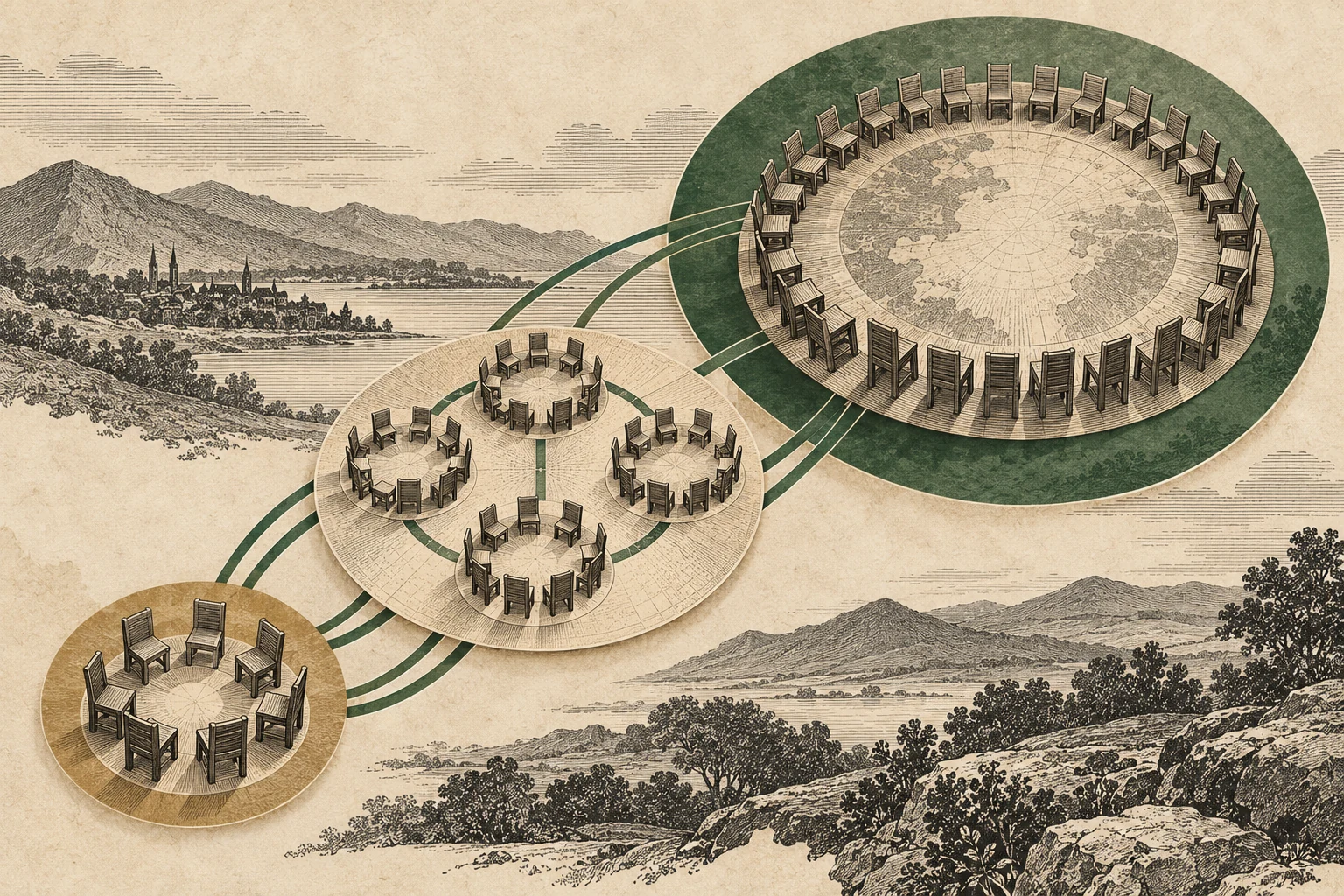
The government is the distinguishing mark. A congregation is governed by a session of elders; congregations together form a presbytery; presbyteries form a synod or general assembly. No individual holds authority alone, and no congregation stands alone. That structure was designed to guard against both episcopal overreach and congregational isolation.
What the Story Actually Shows
Two things follow from the record.
The first is that Presbyterianism has always insisted that church order is a matter of obedience rather than convenience. Whether the New Testament prescribes a form of government, or merely permits several, is a genuine disagreement among Christians. Presbyterians have historically held the stronger position, and their history of dividing over it is a direct consequence.
The second is that the tradition's greatest strength and its recurring weakness are the same trait. A church governed by graded assemblies with written standards is remarkably resistant to the whims of a single leader. It is also remarkably prone to schism, because a written standard can be disagreed with precisely.
For readers tracing their own tradition, the Presbyterian case is the clearest example of the conviction that how a church is governed is itself a theological question.