Every other article in this series can name a founder and a date. This one cannot, and the reason is the whole point.
The Eastern Orthodox Church does not describe itself as having been founded in the sense the others were. It claims to be the church of the apostles, continuing without interruption, from which others departed. Whether that claim succeeds is a genuine dispute between Orthodox, Roman Catholic, and Protestant Christians, and it cannot be settled by simply reporting dates.
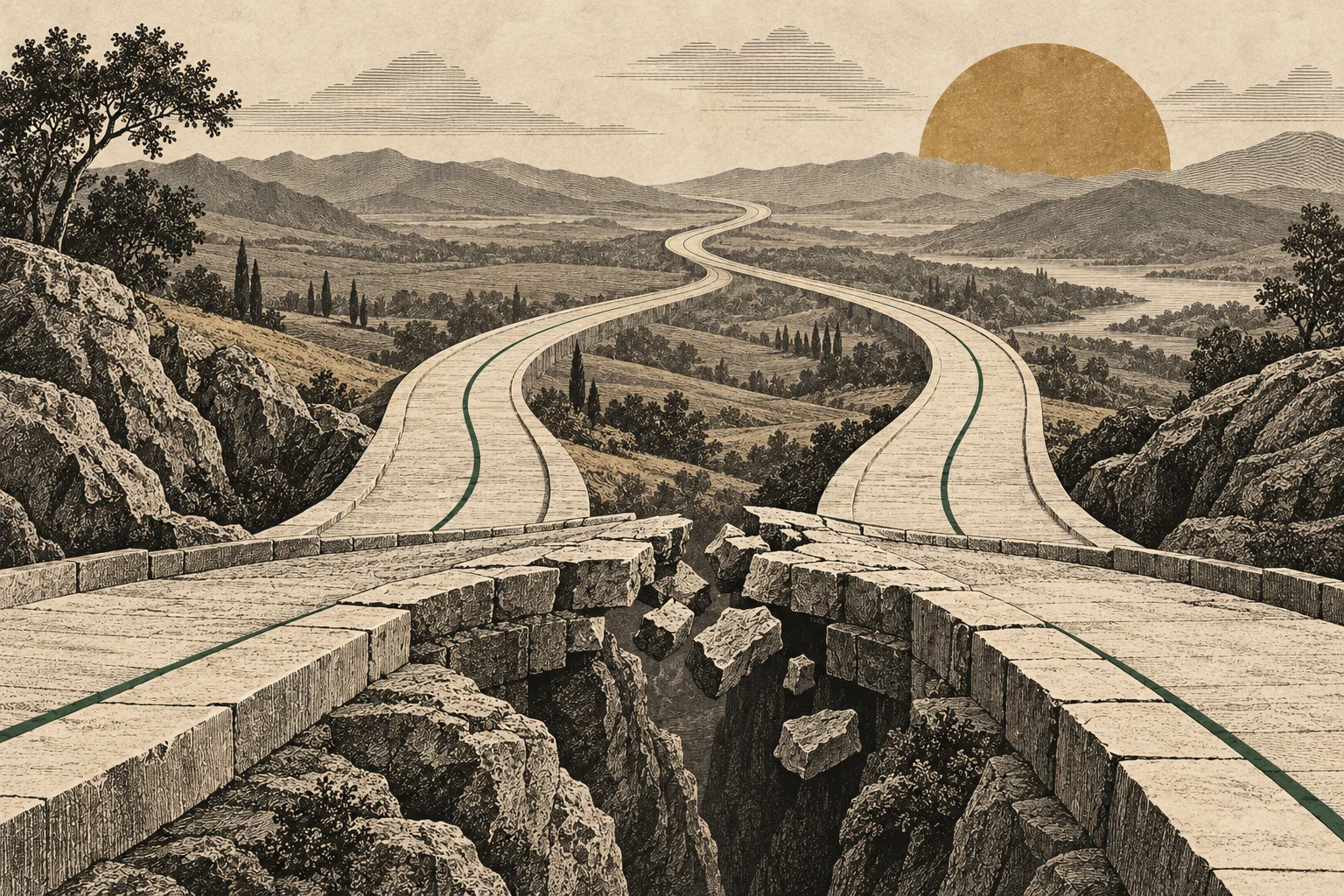
What can be described is how the Christian world came to be divided between East and West, and that story is longer and less dramatic than the single date usually given for it.
A Gradual Divergence
For the first several centuries there was one church across the Roman world, with recognised centres at Rome, Constantinople, Alexandria, Antioch, and Jerusalem. Its doctrine was settled at councils attended by bishops from across the empire. The Orthodox recognise seven of these as ecumenical, from Nicaea in 325 to the Second Council of Nicaea in 787.
Several pressures pulled East and West apart over centuries.
Language was the first. The East thought and worshipped in Greek, the West increasingly in Latin. By the ninth century few theologians in either half read the other's language well, which meant they read each other in translation or not at all.
Politics was the second. The founding of Constantinople in 330 gave the East an imperial capital. When imperial authority collapsed in the West, the bishop of Rome inherited a civil role that eastern bishops never held, and developed a correspondingly larger conception of his office.
Theology was the third, and it centred on a single word. The Nicene Creed as agreed at Constantinople in 381 states that the Spirit proceeds from the Father. Western churches came to recite it with the addition filioque, and from the Son. The addition appeared regionally in Spain from the Third Council of Toledo in 589, spread through the Frankish realms, and was eventually adopted at Rome in the early eleventh century. The eastern objection was twofold: that the addition was theologically mistaken, and that no local church had authority to alter a creed settled by an ecumenical council.
The iconoclast controversy of the eighth and ninth centuries, resolved in favour of images at Nicaea in 787 and commemorated as the Triumph of Orthodoxy in 843, also shaped eastern identity in ways the West did not share.
The Date Everyone Cites
In 1054 papal legates led by Cardinal Humbert laid a bull of excommunication on the altar of Hagia Sophia against Patriarch Michael Cerularius, who excommunicated the legates in return.
This is universally given as the date of the Great Schism, and historians of every confession now treat that as an oversimplification. The excommunications were personal rather than institutional. The pope who sent the legates had died before they acted, which raised questions about their authority. Communion between East and West continued in places for some time afterward, and contemporaries did not regard the episode as a final rupture.
What made the division permanent was violence. In 1204 the armies of the Fourth Crusade, diverted from their objective, sacked Constantinople, desecrated churches, and installed a Latin patriarch. Eastern Christians who had regarded western Christians as mistaken now regarded them as enemies. Attempts at reunion at Lyon in 1274 and at Florence in 1439 produced agreements that eastern populations refused to accept.
Constantinople fell to the Ottomans in 1453. The Orthodox churches survived four centuries under Muslim rule, and the centre of Orthodox numbers and resources shifted north to Russia, whose church had been received from Constantinople in 988.
How Orthodoxy Is Organised
Orthodoxy consists of a family of self-governing, or autocephalous, churches in communion with one another: Constantinople, Alexandria, Antioch, Jerusalem, Russia, Serbia, Romania, Bulgaria, Georgia, Greece, and others.
The Ecumenical Patriarch of Constantinople holds a primacy of honour and does not govern the other churches. This is the structural difference from Rome that matters most, and it explains both the resilience of Orthodoxy under hostile governments and its difficulty in resolving disputes between national churches.
What Orthodox Christians Actually Hold
Holy Tradition is the framework: Scripture, the seven ecumenical councils, the liturgy, the fathers, and the icons are understood as one continuous transmission rather than as Scripture plus additions.
Salvation is commonly described as theosis, participation in the divine life, restoring what was lost in Adam. Eastern theology has generally not framed salvation in the juridical terms that shaped Western thought after Anselm, and this difference of framing accounts for a great deal of mutual misunderstanding.
Icons are venerated rather than worshipped, a distinction the Seventh Council was convened to establish, and one that Protestant readers should understand before assessing the practice.
The Divine Liturgy, chiefly that of John Chrysostom, is the centre of Orthodox life, and its text has been substantially stable for well over a thousand years.
What the Story Actually Shows
Three observations follow.
The first is that the popular account of 1054 is misleading in both directions. The division was neither sudden nor complete on that date. It took roughly four centuries to form and was sealed by a military atrocity rather than by a theological verdict.
The second is that the filioque dispute is not the trivial technicality it is sometimes made out to be. Underneath the word lies a real question about whether any part of the church may alter what a universal council determined. That is a question about authority, and it is the same question in a different form that the sixteenth century raised again.
The third is that Orthodoxy poses a genuine challenge to Protestant assumptions, and it should be stated rather than avoided. A tradition claiming unbroken continuity, with a liturgy older than any Protestant body and councils that Protestants also accept, cannot be dismissed as a late corruption in the way Reformation polemic sometimes attempted.
For readers tracing their own tradition, the Orthodox case is the reminder that the sixteenth-century split was the second great division in Christian history, not the first, and that half of the Christian world was not party to it at all.