The Roman Catholic Church answers this question by pointing to Peter and claiming an unbroken succession of bishops from the apostles to the present. That claim is a matter of genuine dispute, and no article of this length will settle it.
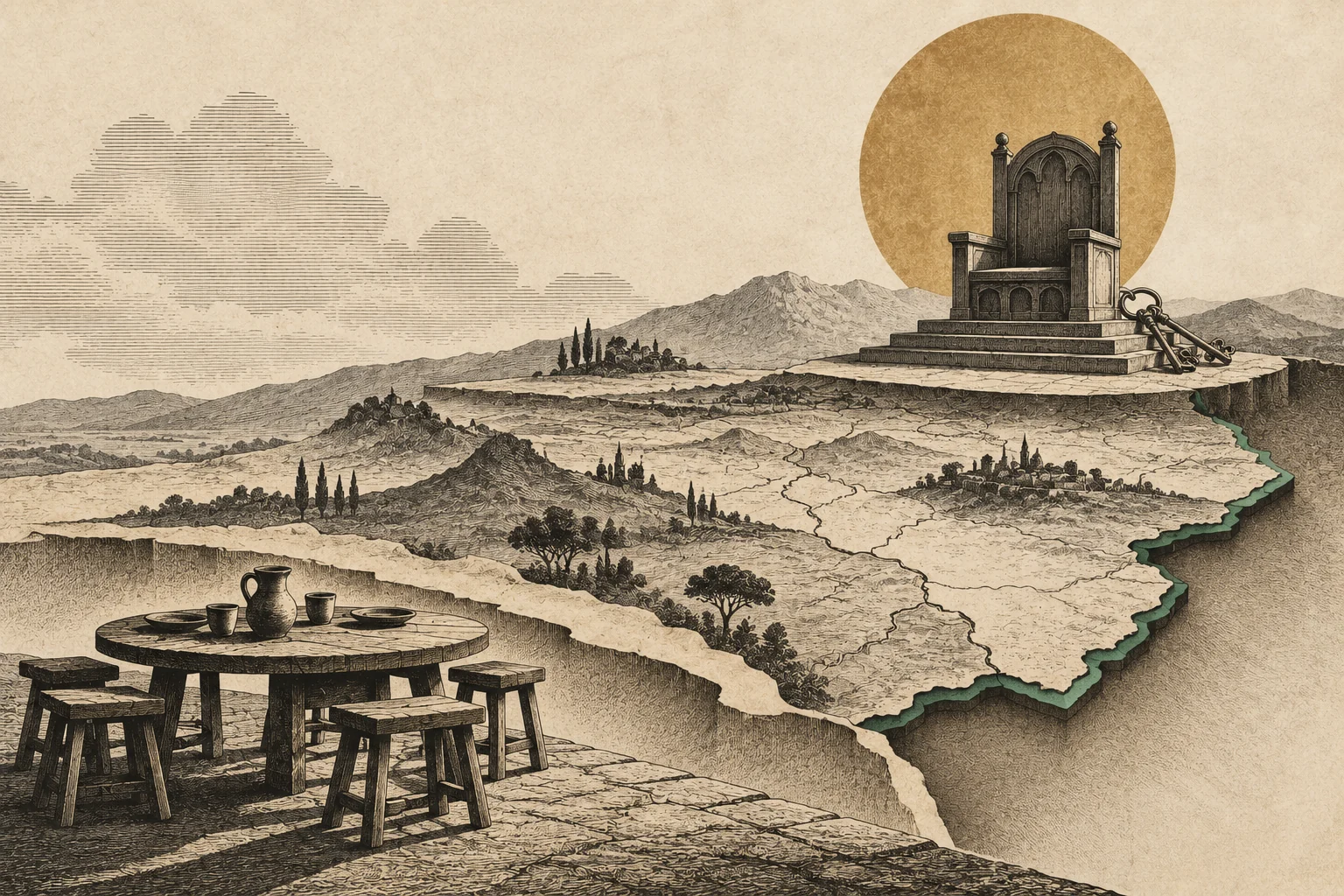
A different question can be answered, and the record for it is public and well documented. The church that meets in the New Testament is a network of local congregations with no central government, no legal standing, and no political power whatever. Twelve centuries later the bishop of Rome commands armies, crowns emperors, rules territory in central Italy, and claims authority over every temporal ruler in Christendom. That transformation did not happen at once, and it did not happen by accident. It happened in stages, and each stage can be dated.
The Local Church
For roughly the first three centuries the churches were local congregations. Each had its own overseers and deacons, and the New Testament speaks of these officers in the plural within a single city. Congregations corresponded, sent relief to one another in famine, and received travelling teachers, but no bishop governed another bishop's church and no see collected revenue from another.
The word catholic belongs to this period and meant something modest. Ignatius of Antioch, writing to the church at Smyrna around AD 107, states that wherever Christ is, there is the catholic church.1 He means universal, the whole company of believers everywhere, as opposed to a faction. The word described an attribute of the church long before it named an institution, and reading the later institution back into the earlier word is the most common error made about this subject.
The situation of these congregations was precarious. Christianity was not a permitted religion. Persecution came in waves, most severely under Decius in 250 and under Diocletian from 303. A church that could be prosecuted for existing accumulated no political power at all.
Constantine: The Hinge
The change begins with an emperor rather than a bishop.
In 313 Constantine and Licinius issued from Milan a policy of toleration, granting Christians and everyone else liberty to follow the religion they chose and ordering confiscated church property restored.2 Toleration is not establishment, and Constantine did not make Christianity the religion of the empire. What he did was more gradual and, in the long run, more consequential. He exempted clergy from civic burdens, granted bishops authority to hear certain legal cases, funded the construction of basilicas from public money, and gave the church the right to receive bequests.
In 325 he summoned the bishops to Nicaea to settle the Arian controversy, paid for their travel, presided at the opening, and enforced the outcome with imperial sanctions. The precedent set there was not a doctrinal one. It was that the settlement of Christian doctrine now carried the weight of the state, and that the state had an interest in the result.
Within a generation the church had acquired what it had never possessed: property, legal privilege, public revenue, and a direct relationship with imperial power. Bishops who had recently faced prosecution now advised emperors.
Theodosius: Establishment
The decisive legal step came later, and it is the step usually credited to Constantine by mistake.
In 380 Theodosius I issued from Thessalonica an edict commanding all peoples under his rule to hold the faith confessed at Nicaea, naming those who did so Catholic Christians and declaring the rest heretics who must expect divine punishment and imperial action.3 In 381 the Council of Constantinople confirmed the Nicene settlement, and through the following decade sacrifice in the old temples was prohibited outright.4
The consequence is difficult to overstate. Doctrinal error was now a civil offence. The church gained the coercive power of the empire, and the empire gained a religious sanction for its authority. Every later development of Roman power rests on this foundation.
Filling the Vacuum
Imperial authority in the West then collapsed, and the bishop of Rome inherited what it left behind.
Leo I, bishop from 440 to 461, argued the Roman see's primacy in explicitly juridical terms and, when Attila's forces approached Rome in 452, met them as the city's effective representative. Gregory I, bishop from 590 to 604, administered the grain supply, paid troops, negotiated with the Lombards, and governed the estates of the Roman church as a working civil administration.5 Neither man seized power. Both filled a vacuum left by an empire that had ceased to function in the West, and the office they left behind was larger than the one they received.
Formal temporal rule followed. In 756 Pepin, king of the Franks, granted the papacy territory taken from the Lombards, creating the Papal States, which the popes would rule until 1870.6 On Christmas Day in 800 Leo III placed a crown on Charlemagne, establishing a precedent that imperial legitimacy came through Rome.
The claim was also supported by a document. The Donation of Constantine purported to record the emperor's grant of Rome and the western provinces to Pope Sylvester. It was cited for centuries in support of papal territorial authority and it is a forgery, composed in the eighth or ninth century and demonstrated to be false on linguistic grounds by Lorenzo Valla in 1440.7
The Height
The logic reached its conclusion in the eleventh through fourteenth centuries.
Gregory VII asserted in 1075 that the pope may depose emperors and that all princes owe him the kiss of the feet.8 Two years later Henry IV stood in the snow at Canossa seeking absolution. Innocent III, pope from 1198 to 1216, arbitrated imperial elections, laid whole kingdoms under interdict, and received England as a papal fief. In 1302 Boniface VIII declared in Unam Sanctam that both swords, spiritual and temporal, belong to the church, and that submission to the Roman pontiff is necessary for salvation for every human creature.9
A body that began as congregations meeting in houses under threat of prosecution now claimed, as a matter of doctrine, authority over every ruler on earth.
What the Story Shows
Roman Catholics read this history differently, and the difference should be stated plainly rather than smoothed over. They see development rather than accumulation: an authority present in seed from the beginning, unfolding as circumstances required it, much as doctrine itself developed without becoming a different doctrine. That reading is coherent and it is held by serious historians.
The alternative reading, held across the Protestant traditions and in a different form in the East, is that each stage was an addition, that political power altered the institution which acquired it, and that the church of Ignatius and the church of Boniface VIII are not the same thing wearing different clothes.
What is not in dispute is the sequence. The congregations came first. Toleration came in 313, establishment in 380, territorial rule in 756, and the claim to universal temporal supremacy in 1302. Whatever conclusion is drawn from that sequence, it is the necessary background to every article that follows in this series, because every division treated here is in some measure a response to it.
-
Ignatius of Antioch, Letter to the Smyrnaeans 8.2, c. AD 107. ↩
-
The rescript issued from Milan in 313, preserved in Lactantius, On the Deaths of the Persecutors 48, and Eusebius, Ecclesiastical History X.5. ↩
-
Codex Theodosianus XVI.1.2, the Edict of Thessalonica, 27 February AD 380. ↩
-
Codex Theodosianus XVI.10.10-12, AD 391 and 392. ↩
-
Gregory I, Register of Letters, particularly the correspondence on the Lombard negotiations and the administration of the papal patrimony. ↩
-
Liber Pontificalis, Life of Stephen II, on the grant of 756. ↩
-
Lorenzo Valla, De falso credita et ementita Constantini donatione declamatio, 1440. ↩
-
Dictatus Papae, 1075, propositions 9 and 12. ↩
-
Boniface VIII, Unam Sanctam, 18 November 1302. ↩