Methodism did not begin as a church. It began as a nickname, and an unkind one.
In 1729, a small group of students at Christ Church, Oxford, began meeting for prayer, fasting, frequent communion, and the systematic study of Scripture. They visited prisoners at the Castle and Bocardo gaols, taught poor children, and kept written accounts of how they spent every hour. Their contemporaries found the whole enterprise ridiculous and called them the Holy Club, the Bible Moths, and, most durably, the Methodists, on account of the methodical rigour of their devotion.1 The leaders of that group were two brothers, John Wesley (1703 to 1791) and Charles Wesley (1707 to 1788), sons of an Anglican rector at Epworth in Lincolnshire.
The name stuck. The movement it eventually described took another half century to become a separate church, and it did so largely against the wishes of the man who founded it.
A Failed Mission and a Warmed Heart
John Wesley was ordained in the Church of England and remained an Anglican priest until his death. In 1735 he sailed for the new colony of Georgia as a missionary, an undertaking he later judged a failure. What impressed him on that voyage was not his own preaching but the conduct of a group of Moravian passengers who sang calmly through a storm that terrified everyone else aboard. Wesley, who was frightened, understood that they possessed an assurance he did not.
The turning point came on 24 May 1738, at a meeting in Aldersgate Street, London. Someone was reading aloud from Luther's preface to the Epistle to the Romans. Wesley recorded the moment in his journal: "I felt my heart strangely warmed. I felt I did trust in Christ, Christ alone, for salvation; and an assurance was given me that He had taken away my sins, even mine, and saved me from the law of sin and death."2
That sentence is the hinge of Methodist history. Wesley had been devout, disciplined, and ordained for over a decade. What he lacked, by his own account, was the settled assurance that his sins were forgiven. Methodism afterward preached that assurance as something an ordinary believer could expect, not a rare gift reserved for the unusually holy.
Preaching in the Fields
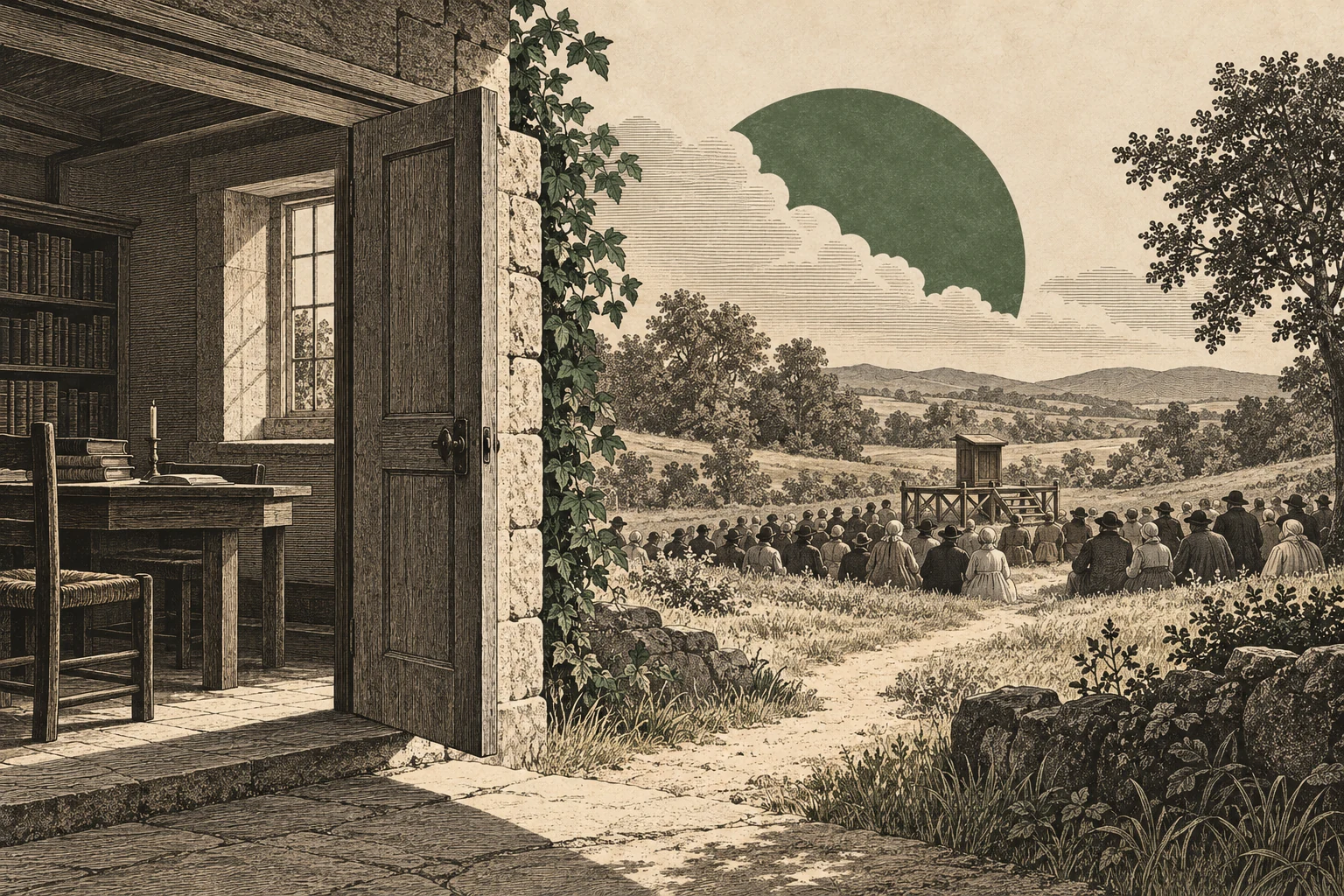
The movement grew because Wesley took the gospel outdoors, and he did so reluctantly.
George Whitefield (1714 to 1770), another member of the Oxford group, began preaching in the open air to the colliers at Kingswood near Bristol early in 1739. The parish churches were closing to him, and the miners were not coming to church in any case. Whitefield urged Wesley to join him. Wesley, who preferred order and thought the practice nearly indecent, submitted on 2 April 1739 and preached in a field near Bristol to about three thousand people. He wrote afterward that he had "submitted to be more vile."3
Field preaching put the movement within reach of people the parish system was not touching: miners, weavers, labourers, and the urban poor of a country in the early stages of industrial change. Wesley organised converts into societies, and the societies into small groups called classes, each with a leader responsible for the spiritual state of about a dozen members. Lay preachers, who were not ordained, carried the work between towns. Wesley himself rode an estimated quarter of a million miles on horseback over fifty years.
The structure mattered as much as the preaching. Revivals commonly produce enthusiasm and then dissipate. Methodism produced enthusiasm and then organised it.
The Break with Whitefield
The movement divided early over predestination. Whitefield held to a Calvinist account of election. Wesley preached an Arminian one, insisting that the atonement was offered to all and that grace could be resisted. Wesley's sermon "Free Grace," published in 1739, made the disagreement public and the friendship painful.
The two men eventually reconciled personally, and Wesley preached at Whitefield's memorial service in 1770. The division nonetheless persisted institutionally, producing Calvinistic Methodism, strongest in Wales, alongside the Wesleyan stream that carried the name in England and America. Anyone tracing Methodist origins should notice that the movement was theologically contested from the beginning, and that its dominant Arminian character was a decision rather than an inheritance.
How a Movement Became a Church
Wesley never intended to leave the Church of England. He instructed his preachers not to hold services at hours that competed with parish worship, and he told the Methodist conference repeatedly that they were a society within the church, not a rival to it.
Two pressures broke that arrangement, and both concerned the American colonies.
After the Revolution, Methodists in America were left without clergy able to administer the sacraments. The Bishop of London declined to ordain men for the work. In 1784 Wesley, holding that in the New Testament a presbyter and a bishop were the same order, took the step of setting apart Thomas Coke as superintendent for America and ordaining others to serve under him. In doing so he acted outside the authority his own church recognised. At the Christmas Conference in Baltimore in December 1784, the Methodist Episcopal Church was constituted as a distinct body, with Coke and Francis Asbury as its superintendents.4
In the same year Wesley executed the Deed of Declaration, which gave the British conference of preachers a legal identity capable of surviving him. He died on 2 March 1791. In 1795, four years later, the Plan of Pacification permitted Methodist preachers in Britain to administer the sacraments in their own chapels, which completed in practice a separation Wesley had spent his life resisting.
What the Story Actually Shows
Three observations follow from the record.
The first is that Methodism began as a renewal movement inside an existing church and became a separate one by increments, each of them a response to a pastoral necessity rather than a doctrinal quarrel with Anglicanism. Methodists did not leave over the Thirty-nine Articles. They left because people needed sacraments and preachers, and the existing structure would not supply them.
The second is that the emphasis on assurance, on holiness of life, and on disciplined accountability in small groups was not incidental to the movement but constitutive of it. Methodist theology is best understood as a theology of the ordered Christian life.
The third is that a movement's founder does not control its outcome. Wesley died an Anglican priest, and the church that bears his method was fully separate within four years of his burial.
For readers tracing their own tradition, the Methodist case is a useful corrective to the assumption that denominations begin in argument. This one began in a study at Oxford, with a handful of students who kept a timetable.
-
Richard P. Heitzenrater, Wesley and the People Called Methodists, 2nd ed. (Nashville: Abingdon Press, 2013), 39 to 44. ↩
-
John Wesley, Journal, entry for 24 May 1738. ↩
-
John Wesley, Journal, entry for 2 April 1739. ↩
-
Frank Baker, John Wesley and the Church of England (London: Epworth Press, 1970), 253 to 270. ↩
You May Also Enjoy
 Where Did the Congregational Church Come From?
 Where Did the Baptist Church Come From?
 Lesson 5: Shepherding with a Tender Heart — 1 Thessalonians 2:7-9
 Where Did the Anglican Church Come From?
 Catholics vs. Anglicans: The Real Difference
 Lesson 6: Called into His Kingdom and Glory — 1 Thessalonians 2:10-12