Few words are used more often and understood less clearly than the word sin. In common speech it has shrunk to a label for obvious wrongdoing, a category reserved for crimes and scandals. Scripture uses the word with far greater weight. Sin there is not merely a list of forbidden acts but a condition of the whole person, a settled disposition of the heart that expresses itself in what a person thinks, desires, and does. To ask what sin is, therefore, is to ask what has gone wrong with humanity at its root, and any answer that stops at behavior has stopped too soon.
The Biblical Vocabulary
The biblical writers did not work with a single term. They reached for several, and each exposes a different face of the same reality. The most common Hebrew word, chatta't, carries the sense of missing a mark or failing to reach a target.1 The Greek equivalent, hamartia, does the same, and Paul draws on it when he writes that all "have sinned, and come short of the glory of God."2 A second family of words, pesha' in Hebrew and anomia in Greek, describes rebellion and lawlessness, a deliberate crossing of a boundary that God has set. John states the matter plainly: "sin is the transgression of the law."3 A third term, 'avon, points to crookedness or distortion, a bending of what was meant to be straight.
Taken together these words form a single portrait. Sin is a failure to reach the standard, a rebellion against the One who set it, and a corruption of the nature that was made to keep it. No one of these descriptions is adequate alone. Held together they show that sin is at once a shortfall, a defiance, and a deformity.
Nature Before Act
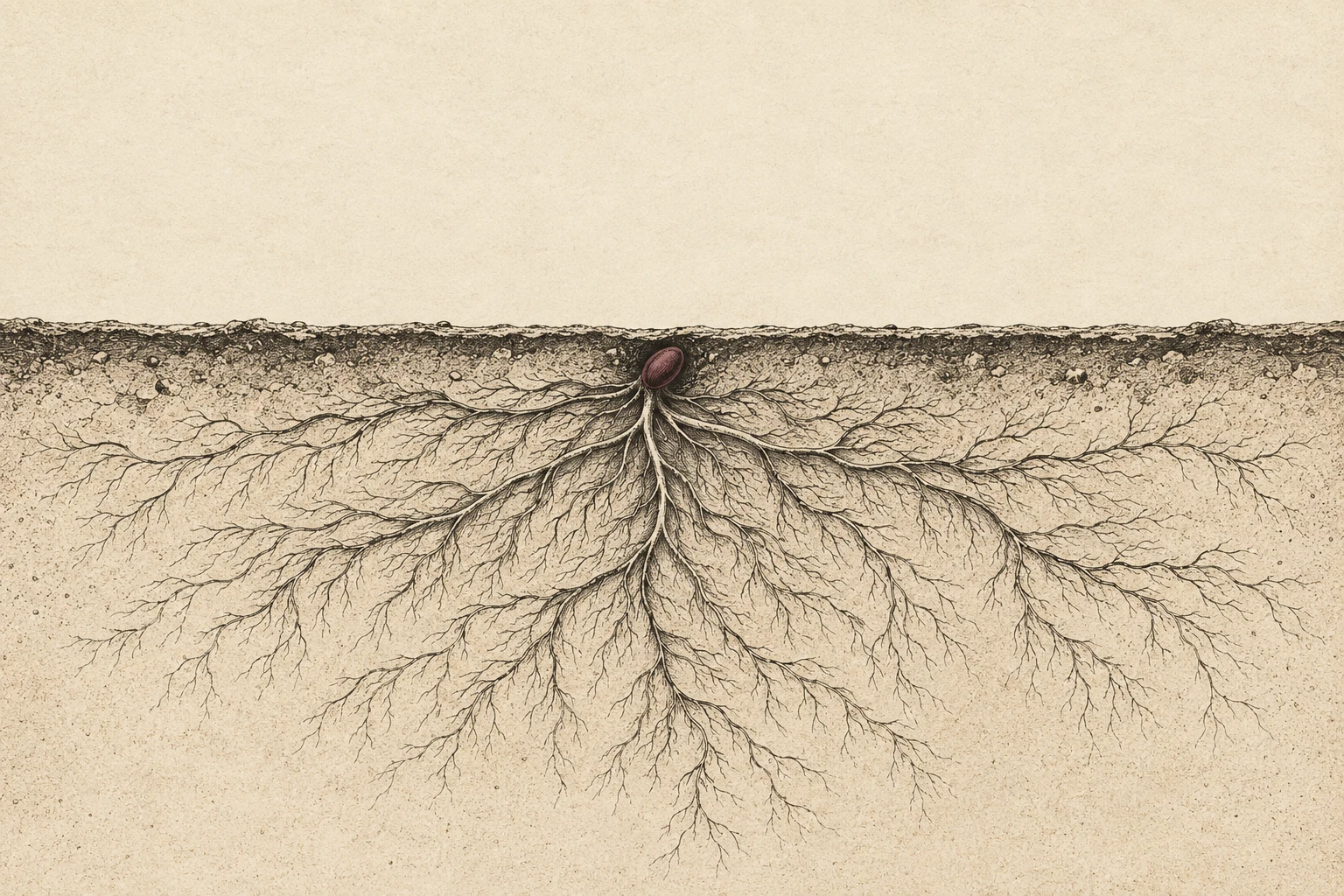
The most important claim Scripture makes about sin is also the one most often missed. Sin is a nature before it is an act. A person does not become a sinner by sinning; a person sins because he is already a sinner by nature. The Lord traced conduct back to character when He taught that "a corrupt tree bringeth forth evil fruit," locating the problem in the root rather than the branches.4 David reached the same conclusion about himself, confessing that he was "shapen in iniquity" and conceived in sin, which is to say that the disorder preceded any deed he could name.5 Paul described the whole race as "by nature the children of wrath."6
This is the doctrine the church has long called total depravity, though the phrase is easily misread. It does not mean that every person is as wicked as he could possibly be, nor that human beings are incapable of acts that appear kind or noble. It means that sin has reached every part of human nature, the mind, the will, and the affections alike, so that no faculty remains untouched and able to save itself.7 The corruption is total in extent, not total in degree. The published teaching of this ministry has already made the same point in a different key, that sin affects the whole person without making every person as evil as possible.8
Against God First
Sin is also, first and finally, against God. This is what distinguishes the biblical understanding from a merely social account of wrongdoing. When David had sinned grievously against Bathsheba and Uriah, harming them in ways he could never undo, he still prayed, "Against thee, thee only, have I sinned, and done this evil in thy sight."9 He did not mean that no human being had been wronged. He meant that every wrong done to a neighbor is at the same time a wrong done to the God who made that neighbor and who gave the law under which the wrong was committed. Sin has a horizontal cost, and that cost is real, but its deepest offense is vertical. This is why sin cannot be measured only by the damage it does among people, and why it cannot be resolved by human reconciliation alone.
Where Sin Began and Where It Leads
Scripture does not present sin as an eternal feature of the world but as an intrusion into it. The account of the Fall in Genesis describes a real event, a movement from doubt to desire to deed, in which the first man and woman set their judgment above the word of God.10 Paul teaches that through that one act sin entered the world, and death through sin, so that the disorder was passed to the whole family that followed.11 The consequence is not arbitrary. "The wages of sin is death," a verdict that touches body, relationship, and the created order itself.12 Left to itself, sin does not remain static. It grows, and it carries a penalty that no sinner can pay.
Why the Definition Matters
Defining sin correctly is not a matter of academic precision only. A shallow definition produces a shallow gospel. If sin is merely bad behavior, then the remedy is better behavior, and a person may hope to correct the account by his own effort. If sin is a nature, a rebellion, and an offense against God Himself, then no amount of moral improvement can reach the problem, and the sinner needs something he cannot supply. That is precisely the point at which the good news begins, for the same Scripture that diagnoses the condition also announces the One who came to deal with it. The doctrine of sin, rightly understood, does not leave a person in despair. It sends him to look outside himself for a remedy equal to the disease.
Thus the only remedy for sin is the new birth, a change that God alone can work. This is why the Lord Jesus said, "Ye must be born again."13
Scripture quotations are from the King James Version.
-
On the Hebrew and Greek vocabulary of sin, see the standard lexical treatments of chatta't, pesha', 'avon, hamartia, anomia, and parabasis. ↩
-
Romans 3:23. ↩
-
1 John 3:4. ↩
-
Matthew 7:17. ↩
-
Psalm 51:5. ↩
-
Ephesians 2:3. ↩
-
This is the historic Reformed and Augustinian understanding of the extent of human corruption, later summarized in the confessional tradition. It is cited here as the church's considered reading of Scripture rather than as a claim beyond the text. ↩
-
Theology in Focus, "We Freely Admit We Are Sinners," theologyinfocus.org. ↩
-
Psalm 51:4. ↩
-
Genesis 3:1 through 6. ↩
-
Romans 5:12. ↩
-
Romans 6:23. ↩
-
John 3:7. ↩