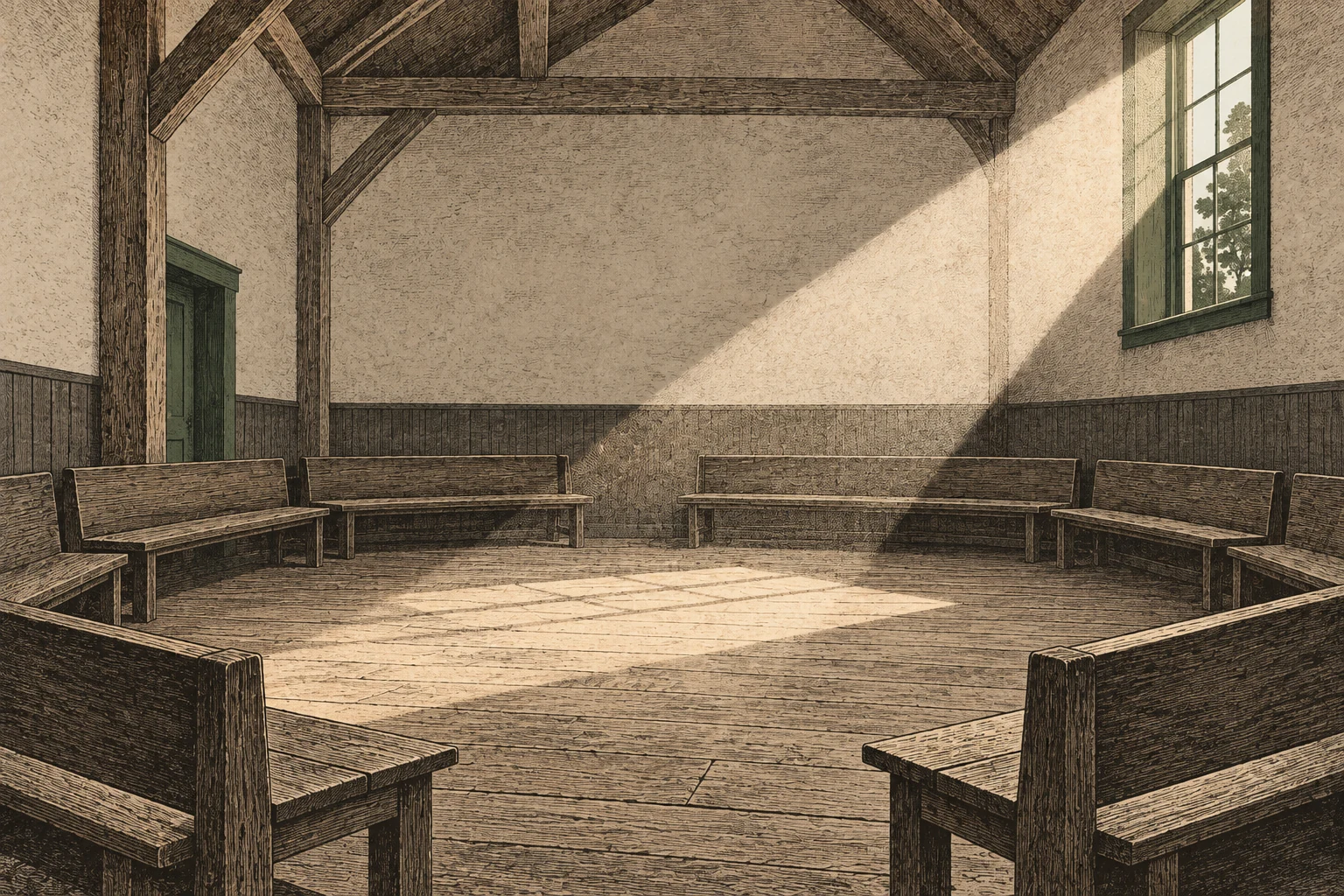
The proper name is the Religious Society of Friends. Quaker was an insult, and like most of the insults in this series it became the name everyone uses.
According to the traditional account, George Fox was brought before Justice Gervase Bennet at Derby in 1650 and told the magistrate to tremble at the word of the Lord. Bennet called him a quaker in return. Fox recorded the exchange in his journal, and the name attached itself to the movement.1
The Friends emerged in England in the 1650s, in the aftermath of civil war, at a moment when the established order of church and state had collapsed and every religious question seemed open again.
A Seeker Who Stopped Seeking
George Fox (1624 to 1691) was a weaver's son from Leicestershire. He left home around 1643 and spent several years travelling, consulting clergymen and separatist teachers, and finding none of them able to speak to his condition.
The turning point, as he described it, came when he had exhausted every human counsellor. He wrote that when all his hopes in them were gone, he heard a voice which said, "There is one, even Christ Jesus, that can speak to thy condition."2
The conviction that followed governed everything the Friends taught. Christ was available to teach his people directly, without the mediation of clergy, sacraments, or buildings. Fox called this the inward light, or that of God in every man.
The movement grew rapidly in the north of England from 1652, when Fox preached at Firbank Fell to a gathering of Seekers, and found at Swarthmoor Hall in Lancashire the household of Thomas and Margaret Fell. Margaret Fell (1614 to 1702), who later married Fox, organised the movement's correspondence, funding, and legal defence, and is reasonably described as its co-founder.
What Followed From the Inward Light
Quaker practice was not eccentricity. Each distinctive followed from the central conviction.
If Christ teaches directly, a paid professional ministry is unnecessary. Friends refused to pay tithes to support the parish clergy, and were imprisoned and distrained for it in large numbers.
If Christ teaches directly, worship consists of waiting in silence until someone is moved to speak. Traditional Quaker meetings have no order of service, no sermon prepared in advance, and no presiding minister.
If the light is in every person, then social distinctions are illegitimate. Friends refused to remove their hats to social superiors and addressed everyone as thee and thou, the familiar form then reserved for inferiors and intimates. This was not quaintness. It was calculated insult to a hierarchical society, and it was punished as such.
If Christ is the substance, the outward signs are unnecessary. Friends do not practise water baptism or the Lord's Supper, holding that the realities these signify are received inwardly. This is the point at which most other Christians regard the tradition as having gone too far, and readers should know it is a real and substantial difference rather than a matter of emphasis.
Two further commitments proved historically consequential. Friends refused to swear oaths, taking the command in Matthew 5 literally, which barred them from public office and made legal proceedings hazardous. And in 1660 they issued a declaration to Charles II renouncing all outward wars and strife, which established the peace testimony that has defined them since.
Persecution and Pennsylvania
The Quaker Act of 1662 and the Conventicle Acts made Quaker worship illegal. Thousands were imprisoned; several hundred died in custody. Fox himself was jailed repeatedly.
William Penn (1644 to 1718), the son of an admiral and a convert to the movement, received a grant of American territory from Charles II in 1681 in settlement of a debt owed to his father. Pennsylvania was founded as what Penn called a holy experiment: a colony with religious liberty, no established church, and treaties with the Lenape rather than conquest.
The experiment was partial and it was real. Pennsylvania's guarantee of liberty of conscience was among the broadest in the seventeenth-century world and had a demonstrable influence on later American constitutional thought.
Conscience Applied
The Friends' historical significance is out of all proportion to their numbers, and it lies chiefly in the application of conscience to public questions.
Quakers were among the earliest organised opponents of slavery. The Germantown Protest of 1688 is the first known formal protest against slavery in the American colonies. John Woolman (1720 to 1772) spent decades persuading Friends to free their own slaves, and by 1776 the Philadelphia Yearly Meeting required members to do so, well before any comparable body.
Friends were prominent in prison reform through Elizabeth Fry, in the education of women, in mental health reform through the York Retreat, and in the anti-slavery movement in Britain. Quaker relief work during and after the world wars led to the Nobel Peace Prize being awarded in 1947 to the Friends Service Council and the American Friends Service Committee.
The tradition also divided. The Hicksite separation of 1827 and later divisions produced Friends bodies ranging from those holding evangelical doctrine with paid pastors and programmed worship, chiefly in the American Midwest and in Kenya, to liberal unprogrammed meetings where explicitly Christian language is optional. Anyone using the word Quaker today should be aware that it covers a very wide range.
What the Story Actually Shows
Two observations follow.
The first is that the Friends pressed one principle further than any other body in this series. The priesthood of all believers was affirmed by every Protestant tradition. The Quakers took it to its structural conclusion and abolished the clergy, the liturgy, and the sacraments along with it. Whether that is faithfulness or overcorrection is precisely what other Christians dispute with them, and the disagreement is worth stating plainly rather than smoothing over.
The second is that a small body holding an unpopular conviction consistently over three centuries can change a society. The Friends never numbered more than a fraction of a percent of the English or American population. Their fingerprints are on the abolition of slavery, prison reform, the treatment of the mentally ill, and the modern conception of conscientious objection.
For readers tracing their own tradition, the Quaker case is the strongest test of how far the immediate access of the believer to God can be carried.
You May Also Enjoy
 Lesson 5: Shepherding with a Tender Heart — 1 Thessalonians 2:7-9
 Lesson 6: Called into His Kingdom and Glory — 1 Thessalonians 2:10-12
 Lesson 13: The Cross and the New Creation — Galatians 6:11-18
 Christ Is the End of the Law
 Restoring What Was Lost: Adam Sold Humanity to Be the Slave of Sin (Part 2 of 16)
 Where Did the Congregational Church Come From?