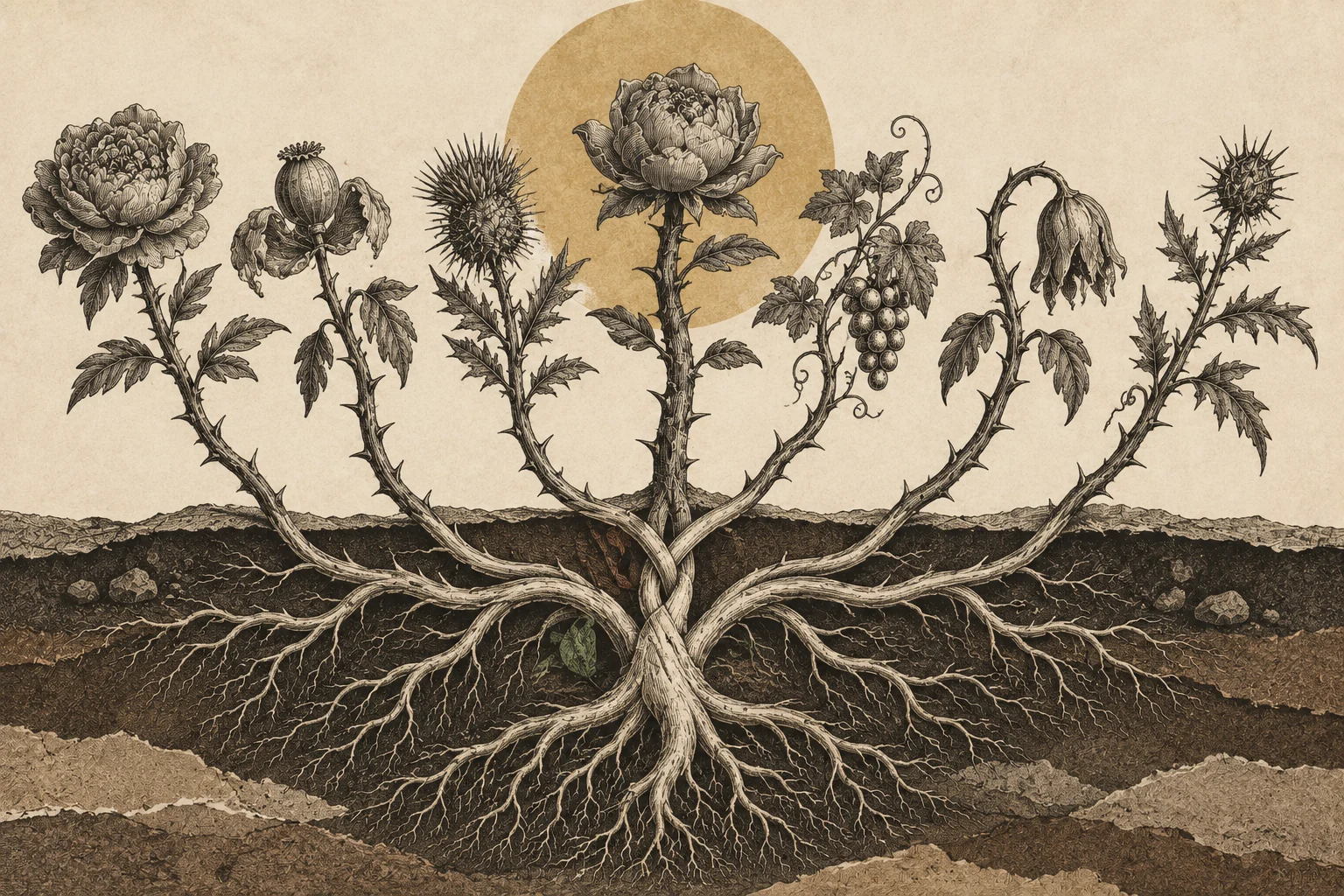
Pride, envy, wrath, sloth, avarice, gluttony, and lust. The list is among the most widely recognized items in Western religious culture, familiar to people who have never opened a Bible, and it has furnished material for painters, poets, and film directors for centuries. It is also, as a list, absent from Scripture. No biblical writer enumerates these seven, and no council canonized them. The catalogue came out of the Egyptian desert, passed through a Latin monastery, and reached its familiar form in a commentary on the book of Job written by a bishop of Rome. That history is worth knowing, because it explains both what the list is good for and what it was never meant to be.
The Desert Origin
The taxonomy begins with Evagrius Ponticus, a deacon of Constantinople who left the city under a cloud and became an anchorite in the Egyptian desert in the fourth century. There he produced the first systematic literature of the interior ascetic life. He organized the temptations that assault the solitary into a fixed list of eight, matched each with passages of Scripture to be used against it, and set out the stages of prayer and contemplation in terms his successors inherited.1
His most consequential work for this subject was the Antirrheticus, a collection of Scripture passages arranged against the eight divisions of evil thoughts.2 The Greek term he used was logismoi, meaning thoughts, and the distinction matters. Evagrius was not cataloguing crimes. He was cataloguing the recurring patterns of temptation that present themselves to a mind at prayer, and prescribing a text of Scripture against each.
Honesty about the source requires one further note. Evagrius was a committed follower of Origen, and in 553, a century and a half after his death, the fifth ecumenical council anathematized him by name alongside Origen and Didymus.3 His speculative theology was formally condemned. His moral taxonomy survived anyway, carried west by a man who had been in Egypt in the same decade.
Cassian Carries It West
John Cassian transmitted the scheme into Latin monastic practice. His Institutes devote books 5 through 12 to what he calls the eight principal faults, and in the Conferences he has the abbot Serapion enumerate them: gluttony, fornication, covetousness, anger, dejection, accidie, vainglory, and pride.4
Two of those names have no modern equivalent and are usually mistranslated. Accidie, sometimes rendered sloth, does not mean laziness. It names a specific spiritual condition well known to monks, a listless weariness with the spiritual life itself, an inability to care about what one knows to be worth caring about. Dejection is likewise not ordinary sadness but a settled gloom that corrodes the will. Both were diagnosed as occupational hazards of the contemplative life, which is precisely the setting the whole scheme was designed for.
Through Cassian the eight passed into Western monastic practice, and in shortened form into medieval moral theology.
Gregory Makes It Seven
The final form is the work of Gregory the Great. In the Moralia in Job, a commentary in thirty-five books begun during his years in Constantinople and completed in Rome, Gregory systematized the catalogue of principal vices. He reduced the list from eight to seven by combining vainglory with pride and adding envy, producing the canonical set: pride, envy, wrath, sloth, avarice, gluttony, and lust. He arranged them hierarchically, with pride as the root from which the others grow.5
The Moralia was one of the most frequently copied and cited texts of the entire medieval period, and Gregory's arrangement dominated Western moral theology for the next thousand years. The list most people can recite today is his.
What “Deadly” and “Capital” Actually Mean
The traditional Latin term is vitia capitalia, capital vices, and the adjective comes from caput, meaning head. They are capital in the sense of being sources, the heads from which other sins spring, in the same way a river has a headwater. Gregory's hierarchy is exactly this claim: pride is the head, and the rest flow from it.
The popular understanding that these are the seven sins that send a person to hell, as distinct from lesser sins that do not, is a different idea altogether and a later one. Nothing in the scheme as Evagrius, Cassian, or Gregory framed it establishes a tier of unforgivable offenses. The list is diagnostic, not judicial. It answers the question of where sin characteristically starts, not the question of who is condemned.
What Scripture Does Have
Scripture contains vice lists, and it is worth noticing that none of them is this one. Proverbs supplies the closest formal parallel, and it is frequently confused with the seven: "These six things doth the LORD hate: yea, seven are an abomination unto him: A proud look, a lying tongue, and hands that shed innocent blood, An heart that deviseth wicked imaginations, feet that be swift in running to mischief, A false witness that speaketh lies, and he that soweth discord among brethren."6 Only pride appears on both lists. Lying, murder, false witness, and sowing discord appear on the biblical one and not on Gregory's.
Paul supplies another catalogue in the works of the flesh, which runs to seventeen items and ends with an explicit note that the list is not exhaustive.7 That openness is characteristic. Scripture diagnoses sin at the root, in the heart and its desires, rather than by fixing a numbered inventory.
Whether the List Is Still Useful
It is useful, provided it is used for what it is. As a piece of pastoral diagnosis developed by men who spent their lives observing how temptation actually behaves, the scheme is shrewd. It notices that sins have genealogies, that greed and gluttony and lust are frequently the visible end of something that began as pride, and that despair and spiritual boredom are real conditions requiring real remedies rather than moral scolding. Evagrius answering each thought with a specific passage of Scripture is a method still worth imitating.
What the list is not is a canon. It carries the authority of long and thoughtful Christian reflection, which is considerable, and not the authority of revelation, which is different in kind. Treating a sixth-century arrangement of a fourth-century monastic taxonomy as though it were apostolic teaching confuses the two, and the confusion runs in both directions: some inflate the list into Scripture, and others dismiss it because it is not. Neither response takes the history seriously.
The seven deadly sins are what the church learned about the anatomy of sin over several centuries of close attention. That is a real inheritance, and it should be received as exactly that.
Scripture quotations are from the King James Version.
-
Evagrius was a deacon of Constantinople who became an anchorite in the Egyptian desert and produced the first systematic literature of the interior ascetic life. ↩
-
Wace, Dictionary of Christian Biography, s.v. "Evagrius (12) Ponticus," describing the Antirrheticus as a collection of passages of Scripture against the eight divisions of evil thoughts. ↩
-
The Second Council of Constantinople, AD 553. ↩
-
John Cassian, Institutes, books 5 to 12, titled in the manuscripts "On the Eight Principal Faults"; Conferences 5, where the abbot Serapion enumerates them. ↩
-
Gregory the Great, Moralia in Job 31.45. ↩
-
Proverbs 6:16-19, KJV. ↩
-
Galatians 5:19-21. ↩
You May Also Enjoy
 The Early Church Councils: How Orthodoxy Was Defined
 Christ Is the End of the Law
 Lesson 5: Shepherding with a Tender Heart — 1 Thessalonians 2:7-9
 The Council of Nicaea: When the Church Defined the Faith
 Lesson 6: Called into His Kingdom and Glory — 1 Thessalonians 2:10-12
 Lesson 4: Leading from the Fire — 1 Thessalonians 2:1-6