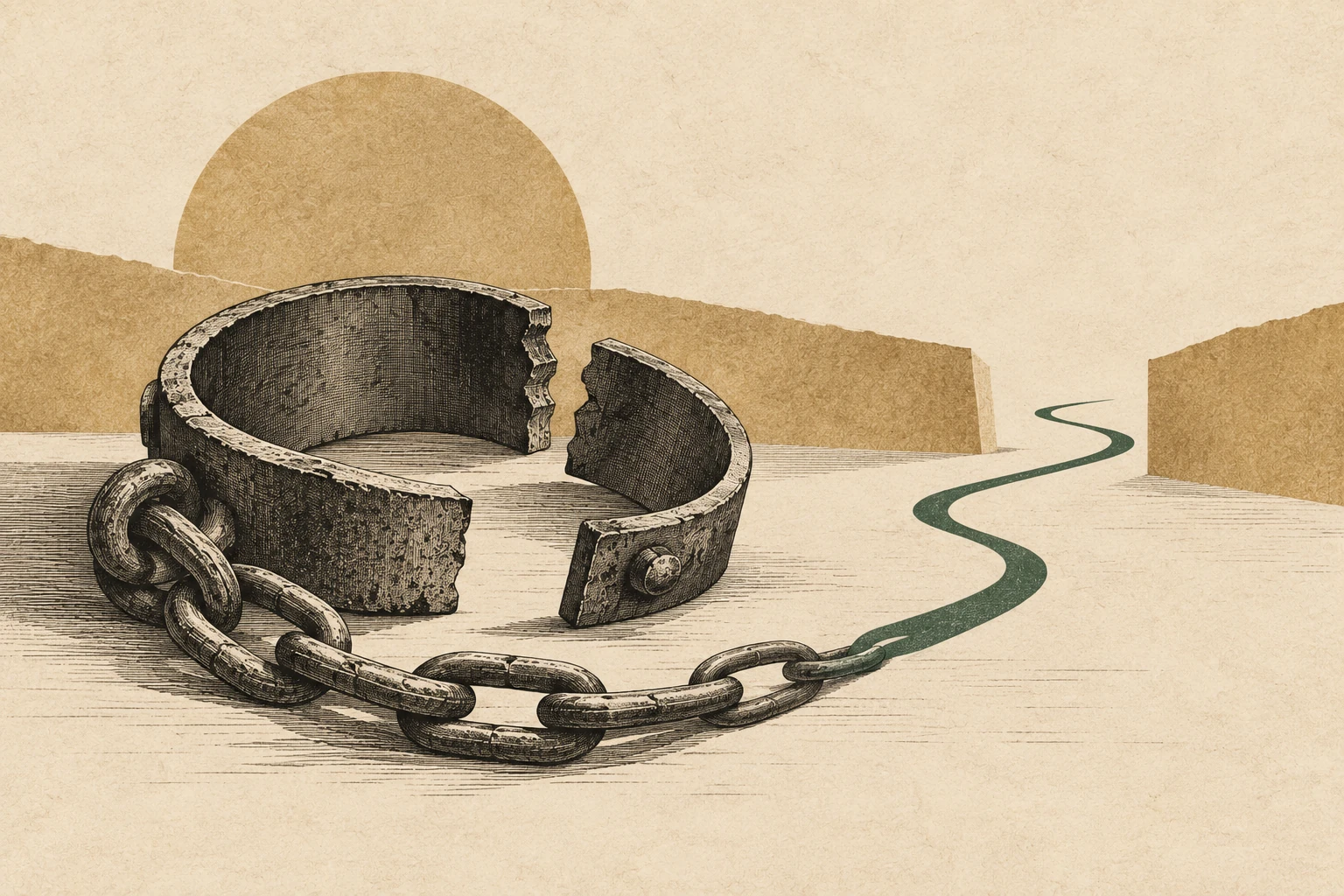
The mortality that swept across Europe between 1347 and 1351 is remembered first as a demographic catastrophe, and rightly so. Within four years the pestilence that later generations named the Black Death killed somewhere between a third and a half of the continent's population.1 Yet to read the plague only as a body count is to miss its slower and more consequential work. The disease did not merely empty villages and parishes. It weakened the assumptions on which medieval authority rested, both the manorial economy that bound the peasant to his lord and the ecclesiastical order that claimed to mediate between God and the living. The argument of this essay follows a single thread from the labor market to the conscience. The scarcity of hands gave the surviving peasant a mobility and a bargaining power he had never held before; that bargaining taught him that he had choices; and the discovery of choice matured into opinion, and opinion into the conviction that his judgment weighed as much as that of the men set above him. Once that conviction had learned to question authority in the manor, it did not stay there. The habit of questioning crossed from the civil realm into the ecclesiastical, so that the peasant who had bargained with his lord grew willing to weigh the claims of his priest, all of it resting on a slow and unfamiliar thought, that the common life had worth.
The Scale of the Mortality
The plague reached the ports of Sicily in October 1347 and moved along the trade routes of the Mediterranean and the Atlantic coast with a speed that outran any medieval remedy. By 1349 it had crossed the Alps and the Channel; by 1351 it had touched Scandinavia and the Baltic. Modern demographic study places the death toll across Europe between one-third and one-half of the whole population, with some regions losing more. What made the mortality so corrosive was its indifference as much as its scale. The pestilence took the noble and the serf, the bishop and the parish priest, without regard to the ranks that ordered medieval life. A world that had explained itself through fixed stations found those stations emptied by a force that respected none of them.
The Manorial Economy Under Strain
The manorial system depended on a settled abundance of labor. Land was worked by peasants who owed customary services and dues to a lord, and the arrangement held because there were always more hands than the land strictly required. The plague reversed that ratio in a single generation. With fields left untended and whole holdings vacant, surviving laborers found that their work commanded a price it had never commanded before. Wages rose, rents came under pressure, and peasants began to leave their manors in search of better terms elsewhere. The movement itself was the decisive novelty. A villein who could walk to the next estate, where a short-handed lord would take him without close inquiry into his obligations, held a leverage that the customary order had never had to answer.2
The governing class understood the danger and tried to legislate it away. In England the Ordinance of Labourers of 1349 and the Statute of Labourers of 1351 attempted to freeze wages at their pre-plague levels and to compel laborers to accept work at the old rates.3 The chronicler Henry Knighton recorded both the shortage of workers and the refusal of the survivors to serve for the customary pay, noting that laborers had grown so scarce and so proud that the great men of the realm could not obtain their service except at a heavy cost.4 The statutes were widely evaded, because the market pressure behind the higher wages was stronger than any penalty the crown could enforce. Across the following decades the customary bonds of serfdom loosened, and labor services were increasingly commuted into money rents. The economic scaffolding of the old deference was quietly coming down.
The change reached beyond wages. As holdings fell vacant, enterprising survivors consolidated land that would once have been beyond their reach, and a stratum of more prosperous peasants began to emerge with property, ambition, and a sharper sense of its own worth. Lords who wished to keep tenants found themselves negotiating rather than commanding, offering better terms to hold hands on the land. The assumption that a man was born to his station and would die in it had been a quiet foundation of the whole order, and that assumption did not survive the labor market the plague created.
Where legislation pressed hardest against economic reality, revolt followed.5 The Jacquerie erupted in northern France in 1358, and the English Rising of 1381 brought a peasant army to the gates of London under Wat Tyler and the preacher John Ball.6 Ball is remembered for the couplet that reduced the whole medieval theory of estates to a question: "When Adam delved and Eve span, who was then the gentleman?"7 The risings were crushed and their leaders killed. What did not fully recover was the unspoken confidence that the social hierarchy was simply the way of things. Once ordinary people had asked aloud why the order should be as it was, the question did not go away.
The Discovery of Choice
The economic story is the visible half of the change. The half that mattered more in the long run took place in the mind of the laborer who found, for the first time in living memory, that his work was sought rather than simply commanded. To bargain is to choose, and to choose is to suppose that one's own judgment counts for something. A man who could refuse one lord's terms and accept another's had been handed a small daily lesson in his own agency, and the lesson did not remain confined to the question of wages.
The progression ran by short and natural steps. From the sense that he had a choice came the sense that he had an opinion; from the sense that he had an opinion came the sense that his opinion was worth as much as another man's; and from that came the willingness, unthinkable in his grandfather's world, to hold his own view against the view of those set above him. The deference that had bound the estates together was not argued away. It was worn away by the repeated experience of being treated, in the one transaction that touched a peasant's life most directly, as a party whose consent had value.
What began in the civil realm did not stay there. The questioning a peasant had learned to direct at his lord was available, once learned, to direct at his priest. The two authorities had long stood on the same footing, each claiming a place in a fixed and God-given order, each expecting obedience rather than assent. When the first had been made to negotiate, the second could not long be spared the same scrutiny. The man who had asked why he owed his labor to a lord who did no labor was prepared, in time, to ask why he owed unquestioning obedience to a clergy whose lives did not always match their office. The passage from the secular question to the sacred one is the hinge of the whole development, and it turned on a conviction the plague had done most to plant: that the life of the common man was not cheap, and that a soul worth the same redemption as any lord's was worth a voice as well.
The Crisis of Clerical Authority
The Church met this rising disposition to question at the worst possible moment, for the plague had already shaken its standing on its own account. The clergy were struck with particular force, in part because their office carried them to the bedsides of the dying. Parishes lost their priests, and the men hurried in to replace them were often younger and less trained than those they succeeded. More damaging than the shortage was the impression the pestilence left behind. The Church had taught that its sacraments and intercessions reached into the order of providence, yet the plague advanced through processions and prayers as freely as through anything else. To many, the institution that claimed the keys appeared unable to unlock the one door that mattered.
The strain surfaced in movements the hierarchy could not easily control. Bands of flagellants moved from town to town, scourging themselves in the belief that public penance might turn away the wrath they read in the plague, until Pope Clement VI condemned the processions in 1349.8 Anticlerical feeling sharpened. The wealth of prelates, the absenteeism of beneficed clergy, and the sale of spiritual goods drew criticism that had circulated before but now found a wider and less patient audience. The plague did not invent these grievances. It stripped away the deference that had kept them muted.
From Dislocation to Dissent
A population that was more mobile, less bound to a single manor, and less inclined to assume that its betters spoke for God was a population more willing to listen to voices that questioned the Church's claims. In England, John Wyclif and the Lollards pressed for Scripture in the common tongue and challenged the mediating pretensions of a wealthy clergy.9 In Bohemia, Jan Hus carried a related program to a wider public and paid for it at the stake in 1415.10 Neither man was a product of the plague, and it would be careless to say that the pestilence produced them. The relationship was indirect. The Black Death did not write the ideas of reform; it thinned the ground's resistance to them, so that seed which might once have failed now found purchase.
The appetite for Scripture in the common tongue belongs to the same story. A population shaken loose from settled deference grew less content to receive the faith only through a clerical intermediary, and the demand for the Bible in English and in Czech gathered force in the decades after the plague. Wyclif and his associates undertook the labor of translation, and the Lollards carried handwritten portions of Scripture from town to town, precisely to place the text in lay hands. The instinct behind the work was that the ordinary believer might read and weigh the text for himself, an instinct that the older order had discouraged and that the loosened conditions of the later fourteenth century made harder to suppress.
The qualification matters, because history is rarely served by single causes. The fracturing of medieval authority had many sources: the long quarrel between popes and kings, the scandal of a papacy divided against itself during the Great Schism, the growth of towns and universities, and the slow rise of literacy. The plague belongs among these forces rather than above them. Its distinctive contribution was to act upon economic and religious authority at the same moment, and to do so with a suddenness that no institution could absorb.
Conclusion
The Black Death is most often measured by the dead, and the count is staggering enough to justify the emphasis. The deeper measure is what the plague did to the living arrangements that survived it. By emptying the manor of the surplus labor that had sustained serfdom, it gave the peasant a mobility and a bargaining power that customary law could not long deny. That bargaining did its quiet work on the mind, teaching a man who had always been told his place that he now had a choice, and from the sense of choice grew the sense of an opinion, and from opinion the standing to hold that opinion against his betters. The scrutiny he had learned to turn on his lord he was ready, before long, to turn on his priest, and the Church met that scrutiny already weakened by its own failure against the pestilence. Beneath each step lay the same slow conviction, that the common life had worth and that a voice belonged to it. None of this amounted to reformation by itself. Yet the space it cleared, and the confidence it planted, were the conditions in which the reforming voices of the later Middle Ages could be heard, and in which, a century and a half later, a wider reformation would find an audience already prepared to listen.
Notes
- Ole J. Benedictow, The Black Death 1346-1353: The Complete History (Woodbridge: Boydell Press, 2004), 380-84. Modern estimates of European mortality cluster between one-third and one-half of the population.
- John Hatcher, "England in the Aftermath of the Black Death," Past and Present, no. 144 (1994): 3-35. On the erosion of customary serfdom and the rise of real wages in the decades after 1348, see also Christopher Dyer, Making a Living in the Middle Ages: The People of Britain 850-1520 (New Haven: Yale University Press, 2002).
- The Ordinance of Labourers (1349) and the Statute of Labourers (1351), in Statutes of the Realm, vol. 1 (London: Record Commission, 1810), 307-9.
- Henry Knighton, Knighton's Chronicle 1337-1396, ed. and trans. G. H. Martin (Oxford: Clarendon Press, 1995), 100-103.
- Rodney Hilton, Bond Men Made Free: Medieval Peasant Movements and the English Rising of 1381 (London: Temple Smith, 1973). Hilton connects the seigneurial reaction and the labor legislation of the post-plague decades to the grievances behind the rising of 1381.
- Jean Froissart, Chronicles, trans. Geoffrey Brereton (London: Penguin, 1978), on the Jacquerie of 1358 and the English rising of 1381.
- The couplet is associated with the preaching of John Ball and preserved in the chronicle tradition of the 1381 rising; see Froissart, Chronicles, 212.
- Clement VI condemned the flagellant processions in the bull Inter sollicitudines (October 1349).
- On Wyclif and the Lollards, see John Wyclif, De Civili Dominio, and the summary in G. R. Evans, John Wyclif: Myth and Reality (Downers Grove: IVP Academic, 2005).
- Jan Hus was condemned and burned at the Council of Constance in 1415; see Matthew Spinka, John Hus: A Biography (Princeton: Princeton University Press, 1968).
You May Also Enjoy
 Pre-Reformers, Reformers, and the Social Transformation of Late Medieval Europe
 Lesson 5: Shepherding with a Tender Heart — 1 Thessalonians 2:7-9
 Lesson 6: Called into His Kingdom and Glory — 1 Thessalonians 2:10-12
 The Renaissance Made the Reformation Inevitable
 The Office of Christ and the Office of the Spirit: A Necessary Distinction
 Christ Is the End of the Law
