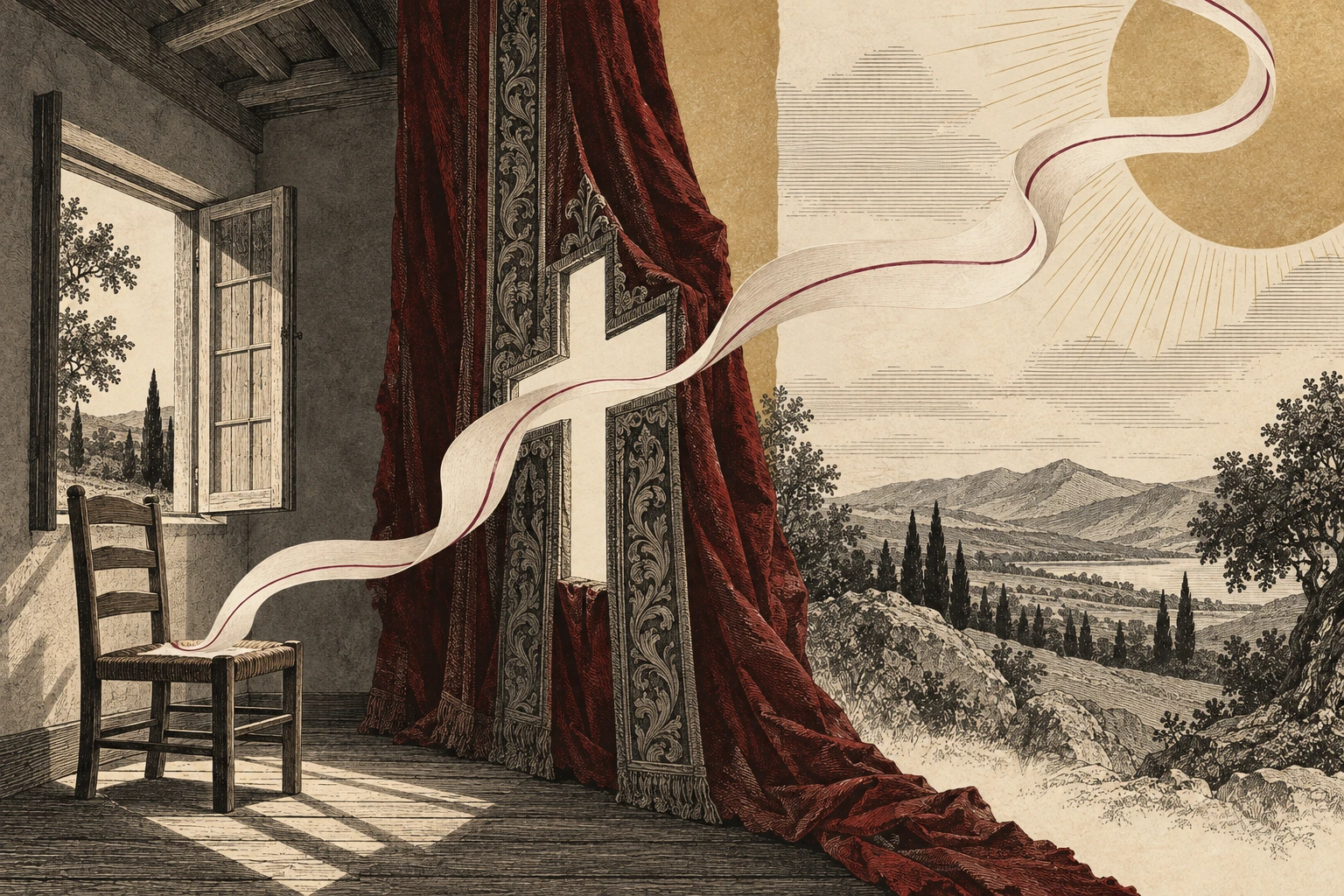
Prayer is at once the most natural and the most neglected act of the Christian life. Natural, because distress wrings it even from people who claim no faith; there is a reason the proverb says there are no atheists in foxholes. Neglected, because nothing is easier to postpone than speaking with One who cannot be seen. Between those two poles lies a great deal of confusion about what prayer actually is. Some treat it as a religious technique for obtaining outcomes. Others reduce it to meditation, a way of composing one's own thoughts. Scripture knows nothing of either. In the Bible, prayer is speech directed to the living God by those who have been given the right to address Him, and it is as plain, and as staggering, as that.
What Prayer Is
The simplest biblical definition is the psalmist's: "Let my prayer be set forth before thee as incense; and the lifting up of my hands as the evening sacrifice."1 Prayer is the heart lifted to God. It is not primarily a feeling sought or a state achieved but an address made, which is why Scripture describes it with the ordinary vocabulary of speech: crying, calling, asking, pleading, thanking, blessing. "In every thing by prayer and supplication with thanksgiving let your requests be made known unto God."2
Because prayer is address, its value hangs entirely on the One addressed. The prophets of Baal cried aloud from morning until noon and no voice answered, while Elijah mocked them with the suggestion that their god was merely occupied: "either he is talking, or he is pursuing, or he is in a journey, or peradventure he sleepeth, and must be awaked."3 Prayer to the true God rests on His actual character: He hears, He knows what we need before we ask, He is "a rewarder of them that diligently seek him."4 Prayer, in other words, is an act of faith before it is anything else, and that is why Scripture ties the two so tightly together: "he that cometh to God must believe that he is."
Prayer is also broader than requests. Scripture shows adoration, in which the pray-er is occupied with what God is; confession, in which he owns what he has done; thanksgiving, in which he names what he has received; and supplication, in which he asks, both for himself and for others. The old summary gathered these under four heads, and the balance matters. A prayer life consisting only of requests is a child who speaks to his father only when he wants money.
The Ground on Which We Come
The boldest claim of the gospel touches prayer directly: sinners are invited to speak with the holy God, and the invitation rests not on their worthiness but on Christ. "For there is one God, and one mediator between God and men, the man Christ Jesus."5 Because His death has opened the way, the believer is told to "come boldly unto the throne of grace, that we may obtain mercy, and find grace to help in time of need."6 This is why Christian prayer is offered in Jesus' name.7 The phrase is not a closing formula that seals the transaction; it is the ground of admission, a confession that we are heard for His sake and not for our eloquence. And the help does not end there, for "the Spirit itself maketh intercession for us with groanings which cannot be uttered," carrying to God what we cannot put into words.8 The weakest prayer of the weakest believer travels on stronger shoulders than his own.
How, Then, Should a Person Pray?
Scripture's instruction here is mercifully concrete.
Prayer should be simple. Jesus warned against "vain repetitions, as the heathen do: for they think that they shall be heard for their much speaking."9 God is not persuaded by volume or vocabulary. The publican's seven words, "God be merciful to me a sinner," went home justified when the professional's polished prayer did not.10
Prayer should be honest. The Psalms, the Bible's own prayer book, contain complaint, grief, fear, and perplexity alongside praise. "Pour out your heart before him," the psalmist urges.11 God is not honored by pretense in His presence; He "desirest truth in the inward parts."12
Prayer should be regular, and it may be offered anywhere. Daniel prayed three times a day at an open window; Jesus rose "a great while before day" to pray alone; Paul directs believers to "pray without ceasing," a settled disposition of dependence that turns the whole day Godward.13 Set times guard the habit, and the habit frees the heart to pray at any moment, for no appointment is needed.
Prayer should be shaped by God's will. "If we ask any thing according to his will, he heareth us."14 Prayer is not a lever by which God is moved to serve our plans; it is the school in which our desires are trained toward His. The Lord Himself prayed in Gethsemane, "not as I will, but as thou wilt," and no deeper lesson in prayer exists than those seven words.15
Prayer also requires that known sin and broken relationships be faced. "If I regard iniquity in my heart, the Lord will not hear me."16 Peter warns husbands to honor their wives "that your prayers be not hindered."17 Prayer is fellowship, and fellowship does not thrive alongside cherished disobedience.
When God Seems Silent
Every praying person meets delay and apparent refusal, and Scripture does not hide this. Paul asked three times for his thorn to be removed and received instead the answer, "My grace is sufficient for thee."18 Some of God's best answers are refusals of what we asked in favor of what we should have asked. Delay is not denial, and the Lord told a parable "to this end, that men ought always to pray, and not to faint," commending the widow whose persistence would not be turned away.19 The Father is not reluctant; He is wise, and He gives "good things to them that ask him," measuring good by eternity rather than by the afternoon.20
Beginning
For the person who wants to pray and does not know where to start, the counsel of Scripture is almost embarrassingly practical. A quiet place comes first, for the Lord said, "enter into thy closet."21 The pattern He supplied, the Lord's Prayer, is the natural beginning, prayed slowly, each petition put into the pray-er's own words. Brevity serves better than eloquence, and the address is to a Father, because in Christ that is what He is. Prayer is not a performance to be perfected but a relationship to be inhabited, and the only way to learn it is the way the disciples took: "Lord, teach us to pray."22 That request, at least, is one He is always pleased to answer.
Scripture quotations are from the King James Version.
-
Psalm 141:2. ↩
-
Philippians 4:6. ↩
-
1 Kings 18:27; compare verse 26. ↩
-
Matthew 6:8; Hebrews 11:6. ↩
-
1 Timothy 2:5. ↩
-
Hebrews 4:16. ↩
-
John 14:13 and 14; John 16:23 and 24. ↩
-
Romans 8:26. ↩
-
Matthew 6:7. ↩
-
Luke 18:10 through 14. ↩
-
Psalm 62:8. ↩
-
Psalm 51:6. ↩
-
Daniel 6:10; Mark 1:35; 1 Thessalonians 5:17. ↩
-
1 John 5:14. ↩
-
Matthew 26:39. ↩
-
Psalm 66:18. ↩
-
1 Peter 3:7. ↩
-
2 Corinthians 12:8 and 9. ↩
-
Luke 18:1 through 8. ↩
-
Matthew 7:11. ↩
-
Matthew 6:6. ↩
-
Luke 11:1. ↩
You May Also Enjoy
 Lesson 6: Called into His Kingdom and Glory — 1 Thessalonians 2:10-12
 Christ Is the End of the Law
 The Righteousness of God Revealed: What Paul Means in Romans 1
 Lesson 5: Shepherding with a Tender Heart — 1 Thessalonians 2:7-9
 Lesson 2: When the Church Gets It Right — 1 Thessalonians 1:1-5
 Covenant Prayer, Not Anxious Pleading