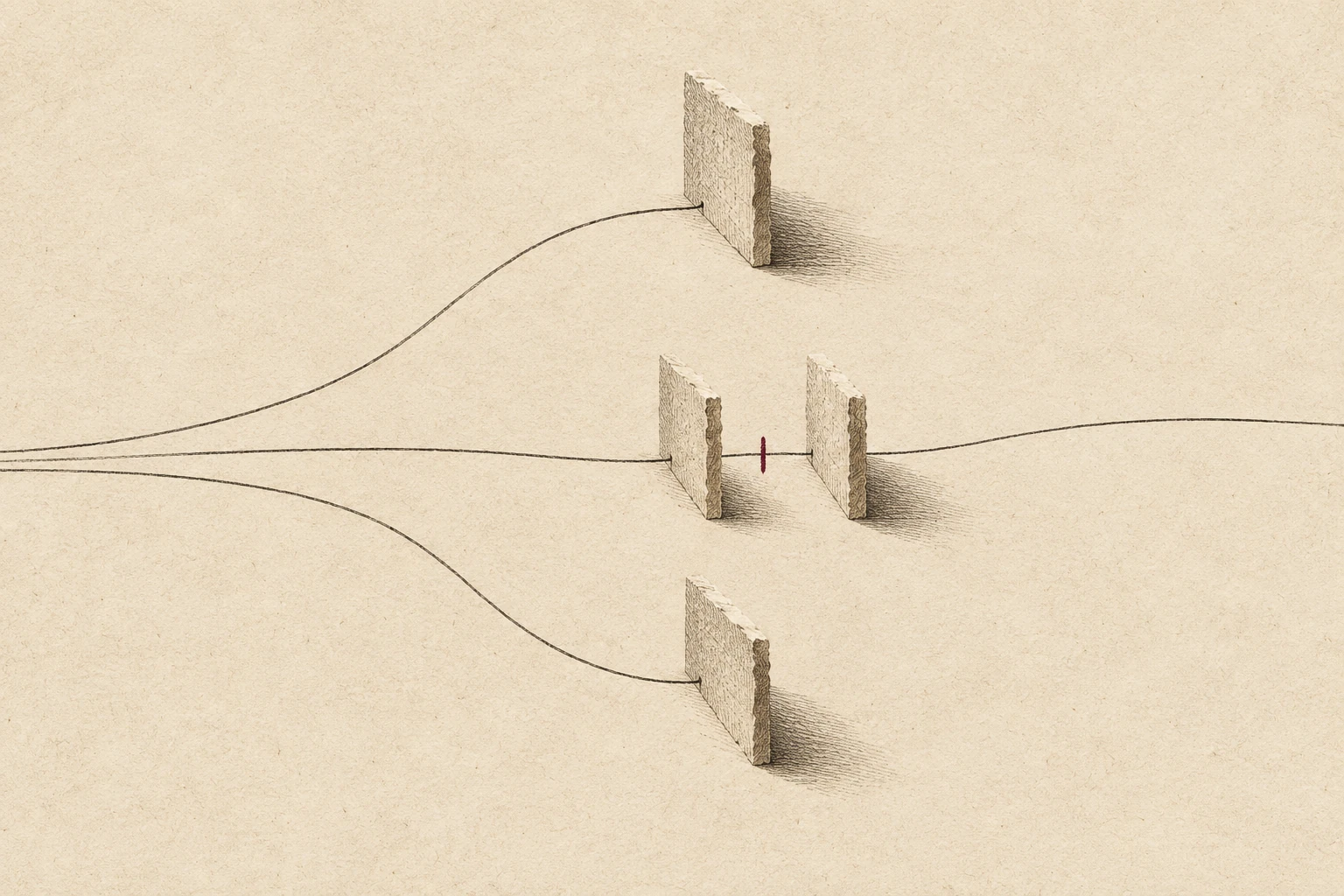
There are moments in the life of faith when God's direction comes not as a command but as a constraint. He does not say, "Go here." He says, "You cannot go there." And the believer, accustomed to receiving clear marching orders, is left standing in the middle of the road, looking at a closed gate, wondering what on earth the Lord is doing.
This is precisely what happened to Paul at the beginning of his second missionary journey, and the account in Acts 16:6-10 offers one of the most instructive passages in the New Testament on the subject of divine guidance. In four compressed verses, Paul is blocked from two major provinces, driven to the western edge of Asia Minor, and redirected across the Aegean into Europe. The speed with which Luke narrates the events should not deceive us: behind those four verses lay weeks or months of travel, repeated frustration, and sustained obedience under conditions of profound uncertainty.
The Scene: Three Closed Doors
Paul and Silas had set out from Antioch, strengthening the churches through Syria and Cilicia, and had passed through the Cilician Gates into the Anatolian plateau. After visiting the Galatian churches planted during the first missionary journey, Paul turned his strategic attention toward the great province of Asia, with Ephesus as its capital. Asia was the commercial and cultural center of the eastern Mediterranean, a province whose influence radiated throughout the Roman world. For a missionary of Paul's ambition and vision, it was the obvious next destination.
The Holy Spirit said no. Luke records the redirection without elaboration: "Paul and Silas traveled through the area of Phrygia and Galatia, because the Holy Spirit had prevented them from preaching the word in the province of Asia at that time" (Acts 16:6). The word translated "prevented" carries the force of a divine prohibition. Paul did not choose to redirect; he was redirected.
With Asia closed, Paul and Silas moved northward toward Bithynia, a Roman province along the Black Sea coast with established Jewish communities and significant urban centers. Again the Spirit intervened: "The Spirit of Jesus did not allow them to go there" (Acts 16:7). A second door, firmly shut.
The pattern that emerges is striking. Asia is closed to the south. Bithynia is closed to the north. The familiar territory of Galatia lies behind them to the east. Three directions are blocked. Only one remains: west, toward the Aegean coast. Paul and Silas passed through Mysia and arrived at Troas, a Roman port city at the very edge of Asia, where, on a clear day, the mountains of Europe were visible across the water. He had arrived, apparently, at a dead end.
The Vision
That night at Troas, the Spirit who had twice said no now spoke clearly. A man from Macedonia stood in Paul's vision, pleading: "Come over to Macedonia and help us!" (Acts 16:9). The word translated "pleading" carries urgency. This was not a casual invitation. After weeks of prohibition and redirection, the positive call finally came, and Paul obeyed immediately.
What follows is one of the most momentous transitions in church history. Luke, who is now traveling with the group (note the shift to "we" in verse 10), records the departure for Macedonia as a matter of settled conviction: "We decided to leave for Macedonia at once, having concluded that God was calling us to preach the Good News there." The gospel crossed from Asia into Europe for the first time, and it did so by way of three closed doors, weeks of uncertain travel, and a single night vision at a coastal port.
Lesson 1: Closed Doors Are Not Rejection
When the Spirit prevented Paul from entering Asia, it was not because Asia did not matter. Ephesus would eventually become one of the most significant centers of Pauline ministry, the site of his longest documented stay and the city from which his influence radiated throughout the entire province. The Spirit's prohibition was about timing, not value. Whatever the reason, the Spirit was not abandoning Asia. He was deferring it.
This matters for the believer who encounters a closed door and interprets it as divine rejection. A closed door may mean: not this way. It rarely means: never. The Spirit's prohibition to Paul in Acts 16:6 contained a temporal qualifier that Luke records faithfully: "at that time." The exclusion was bounded. Believers do well to hold their closed doors loosely, recognizing that the Spirit's "not now" is not the same as "never."
Lesson 2: The Spirit Sometimes Leads by Elimination
Paul did not receive a direct command to go to Macedonia while he was still in Galatia. He received two prohibitions. And by the process of divine elimination, those prohibitions funneled him westward until he arrived at the only place from which the next step was possible.
This is a form of guidance that receives less attention than it deserves. Most teaching on discerning God's will focuses on positive signals: impressions, confirmations, open doors, peace. Less attention is given to the Spirit's negative guidance, the closed doors, the blocked paths, the persistent sense that a particular direction is not permitted. But Acts 16 suggests that negative guidance can be as precise and purposeful as positive guidance. The Spirit was directing Paul's route, and the instrument of direction was prohibition.
For the believer facing a season without clear direction, this is worth sitting with. The absence of a positive call is not the absence of guidance. The closing of doors is itself a form of leading.
Lesson 3: The Moment of Dead-Endedness Is Often the Prelude to God’s Greatest Intervention
Paul arrived at Troas having exhausted every option. Every direction but west was closed, and west led to the sea. He had no obvious next move. This is the condition the biblical narrative consistently identifies as the precondition for divine action: the Red Sea before the liberated Israelites, the empty womb before Isaac's birth, the sealed tomb before the resurrection. The moment of apparent impossibility is the moment at which God characteristically acts.
What looked like a dead end at Troas was, in fact, a launching point. God had been steering Paul toward that specific port city all along, because from Troas, and only from Troas, could Paul board a ship for Macedonia. The closed doors of Asia and Bithynia were not obstacles to God's plan. They were instruments of it.
Lesson 4: Obedience Means Accepting the Doors God Closes
Perhaps the most practically demanding lesson from this passage is one that Paul models without commentary: he did not push against the closed doors. There is a version of persistent faith that, when it encounters an obstacle, simply presses harder. And sometimes that persistence is appropriate. But Paul recognized that these particular closed doors were divine prohibitions, not ordinary obstacles, and he did not attempt to reopen them. He accepted the Spirit's judgment over his own strategic instincts.
This is a difficult posture to maintain when the believer is confident of a calling and frustrated by obstacles. The temptation is to treat divine prohibitions as temporary setbacks to be overcome by sufficient faith and determination. Paul's response is instructive: he trusted the Spirit's "not this way" as fully as he would have trusted a clear command to proceed. Both were guidance. Both deserved obedience.
Conclusion
The Macedonian call is rightly celebrated as one of the pivotal moments in the expansion of the early church. But the vision at Troas is inseparable from the closed doors that preceded it. Without the Spirit's prohibitions in Phrygia, Asia would have been Paul's next destination. Without the second prohibition at the border of Bithynia, Paul would have turned north rather than west. Without the weeks of negative guidance that drove him to Troas, the Macedonian vision would have found him somewhere in the interior of Asia Minor, far from any port, unable to respond.
The gospel came to Europe because Paul obeyed not only the Spirit's commands but the Spirit's prohibitions. He trusted the closed doors as much as the open ones. And because he did, the narrow corridor of blocked paths led him to the exact place where the next great chapter of redemptive history was waiting to begin.
You May Also Enjoy
 Lesson 6: Called into His Kingdom and Glory — 1 Thessalonians 2:10-12
 Lesson 1: A Church Born in Fire — 1 Thessalonians Introduction
 Lesson 5: Shepherding with a Tender Heart — 1 Thessalonians 2:7-9
 Lesson 2: When the Church Gets It Right — 1 Thessalonians 1:1-5
 Lesson 2: Divine Revelation, Not Human Teaching — Galatians 1:11-24
 Lesson 4: Leading from the Fire — 1 Thessalonians 2:1-6