Easter has no fixed place on the calendar. In one year it arrives in late March; in another it falls near the end of April. The reason is not administrative convenience. It is a rule inherited from the earliest Christian centuries, a rule that binds the celebration of the resurrection to the phases of the moon. The rule is simple to state and surprisingly difficult to apply, and the disagreement it produced was not settled in the English church until a synod met at Whitby in the seventh century.
A Calendar Borrowed from Jerusalem
The Jewish calendar of the first century was observational. Each new month began when the first visible crescent of the new moon was sighted in Jerusalem, and from that sighting the days were counted. Passover fell on the fourteenth day of the month of Nisan, which placed it at or very near the full moon. Nothing about this system was mechanical. It depended on witnesses, on weather, and on the judgment of those charged with declaring the month.
The earliest Christians commemorated the death and resurrection of Christ in close connection with Passover, since the events themselves had occurred during that feast. The consequence was practical: the Christian celebration inherited the Jewish reckoning. Communities scattered across the Mediterranean had to learn, often at some distance and after some delay, what the authorities in Jerusalem had determined. Congregations in Asia Minor, Rome, Alexandria, and Gaul were not always able to keep the feast on the same day, and by the second century the differences were substantial enough to provoke correspondence between bishops.
The Church Sets Its Own Rule
As Christianity spread through the Roman Empire, many church leaders concluded that the Church should not depend upon the Jewish authorities in Jerusalem to fix the date of its most important annual celebration. Two concerns converged. The first was ecclesial independence. The second, and in practice the more pressing, was uniformity: a faith that confessed one Lord and one resurrection ought not to observe that resurrection on three or four different Sundays across the empire.
The Council of Nicaea (A.D. 325) addressed the question and determined that the Church would use its own method while keeping the celebration in the same general season. The rule that emerged was straightforward. Easter would be observed on the first Sunday after the first full moon occurring on or after the spring equinox, and the equinox was fixed by the Church at March 21. Two constraints were therefore built into the calculation: a lunar one, since the feast follows a full moon, and a solar one, since the full moon in question must belong to the spring.
What Nicaea did not supply was a table. The council settled the principle and left the annual computation to be worked out, and in the centuries that followed the bishops of Alexandria, whose astronomical tradition was the strongest in the Christian world, took the leading role in announcing the date. That division between an agreed principle and a contested method is the origin of every later dispute.
The Difficulty of Predicting the Moon
The trouble was never the rule. The trouble was knowing in advance exactly when the relevant full moon would occur. The Church needed the date years ahead of time, not weeks: the length of the Lenten fast, the scheduling of baptisms, and the coordination of far flung dioceses all required advance notice. Waiting for observation was therefore impossible.
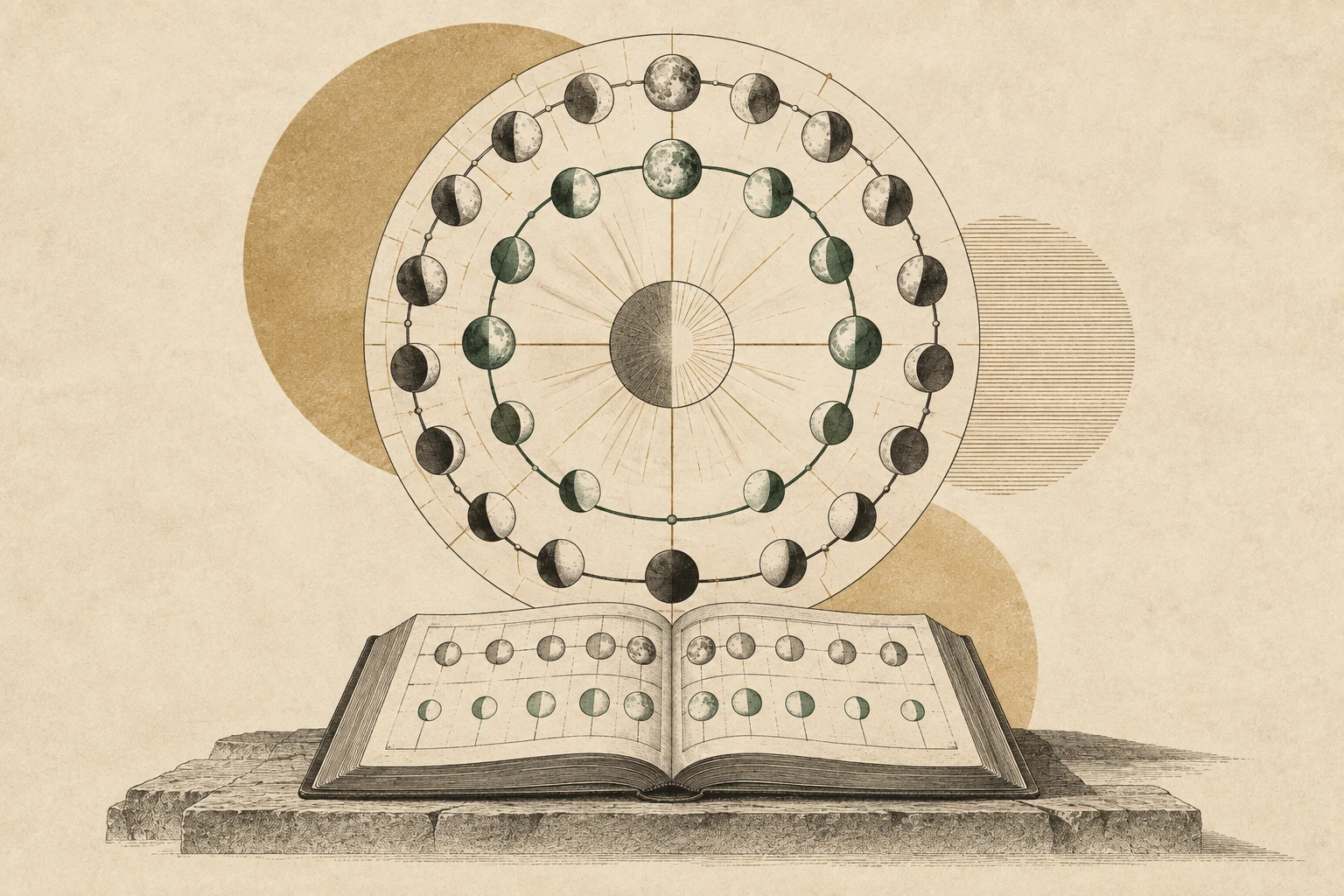
The solution was arithmetic. Churches adopted cycles, that is, spans of years after which the pattern of lunar phases repeats closely enough against the solar calendar to be tabulated. The moon that governs Easter is consequently not the moon in the sky but the ecclesiastical moon, a calculated moon produced by a table. Ordinarily the two agree. Occasionally they do not, and when they diverge the calculation, not the sky, determines the feast.
Two Cycles, Two Answers
Two systems of calculation were in use in the West. Many of the Celtic churches, including those of Ireland and the Ionan mission that had evangelized Northumbria, employed an older 84-year cycle. Rome, drawing on the Alexandrian tradition, used the 19-year Metonic cycle, which rests on the observation that 19 solar years correspond very nearly to 235 lunar months. The Metonic cycle is the more accurate of the two, and its residual error accumulates far more slowly.
Both parties were doing the same thing for the same reason. Both accepted the Nicene rule. Both wanted the feast kept at the right time. They simply held different tables, and each regarded its own as the inheritance of the fathers.
When a Single Day Became a Full Week
An error of one day in an astronomical table sounds like a small matter, and in most years it was. The 84-year cycle drifted enough over time that it could place the ecclesiastical full moon a day or more away from the value given by the more accurate reckoning. In many years that discrepancy changed nothing, because the following Sunday remained the same Sunday.
But the Sunday rule magnifies small errors. If the two calculations fall on opposite sides of a Saturday, the one system reaches Sunday immediately while the other must wait a full seven days. A difference of a single day in the moon becomes a difference of an entire week in the feast. The result, in a kingdom where both traditions were present, was visible and awkward. Bede records that in the Northumbrian court King Oswiu, trained in the Ionan reckoning, would be keeping the feast of the resurrection while his queen, Eanflæd, who had been raised in the Kentish and Roman practice, was still observing the fast of Palm Sunday. The dispute was no longer an academic disagreement among computists. It was a division at the royal table.
The Synod of Whitby
This was among the principal issues brought before the Synod of Whitby in A.D. 664. Colmán, bishop of Lindisfarne, defended the traditional Ionan calculation, appealing to the practice of Columba and to the authority of the apostle John. Wilfrid argued for the Roman and Alexandrian method, appealing to the universal practice of the wider Church and to the authority of Peter. King Oswiu presided and ruled in favor of the Roman position.
The decision brought the English church into conformity with the Western Church at large. Colmán withdrew to Iona and afterward to Ireland with those who would not accept the ruling, and the Ionan community itself adopted the Roman reckoning some fifty years later. Whitby is often described as a contest between Celtic and Roman Christianity, and in a limited sense it was, but the question actually placed before the synod was narrower and more concrete: which table should be used to find the full moon.
Why the Question Mattered
It is tempting to treat all of this as antiquarian detail, an argument about arithmetic that has no bearing on doctrine. That judgment would be too quick. The date of Easter was the one point at which the Church's confession of the resurrection became publicly visible on a shared calendar, and a divided calendar was a divided witness. The parties disagreed not because either took the resurrection lightly but because both took it seriously enough to insist on keeping it rightly.
The controversy also had consequences no one intended. The labor of computing Easter drove much of the astronomical and chronological work of the early medieval West. Bede's treatise on the reckoning of time grew directly out of this discipline, and the practice of numbering years from the incarnation, which the modern world still uses, entered general circulation through the Easter tables of Dionysius Exiguus and their adoption by Bede. A dispute about the moon produced the calendar by which the West has dated its history ever since.
Easter still moves, and it moves for the reason it has moved since Nicaea. The feast follows a full moon that follows an equinox, and the Sunday that follows both is the day of resurrection.