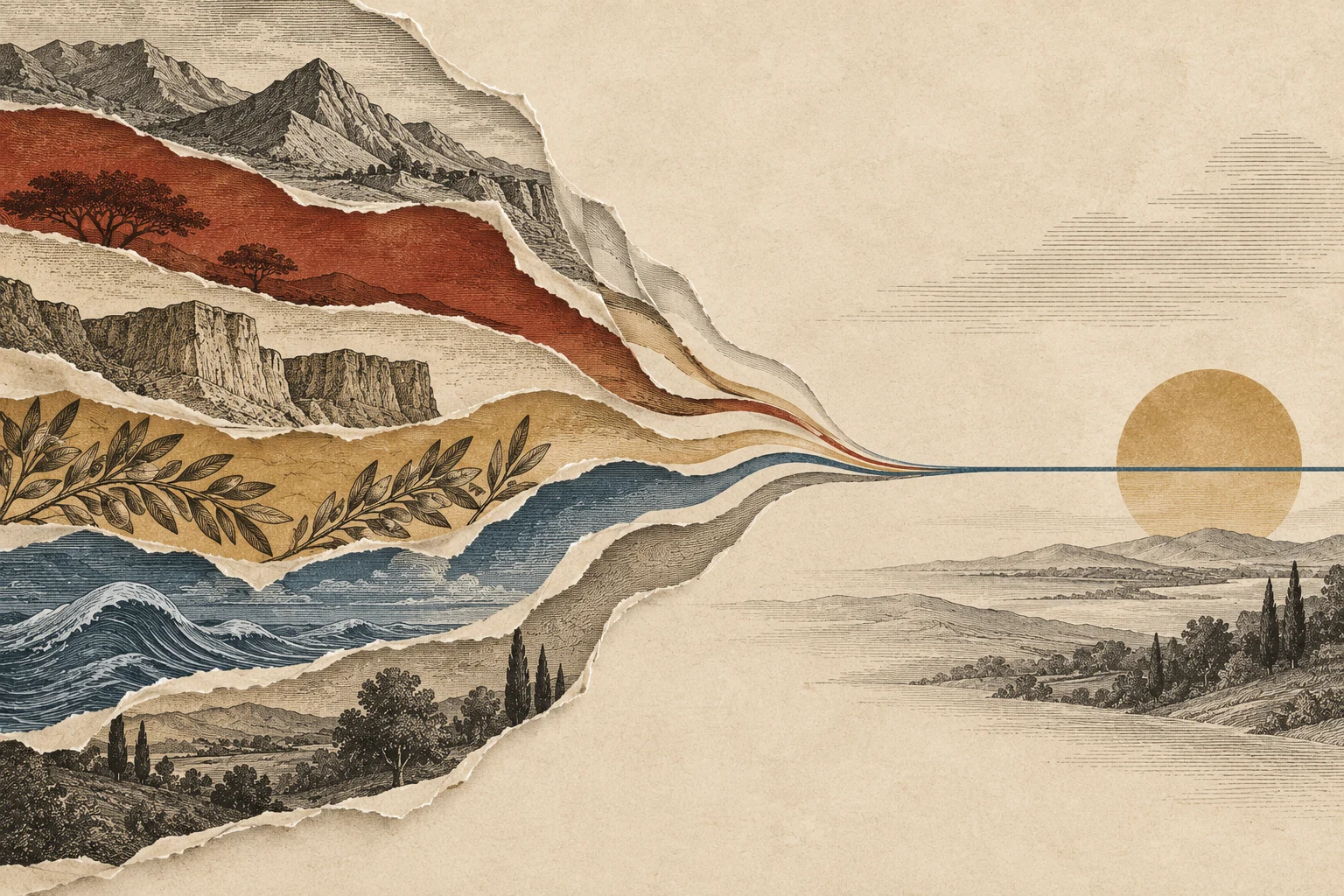
Ask who wrote almost any book and the answer is a name. Ask who wrote the Bible and the honest answer is a story, one that stretches across roughly fifteen centuries, two languages and part of a third, three continents, and some forty human authors ranging from kings to fishermen. Yet the question has a second, deeper layer, for the Bible's own claim is that behind the forty stands One. "All scripture is given by inspiration of God," Paul writes, and Peter describes the process from the human side: "holy men of God spake as they were moved by the Holy Ghost."1 Any full answer to the question must therefore deal with both levels, the men who held the pen and the God who breathed the message.
The Human Authors
Scripture never hides its human authorship, and it never presents that authorship as a single kind of activity. Moses is commanded to write, and the first five books, the Torah, have been attached to his name from the earliest times.2 David and Asaph and the sons of Korah composed psalms, and many carry superscriptions naming their authors. Solomon is credited with the heart of Proverbs and with Ecclesiastes and the Song. The prophets, Isaiah through Malachi, speak in their own names and frequently date their oracles to specific reigns, the way Luke would later anchor his narrative to the fifteenth year of Tiberius Caesar.3 Some books name no author at all, Job, Judges, Ruth, Kings, Esther, Hebrews among them, and honesty requires saying so rather than inventing certainty the text does not offer.
The New Testament follows the same pattern. Paul signs thirteen letters, often adding a greeting in his own large handwriting as a mark of authenticity.4 Peter, James, John, and Jude write in their own names. The four Gospels are formally anonymous on the page, but the church that received them attached the names Matthew, Mark, Luke, and John from the beginning, and the earliest external testimony we possess, from men such as Papias and Irenaeus in the second century, is unanimous in those attributions.5 Luke opens his Gospel with a historian's preface, telling Theophilus that he had "perfect understanding of all things from the very first" and wrote "in order," drawing on eyewitnesses and ministers of the word.6
The diversity among these writers is part of the point. Moses was trained in the learning of Egypt, Amos was a herdsman, Matthew collected taxes, Luke practiced medicine, Paul studied under Gamaliel, John mended nets. They wrote law, history, poetry, proverb, prophecy, biography, and correspondence. No committee planned the collection, and no editor smoothed its voices into one. The styles remain unmistakably individual, which is exactly what the doctrine of inspiration leads us to expect.
The Divine Author
For the Bible's claim is not that God dictated to secretaries, with the men reduced to recording equipment. The claim is stranger and richer. "God, who at sundry times and in divers manners spake in time past unto the fathers by the prophets," Hebrews begins, and the phrase divers manners covers visions, history, poetry, argument, and song.7 Peter's word for the process, "moved by the Holy Ghost," is the word used elsewhere of a ship carried along by the wind.8 The sailors work, the sails fill, the vessel moves, and yet the power and the direction are not their own. So the prophets wrote out of their own vocabularies, circumstances, and griefs, and what resulted was, in the Bible's own estimate, "the word of the LORD."
This is why Scripture can quote Scripture as God speaking even where the original text is a narrator's line, and why the Lord Jesus could settle disputes with the words "it is written," treating the text as final.9 He affirmed the law and the prophets down to the smallest letter, "one jot or one tittle shall in no wise pass from the law, till all be fulfilled."10 Whoever wishes to take Christ seriously inherits His estimate of the book.
How the Books Became One Book
Skeptics sometimes picture the Bible as assembled late, by councils with agendas, selecting winners from a crowded field. The historical record is considerably less dramatic. The books of the Old Testament were already a recognized collection long before the time of Christ; Jesus referred to "the law of Moses, and in the prophets, and in the psalms" as a known threefold whole.11 For the New Testament, the churches received apostolic writings as authoritative from the start; Peter already classes Paul's letters with "the other scriptures."12 The tests the early church applied were sober ones: Was it written by an apostle or a close companion of one? Did it agree with the faith already delivered? Was it received and read in the churches from the beginning? Later councils did not confer authority on the books; they recognized and listed the books whose authority long use had already proven, the way a jeweler certifies gold he did not create.13
Why the Answer Matters
If the Bible were only the work of forty men, it would still be the most remarkable library antiquity produced, but its commands would carry no more weight than the counsel of the dead. If it is also the work of God, then it is not merely a record of what people once believed about Him; it is His word to us, and its promises are as good as His character. The unity of the book argues for the second answer. Across fifteen centuries the writers tell one story, of one God, one ruin, one promised Redeemer, and one salvation, a coherence no human coordination can explain, since most of the writers never met.
The Bible's own summary is the right place to end. "The prophecy came not in old time by the will of man: but holy men of God spake as they were moved by the Holy Ghost."14 Forty hands, one Author. The reader who opens it is not overhearing the religious past. He is being addressed.
Scripture quotations are from the King James Version.
-
2 Timothy 3:16; 2 Peter 1:21. ↩
-
Exodus 17:14; Deuteronomy 31:9 and 24. The Lord Jesus attributes the Torah to Moses in John 5:46 and 47. ↩
-
Isaiah 1:1; Luke 3:1. ↩
-
2 Thessalonians 3:17; Galatians 6:11. ↩
-
The external testimony is surveyed in this ministry's article "The Reliability of the Gospels: Can We Trust the New Testament?", theologyinfocus.org. ↩
-
Luke 1:1 through 4. ↩
-
Hebrews 1:1. ↩
-
2 Peter 1:21; the same verb appears in Acts 27:15 and 17 of the storm-driven ship. ↩
-
Matthew 4:4, 7, and 10; Matthew 19:4 and 5, where the narrator's words of Genesis 2:24 are cited as the Creator's own saying. ↩
-
Matthew 5:18. ↩
-
Luke 24:44. ↩
-
2 Peter 3:15 and 16. ↩
-
The manuscript and canonical evidence is treated at greater length in "Is the Bible Reliable?", theologyinfocus.org. ↩
-
2 Peter 1:21. ↩
You May Also Enjoy
 Lesson 6: Called into His Kingdom and Glory — 1 Thessalonians 2:10-12
 Lesson 5: Shepherding with a Tender Heart — 1 Thessalonians 2:7-9
 Lesson 4: Leading from the Fire — 1 Thessalonians 2:1-6
 The Righteousness of God Revealed: What Paul Means in Romans 1
 Lesson 2: When the Church Gets It Right — 1 Thessalonians 1:1-5
 Lesson 8: Opposition to the Gospel Then and Now — 1 Thessalonians 2:15-16