Jesus told this parable on the Mount of Olives, in the last week of His life, in answer to a question His disciples had asked about the sign of His coming and the end of the age. It follows immediately upon His plainest statement about the timing of that coming: "But of that day and hour knoweth no man, no, not the angels of heaven, but my Father only."1 The parable is what He said next, and it is addressed to people who must live in the interval without knowing its length.
"Then shall the kingdom of heaven be likened unto ten virgins, which took their lamps, and went forth to meet the bridegroom. And five of them were wise, and five were foolish."2
Ten Who Looked Alike
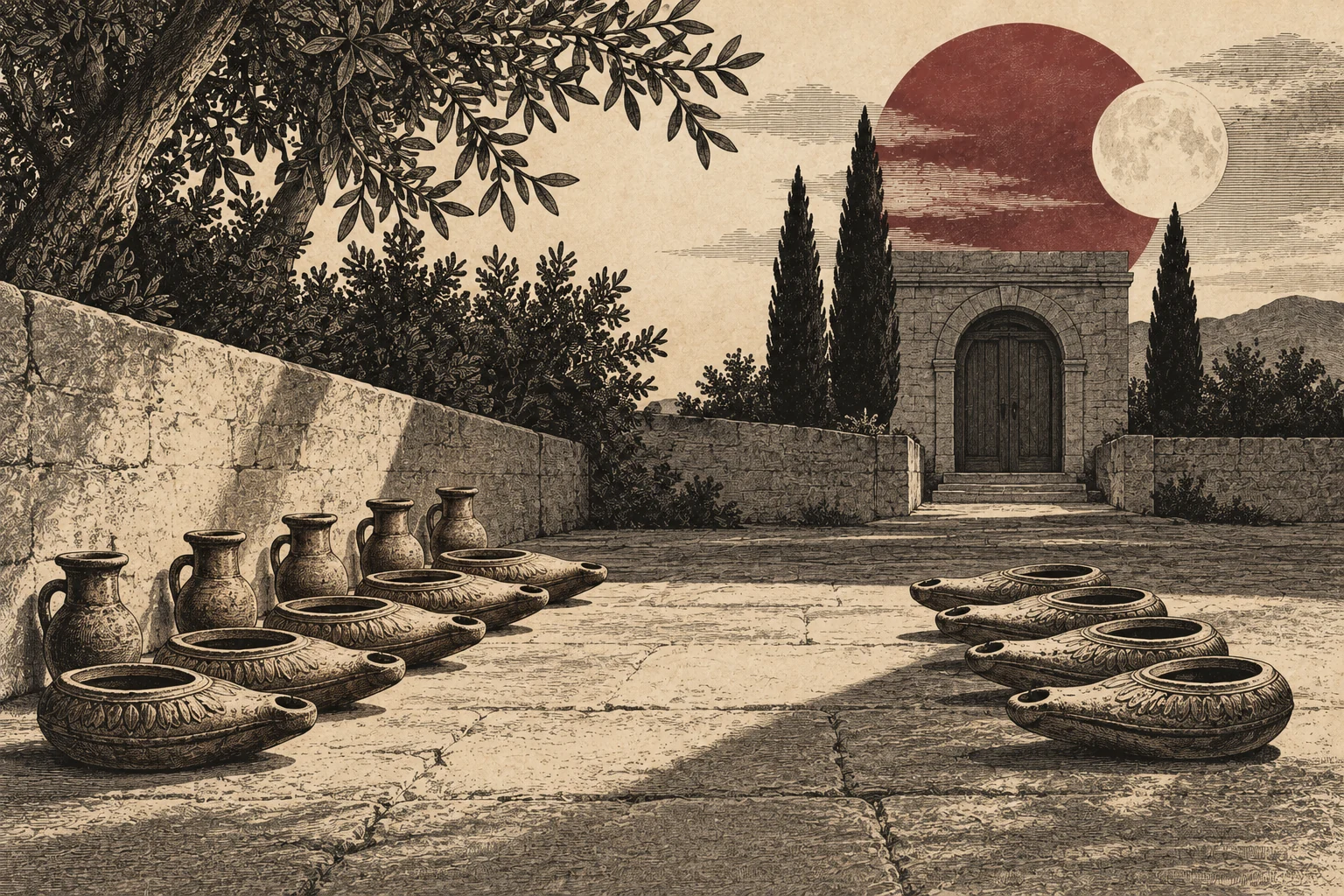
The setting was familiar to everyone listening. A wedding in that country did not run to a printed hour. The bridegroom came to fetch his bride, often after dark, and a procession went out to meet him carrying light. The attendants who formed that procession had one duty: to be there, with lamps burning, whenever he arrived. Their lamps were small clay vessels burning olive oil through a wick, and a full one lasted a few hours at most.
Five of the ten brought oil in separate vessels. Five brought lamps and no reserve.
That is the whole difference, and almost none of it was visible. All ten had been invited. All ten came out. All ten carried lamps, and at the beginning of the evening every lamp was burning, because a lamp with a little oil in it burns exactly like a lamp with a great deal. Nothing in the scene distinguished the wise from the foolish while the waiting was easy.
"While the bridegroom tarried, they all slumbered and slept."3 All ten. The sleeping is not the failure in this parable, and it is a mistake to read it as one. The delay came, the night wore on, and every one of them slept. What separated them was decided before any of them lay down.
The Cry at Midnight
"And at midnight there was a cry made, Behold, the bridegroom cometh; go ye out to meet him. Then all those virgins arose, and trimmed their lamps."4
Midnight is the hour of least readiness, which is why Jesus chose it. All ten woke and all ten did the same thing, which was to trim the wicks and prepare to walk. It was in that ordinary action that the difference finally showed. "And the foolish said unto the wise, Give us of your oil; for our lamps are gone out."5
The answer they received rests on the nature of the thing they lacked. "Not so; lest there be not enough for us and you: but go ye rather to them that sell, and buy for yourselves."6 This is not selfishness, and the parable does not present it as a fault. It is a statement about the nature of the thing lacking. Some things can be handed across in an emergency and some cannot. A man may lend a lamp. He cannot lend the years in which another man should have been getting ready.
That is the point the parable emphasizes most, and it lays that emphasis against the most common form of religious presumption. Readiness cannot be borrowed. It does not pass from a parent to a child, from a wife to a husband, from a congregation to the person sitting in it. The oil in one vessel could not answer for the lack in another.
The Door
"And while they went to buy, the bridegroom came; and they that were ready went in with him to the marriage: and the door was shut."7
Three facts arrive in one sentence. He came. The ready went in. The door was shut. In that culture the shutting of the door was ordinary practice once the feast had begun, both custom and security, and the parable uses the ordinary custom to say something final.
"Afterward came also the other virgins, saying, Lord, Lord, open to us. But he answered and said, Verily I say unto you, I know you not."8
They call him Lord, twice, which is the same doubled address Jesus had already used in the Sermon on the Mount when He warned that "Not every one that saith unto me, Lord, Lord, shall enter into the kingdom of heaven."9 The answer given here is the answer given there. It is not a claim that he had never heard of them. It is a refusal to acknowledge them as his.
Beyond that, Jesus does not say. He does not give the inner history of the five who were shut out, and He does not say at what point their case became hopeless. He says the door was shut, and He gives the bridegroom's words, and there He stops.
What the Oil Is
Jesus did not explain the oil or the lamps. It has long been held that the oil is the Holy Spirit and the lamp the heart, or the vessel that carries Him, and that appears to be the proper interpretation. Oil stands for the Spirit through much of Scripture, and nothing else in the parable accounts so well for something genuinely possessed, invisible from outside, and impossible to hand to another.
The oil had to represent something, or Christ would not have mentioned it at all. What the story establishes about it is sufficient: it was necessary, it could not be seen from outside, it had to be obtained beforehand, and none of it could be given away at midnight.
Watch Therefore
"Watch therefore, for ye know neither the day nor the hour wherein the Son of man cometh."10
That is the parable's own application, given by the one who told it, and it governs everything else. Two things stand behind it.
The first is when the arrival happens. This parable sits in the Olivet Discourse, and the arrival in view is the coming of the Son of man, the same coming described a few paragraphs later when He comes in His glory with all the holy angels. The reckoning of the ten is not a private reckoning at the end of each life. It is the arrival itself, and it falls on everyone waiting at once.
Paul writes to the Thessalonians in the same terms and draws the opposite conclusion from the one people usually draw. He grants that "the day of the Lord so cometh as a thief in the night,"11 and then says that this is precisely why the church is not to be caught out by it: "Ye are all the children of light, and the children of the day: we are not of the night, nor of darkness."12 The suddenness of the arrival is not an excuse for being unready. It is the reason readiness has to be continuous.
Luke records the same charge in the same imagery of lamps and waiting servants: "Let your loins be girded about, and your lights burning."13 The picture there is of men waiting through the night for a master returning from a wedding, and the instruction is not to prepare when he knocks but to be found already prepared.
The second is that nobody is told when. Jesus states the ignorance as a fact and then commands watchfulness on the strength of it. If the hour were known, preparation could be scheduled and postponed until shortly before. Because it is not known, readiness has to be a settled condition rather than an errand.
The five who were shut out were not lazy at midnight. They moved as fast as anyone, and they went to buy the moment they discovered the lack. Their error was earlier and quieter than that: they had judged the wait by its beginning, when a nearly empty lamp burns as brightly as a full one, and they had never asked what would happen if the bridegroom were long in coming.
He was long in coming. He came anyway. That is the parable.
The parable ends at a wedding, and the wedding is not incidental. John hears the announcement of it at the end of the story: "Blessed are they which are called unto the marriage supper of the Lamb."14 The five who went in were not rewarded with an escape from something. They were brought in to a feast.
-
Matthew 24:36, KJV. ↩
-
Matthew 25:1-2, KJV. ↩
-
Matthew 25:5, KJV. ↩
-
Matthew 25:6-7, KJV. ↩
-
Matthew 25:8, KJV. ↩
-
Matthew 25:9, KJV. ↩
-
Matthew 25:10, KJV. ↩
-
Matthew 25:11-12, KJV. ↩
-
Matthew 7:21, KJV. ↩
-
Matthew 25:13, KJV. ↩
-
1 Thessalonians 5:2, KJV. ↩
-
1 Thessalonians 5:5, KJV. ↩
-
Luke 12:35, KJV. ↩
-
Revelation 19:9, KJV. ↩
You May Also Enjoy
 Behold, the Bridegroom Comes: The Ten Virgins and the Visible Church
 The Parable of the Unjust Steward: Wise Stewardship and Eternal Investments
 The Parable of the Ten Minas: Faithful Service and the Reward of Stewardship
 The Parable of the Two Debtors: Understanding Forgiveness and Gratitude
 The Parable of the Talents: Faithful Stewardship of God-Given Gifts
 The Parable of the Faithful Servant and the Evil Servant: Vigilance and Stewardship