The parable is two verses long, and it answers a question nobody in the crowd had dared to ask out loud.
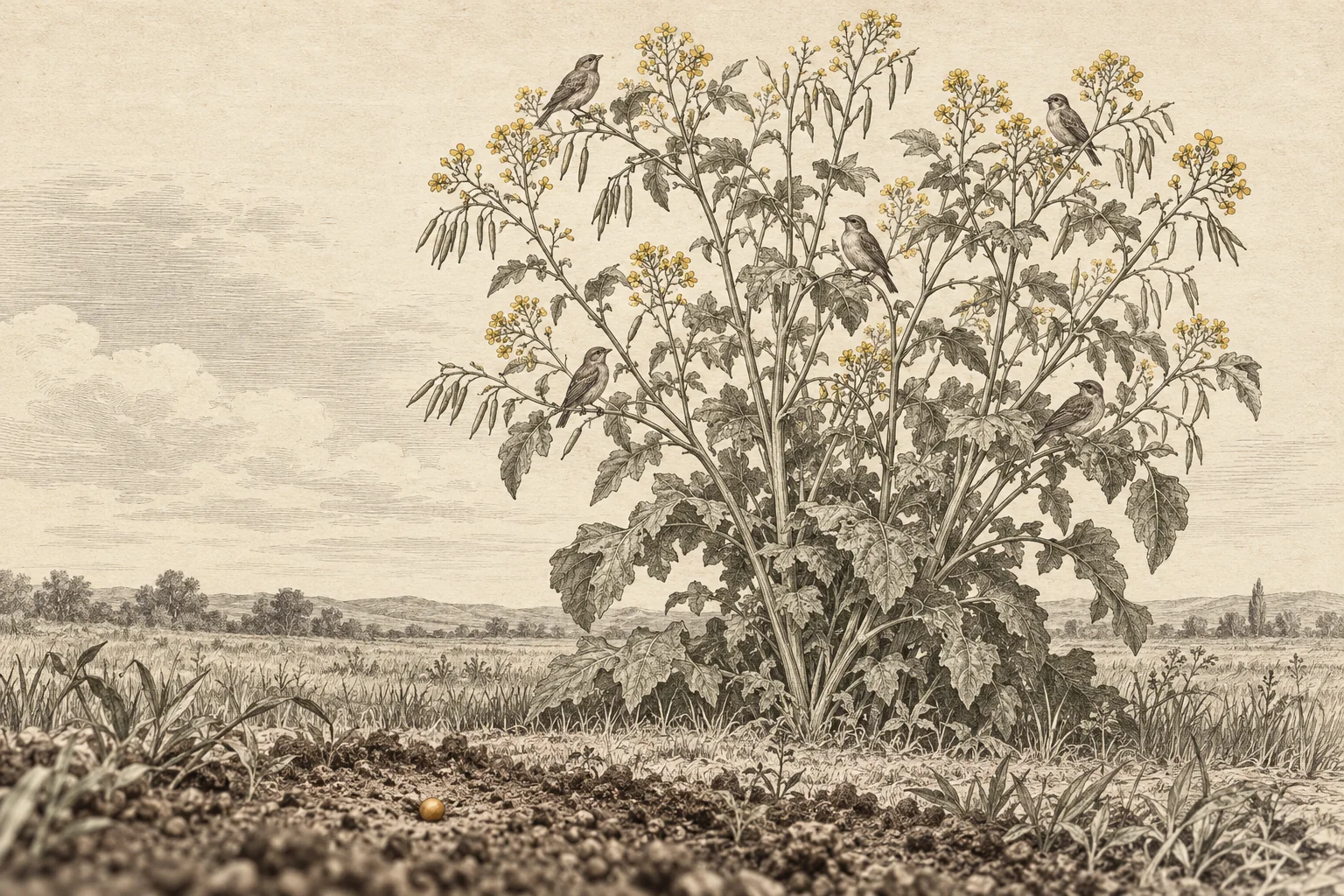
"Another parable put he forth unto them, saying, The kingdom of heaven is like to a grain of mustard seed, which a man took, and sowed in his field: Which indeed is the least of all seeds: but when it is grown, it is the greatest among herbs, and becometh a tree, so that the birds of the air come and lodge in the branches thereof."1
It is the third of the kingdom parables in Matthew 13. The Sower has already explained why the same message produces different results in different hearers. The Wheat and the Tares has already explained why the false grows alongside the true and is not pulled up early. Now Jesus takes up the size of the thing itself.
The Question Underneath
The people listening expected a Messiah who would deal with Rome. That expectation was not foolish and it was not merely political. The prophets had promised a kingdom, and a kingdom in that world meant a throne, an army, and a border.
What stood in front of them was a carpenter from Nazareth and a band of fishermen, a tax collector, and a few others of no particular standing. If this was the kingdom, then the kingdom was very small, and the disciples had eyes and could count. The parable is addressed to that arithmetic.
The Least of All Seeds
"Which indeed is the least of all seeds."2
The phrase has attracted more argument than it deserves. Jesus is not delivering a botanical ruling on the seeds of the world. He is using a proverb His hearers used, in the sense they used it. Among the seeds a Galilean farmer sowed in his own field, the mustard seed was the standard example of the very small, and Jewish teachers used it as a figure for the least quantity imaginable. Jesus Himself uses it that way elsewhere, when He speaks of faith as a grain of mustard seed14.
So the comparison is deliberate and it is not flattering. The kingdom of heaven, He says, begins at the size of the smallest thing a farmer handles.
Mark and Luke both preserve the parable, and each adds something Matthew leaves out. Mark records the question Jesus asked before He told it: "Whereunto shall we liken the kingdom of God? or with what comparison shall we compare it?"3 That is a teacher searching for the right figure in front of His hearers, and the figure He settles on is the smallest one available. Mark then places even greater emphasis on the smallness than Matthew does, calling the seed "less than all the seeds that be in the earth."4 Luke moves the scene from the open field to a garden: "It is like a grain of mustard seed, which a man took, and cast into his garden; and it grew, and waxed a great tree."5 Between the three accounts the point is the same and the emphasis shifts slightly, from the field to the garden, from the sowing to the growing.
The verse carries a second detail. "Which a man took, and sowed in his field." Someone took it and someone sowed it. The kingdom does not spread the way a weed spreads, by accident and neglect. It is planted, deliberately, by people who go out and do it, and the smallness of the seed does not excuse anyone from the sowing.
The Greatest Among Herbs
"But when it is grown, it is the greatest among herbs, and becometh a tree."6
The black mustard grown in that country was cultivated for its seed, used as a spice and in medicine, and in good conditions it grew fast and grew tall, reaching ten or twelve feet in a season. Technically it remained a herb. In practice a man could stand under it.
Jesus states the contrast in the plainest possible terms: least of all seeds, greatest among herbs. The distance between those two phrases is the whole parable, and no part of it is explained by the seed being unusually good. It was the smallest. What is remarkable is not the seed but what happens to it in the ground.
This is the pattern of God's working throughout Scripture rather than an exception to it. A shepherd boy against a giant. An army sent home in waves until three hundred men were left. A virgin's womb. A cross, which by every visible measure was the end of the movement and was in fact its beginning. The kingdom does not advance by accumulating the resources that impress people, and it never has.
Paul states the principle directly, and states the reason for it. God "hath chosen the foolish things of the world to confound the wise; and God hath chosen the weak things of the world to confound the things which are mighty."7 The reason follows in the next verses: that no flesh should glory in His presence. Smallness at the beginning is not an obstacle God works around. It is the condition He selects, so that when the tree stands there is no question who grew it.
Zechariah put the same rebuke as a question to men discouraged by the size of what they were building: "For who hath despised the day of small things?"8 It was asked of a generation laying a temple foundation that looked like nothing beside the one their fathers remembered. The question has not changed.
Shelter for the Nations
"So that the birds of the air come and lodge in the branches thereof."9
The closing image would have registered with anyone who knew the prophets. Ezekiel describes a tender twig planted by God on a high mountain, growing into a goodly cedar, "and under it shall dwell all fowl of every wing."10 Ezekiel uses the same picture for Assyria, in whose boughs "all the fowls of heaven made their nests."11 Daniel uses it of Nebuchadnezzar's kingdom, where "the fowls of the heaven dwelt in the boughs thereof."12
In every case the great tree sheltering birds is an empire, and the birds are the peoples living under it. Jesus takes the image the prophets used for the great kingdoms of the earth and applies it to a mustard plant.
Mark's wording of the ending is worth setting beside Matthew's. The plant "shooteth out great branches; so that the fowls of the air may lodge under the shadow of it."13 Shadow is the word an ancient reader associated with the protection of a king. What began as the least seed in the field ends as the thing under whose shadow the birds are safe.
The word rendered "lodge" carries the sense of settling and dwelling rather than pausing. These are not birds resting a moment on a branch. They are birds that have made their home there. The tree that grew from the smallest seed becomes the place where the nations live.
That is the promise given to Abraham, that in him all families of the earth would be blessed15, arriving by a route nobody would have predicted. The kingdom that began with a handful of Galileans becomes shelter for peoples who had no part in Israel at all.
The Shelter of the Gospel Among the Nations
The prophets had already given the birds their meaning. Of the great cedar Ezekiel wrote, "under his shadow dwelt all great nations."16 The birds that lodge in the branches are the nations that come to lodge under the kingdom.
History has given that promise a visible shape. As the gospel moved into the nations it went from the pulpit into the pews, from the pews into the hearts and minds of the people, and from there into the schools, the shops, the farms, and the offices of government. It carried the conviction that God made man in His own image17, that men are to treat others as they would be treated18, and that "God is no respecter of persons."19 From these came the idea of Christian liberty, and with it the idea that a man's rights are given by God and not by government.
The opponents of the American Revolution traced it to the pulpit. The Loyalist Peter Oliver blamed "Mr. Otis's Black Regiment, the dissenting Clergy,"20 the ministers in their black gowns. William Jones, an adviser to the king, called it "a Presbyterian war from the beginning,"21 and a Hessian captain wrote home that it was "nothing more nor less than an Irish-Scotch Presbyterian Rebellion."22 The Declaration of Independence stated the conviction plainly: men "are endowed by their Creator with certain unalienable Rights."23
The nations formed in this way, and the Protestant nations most of all because they held most closely to the gospel, became a refuge for the peoples of the world. Within them slavery and the brutality of tyranny were slowly brought down, and people from every part of the world still come to them for the life they offer. Where a people turns from the gospel, corruption creeps in, the drift is toward socialism or dictatorship, and the life of the individual grows poorer.
What the Parable Asks of the Discouraged
The parable is aimed at a particular kind of discouragement. It is not the discouragement of failure. It is the discouragement of smallness: work that is real and faithful and looks like nothing.
Jesus does not answer that discouragement by promising quick results, and He does not answer it by telling anyone their work is bigger than it appears. He answers it by identifying where the growth comes from. A seed does not become a tree because the sower is impressive. It becomes a tree because that is what is in the seed and because God gives the increase.
Two things follow. The first is that no one is excused from sowing on the grounds that his portion is small. Somebody took that seed and put it in the ground, and had he judged it by its size he would have thrown it away. The second is that no one is entitled to measure the kingdom by what he can see of it this year. The mustard seed spends a period underground doing nothing that anyone can observe, and the man watching the field would be wrong to conclude that nothing is happening.
The kingdom of heaven began at the size of the smallest seed in a Galilean field, and the nations are lodging in its branches. That is the parable, and it is a plain word to anyone whose work at present looks too small to matter.
-
Matthew 13:31-32, KJV. ↩
-
Matthew 13:32, KJV. ↩
-
Mark 4:30, KJV. ↩
-
Mark 4:31, KJV. ↩
-
Luke 13:19, KJV. ↩
-
Matthew 13:32, KJV. ↩
-
1 Corinthians 1:27, KJV. ↩
-
Zechariah 4:10, KJV. ↩
-
Matthew 13:32, KJV. ↩
-
Ezekiel 17:23, KJV. ↩
-
Ezekiel 31:6, KJV. ↩
-
Daniel 4:12, KJV. ↩
-
Mark 4:32, KJV. ↩
-
Matthew 17:20, KJV. ↩
-
Genesis 12:3, KJV. ↩
-
Ezekiel 31:6, KJV. ↩
-
Genesis 1:27, KJV. ↩
-
Matthew 7:12, KJV. ↩
-
Acts 10:34, KJV. ↩
-
Peter Oliver, Origin and Progress of the American Rebellion (1781). ↩
-
William Jones, "An Address to the British Government on a Subject of Present Concern" (1776), in The Theological, Philosophical and Miscellaneous Works of the Rev. William Jones (London, 1801), 12:356. ↩
-
Johann Heinrichs to the Counsellor of the Court, January 18, 1778, in "Extracts from the Letter Book of Captain Johann Heinrichs of the Hessian Jager Corps, 1778-1780," Pennsylvania Magazine of History and Biography 22 (1898): 137. ↩
-
Declaration of Independence, July 4, 1776. ↩
You May Also Enjoy
 The Parable of the Growing Seed: The Mystery of Kingdom Growth
 Lesson 6: Called into His Kingdom and Glory — 1 Thessalonians 2:10-12
 The Parable of the Hidden Treasure: Valuing the Kingdom of Heaven Above All Else
 Christ Is the End of the Law
 The Righteousness of God Revealed: What Paul Means in Romans 1
 The Parable of the Sower