Few questions matter more to the honest inquirer than whether the Bible can be trusted. If its record is corrupt, its history invented, or its text hopelessly altered across the centuries, then whatever comfort it offers rests on sand. The question deserves a direct answer rather than a defensive one. When the evidence is examined on its own terms, the Bible proves to be a remarkably well attested collection of documents, transmitted with care, corroborated by history, and internally consistent across a span of writers and centuries that no ordinary book could survive.
The Manuscript Record
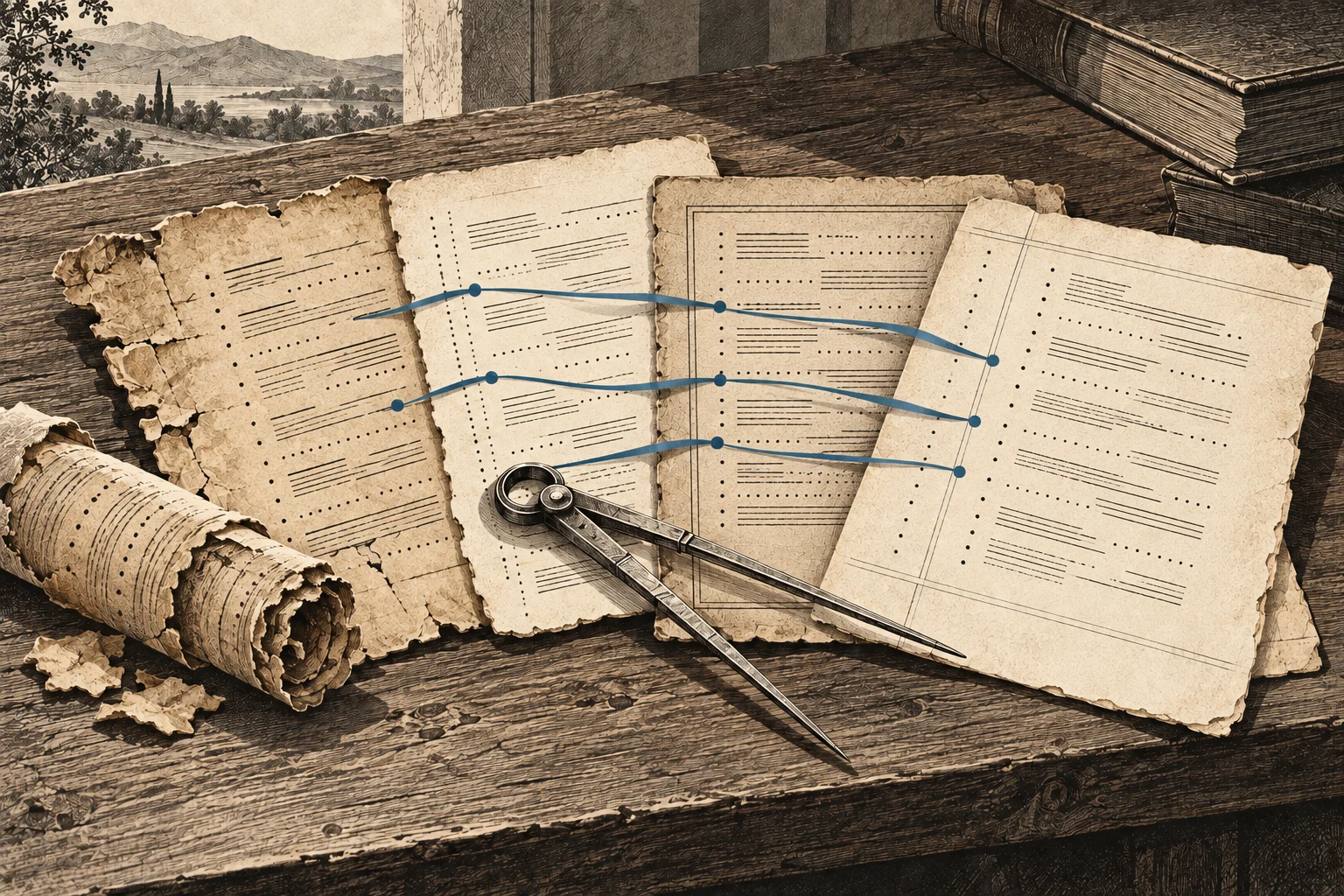
The reliability of any ancient writing begins with the question of transmission. How well has the text been preserved from its origin to the present? For the New Testament the answer is without parallel in the ancient world. Thousands of Greek manuscripts survive, along with many thousands more in early translations, and the earliest fragments stand close in time to the events they record. Where the surviving copies of most classical works number in the handful and stand centuries removed from their originals, the New Testament is preserved in an abundance that allows its wording to be established with high confidence. The variations that exist among the copies are overwhelmingly minor matters of spelling and order, and none of them places any article of the faith in doubt.
The Old Testament was preserved by scribes whose reverence for the text produced habits of extraordinary care. The discovery of ancient scrolls at the Dead Sea, copies far older than those previously known, confirmed that the text had been handed down across many centuries with striking fidelity. The words that the church reads today are, to a degree few realize, the words that were written.
History and Archaeology
The Bible does not present its message in a vacuum. It names kings, cities, customs, and events, and it invites examination. Repeatedly, places and peoples once dismissed as legendary have been confirmed by the spade of the archaeologist. The Gospel writers in particular anchor their accounts in verifiable settings. Luke opens his account by declaring that he has traced everything carefully "from the very first," writing so that his reader might "know the certainty of those things" in which he had been instructed.1 That is the language of a careful historian, not a myth maker, and the ministry has treated this evidence at length in its study of the reliability of the Gospels.2
Consistency Across the Centuries
The Bible was written over a long period by many hands, in different places and circumstances, yet it tells one continued story with a single unfolding purpose. Such coherence is not what one would expect from a collection assembled by chance or invented by design. The apostle Peter insisted that the message rested on eyewitness testimony rather than invention, writing that "we have not followed cunningly devised fables" but had been "eyewitnesses of his majesty."3 The witnesses recorded events that were public, datable, and open to challenge, and they recorded details unflattering to themselves, the mark of men more concerned with truth than reputation.
The Ground of Confidence
The evidence of manuscript, history, and coherence answers the skeptic on his own ground, and answers him well. Yet Scripture claims more for itself than mere accuracy. It claims to be breathed out by God Himself, for "all scripture is given by inspiration of God," which is to say that it proceeds from His own mouth.4 For this reason the Lord could answer that "man shall not live by bread alone, but by every word that proceedeth out of the mouth of God."5 The word that God has spoken is not information only but life. From His mouth it comes to the ear of His people, and by that word they live. While the believer dies daily in the flesh, in receiving that word he increases, living more and more upon it, for "the grass withereth, the flower fadeth: but the word of our God shall stand for ever."6 The One who spoke it has also kept it, so that its preservation across the ages is not an accident of scholarship but the outworking of a promise. The Bible is reliable, then, on two accounts that meet in one. It bears the marks of a trustworthy record when tested as history, and it is the very breath of the God who gave it.
Scripture quotations are from the King James Version.
You May Also Enjoy
 Christ Is the End of the Law
 Lesson 6: Called into His Kingdom and Glory — 1 Thessalonians 2:10-12
 The Reliability of the Gospels: Can We Trust the New Testament?
 The Righteousness of God Revealed: What Paul Means in Romans 1
 Lesson 5: Shepherding with a Tender Heart — 1 Thessalonians 2:7-9
 Covenant Prayer, Not Anxious Pleading