No question in soteriology has divided sincere Christians more persistently, and few have been answered with less care. The reason is that Scripture speaks with two voices on the matter, and both are inspired, both are emphatic, and both are addressed to the same believing congregations, sometimes within the same letter. Most answers on offer achieve their clarity by silencing one voice. A better answer begins by refusing to do that.
The Two Voices
The security texts speak in absolute terms. Christ says of His sheep that they "shall never perish, neither shall any man pluck them out of my hand."1 Paul writes that whom God justified, "them he also glorified," every verb an accomplished act.2 The work begun will be performed "until the day of Jesus Christ."3 Believers are kept by the power of God, and the word Peter chooses is a military one, meaning garrisoned, held under guard.4
The warning texts speak with equal seriousness. Hebrews declares it impossible for those once enlightened, who tasted the heavenly gift and were made partakers of the Holy Ghost, to be renewed again unto repentance if they fall away.5 Willful sin after receiving the knowledge of the truth leaves "no more sacrifice for sins."6 Paul warns the confident man to take heed lest he fall.7
Both sets stand. The history of this doctrine is largely the history of how the churches have subordinated one to the other.
Losing and Walking Away Are Not the Same Question
The confusion dissolves once two questions are separated. To lose something is to have it taken by accident, by weakness, by another's act, or by one's own stumble. Scripture closes that door completely. No sin of weakness, no failure, no season of backsliding, no creature and no enemy removes the offering from the altar. The promise of John 10 answers precisely this: the verb translated "pluck" means to seize by force, and the promise is that no external power can accomplish it.8
The warnings of Hebrews describe something else entirely. They describe a man who deliberately, with open eyes, repudiates Christ as his offering. He did not lose his salvation through weakness. He walked away from it by decision. Renewal is then impossible, not because God has become unwilling, but because the man has pulled the only offering off his own altar. There remains no more sacrifice for sins, and without shedding of blood there is no remission.9
The decisive word is "renew." A thing can only be renewed if it was possessed the first time. The warned man in Hebrews 6 was genuinely enlightened, genuinely a partaker, genuinely sanctified by the covenant blood.10 Any reading that makes him a pretender who was never saved empties the word of meaning.
So the answer to the question as ordinarily asked is no. A Christian cannot lose salvation.
God Inspects the Lamb, Not the Worshiper
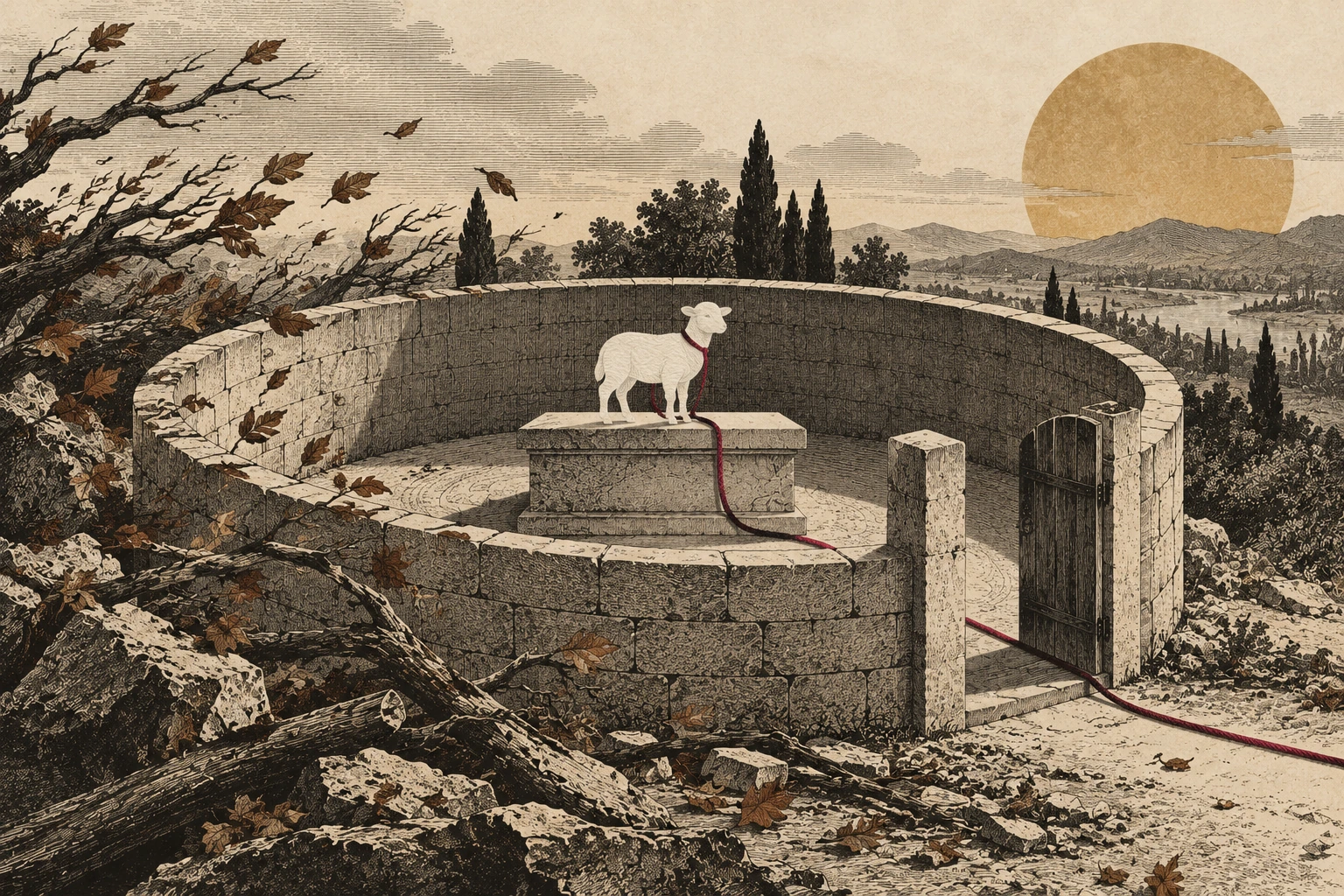
The ground of that security is not the believer's grip but the sufficiency of the offering. Under the Levitical system the priest examined the sacrifice, not the man who brought it. By one offering Christ has perfected forever them that are sanctified.11 As long as Christ is on the altar, the worshiper stands accepted, because the inspection falls on the Lamb.
Scripture stacks the grounds deliberately. The Son's hand and the Father's hand hold the sheep.12 The Son ever lives to make intercession, and He prayed for Peter's faith before Peter ever denied Him.13 The Spirit seals believers unto the day of redemption.14 The Father who began the work will perform it, for a Father who adopts a child feeds him.15 Not one of these grounds is conditioned on the believer's performance.
The Backslider Is Not the Apostate
Pastoral damage follows when these two figures are confused, and they are confused constantly.
The backslider is discouraged, defeated, and ashamed. His sin grieves him. He has pulled nothing off the altar, and his standing is untouched. Peter denied his Lord three times with oaths, and no text says his standing lapsed in the interval; he was restored and commissioned.16 The word to the backslider is that God does not hate him, and that restoration is the ordinary expectation.17
The man Hebrews warns is different in kind, not in degree. He is deliberate rather than defeated, unashamed rather than grieved, and he counts the blood of the covenant an unholy thing.18 The register of the Greek is the high-handed sin of Numbers 15, for which the Law provided no sacrifice at all, as distinct from the sins of ignorance and weakness for which the entire sacrificial system existed.19 No warning passage anywhere names weakness, discouragement, or moral failure as the act that ends salvation.
Why Both Familiar Answers Are Refused Here
Two traditional resolutions are widely taught, and each pays its price in one set of texts.
The Arminian resolution holds that sin forfeits salvation. It honors the warnings and mistakes what triggers them, since no sin of weakness ever pulled Christ off an altar.
The Calvinist resolution holds that whoever finally falls was never truly saved. It honors the promises and forces the warnings, since it must read genuine enlightenment, genuine participation in the Spirit, and genuine sanctification as descriptions of men who possessed none of it. The framework is not apostolic. It first appears with Augustine in AD 428, in a treatise arguing that perseverance is a distinct gift given only to the elect, and it was sharpened by Calvin into the doctrine of a temporary faith.20 For the first four centuries every source that addresses the question assumes the baptized can fall; the debate was never whether but how restoration works. The Council of Trent in 1547 condemned both the claim that the justified cannot fall and the claim that the fallen were never justified, and the Eastern churches never received the Reformed formulation at all.
Both voices can be preached untrimmed because there are two companies in view. Some are foreknown and given by the Father to the Son, predestined to be conformed to the image of the Son, and they will never walk away because God has determined that they will not.21 Others receive Him genuinely and are justified on the same ground by the same verdict, and the warnings are written for them. No one, including the preacher, knows which company he is in, and for the man who keeps Christ on the altar it will never matter.
Assurance, at Full Strength
The practical consequence is that assurance may be preached to every believer as a believer, without hedging and without inviting anyone to audit his own conversion for signs of authenticity. Assurance rests on the offering, not on successful self-examination. The believer who fears he has fallen too far has, by that very grief, demonstrated which figure he is.
Salvation cannot be lost by any sin, weakness, or enemy. It can only be abandoned by a man who deliberately takes the offering off his own altar, and that act is rare, public, and final. For everyone else the word is unchanged: if Christ is on the altar, the case is closed.
Scripture quotations are from the King James Version.
-
John 10:27-28, KJV. ↩
-
Romans 8:30, KJV. ↩
-
Philippians 1:6, KJV. ↩
-
1 Peter 1:5, KJV. ↩
-
Hebrews 6:4-6, KJV. ↩
-
Hebrews 10:26, KJV. ↩
-
1 Corinthians 10:12, KJV. ↩
-
John 10:28-29. The verb is harpazo, to seize by force. ↩
-
Hebrews 10:26; Hebrews 9:22, KJV. ↩
-
Hebrews 6:4-6; Hebrews 10:29. The verb in Hebrews 6:6 is anakainizein, to restore to a former state. ↩
-
Hebrews 10:14; Leviticus 17:11. ↩
-
John 10:28-29. ↩
-
Hebrews 7:25; Romans 8:34; Luke 22:32. ↩
-
Ephesians 1:13-14; Ephesians 4:30. ↩
-
Philippians 1:6; 1 Thessalonians 5:24. ↩
-
Luke 22:31-32, 61-62; John 21:15-19. ↩
-
Galatians 6:1; 1 John 2:1. ↩
-
Hebrews 10:29, KJV. ↩
-
Hebrews 10:26; Numbers 15:30-31; Leviticus 4. The Greek is hekousios, willfully. ↩
-
Augustine, De Dono Perseverantiae, AD 428-429; John Calvin, Institutes of the Christian Religion, III.2.11-12. ↩
-
Romans 8:29-30; John 6:37; John 10:29. ↩
You May Also Enjoy
 Lesson 6: Called into His Kingdom and Glory — 1 Thessalonians 2:10-12
 Christ Is the End of the Law
 The Righteousness of God Revealed: What Paul Means in Romans 1
 Be Reconciled to God: Why the Finished Work of Christ Must Still Be Received
 Lesson 13: The Cross and the New Creation — Galatians 6:11-18
 Lesson 2: When the Church Gets It Right — 1 Thessalonians 1:1-5