Consider two contracts. One requires nothing of the recipient’s own effort and guarantees the outcome. The other demands exhaustive personal performance yet guarantees failure. The rational choice seems obvious, yet the Galatian believers found themselves hesitating between precisely these two options. Paul, writing with pastoral urgency, could hardly believe what he was witnessing. The churches he had planted in faith were drifting back toward a covenant of bondage.
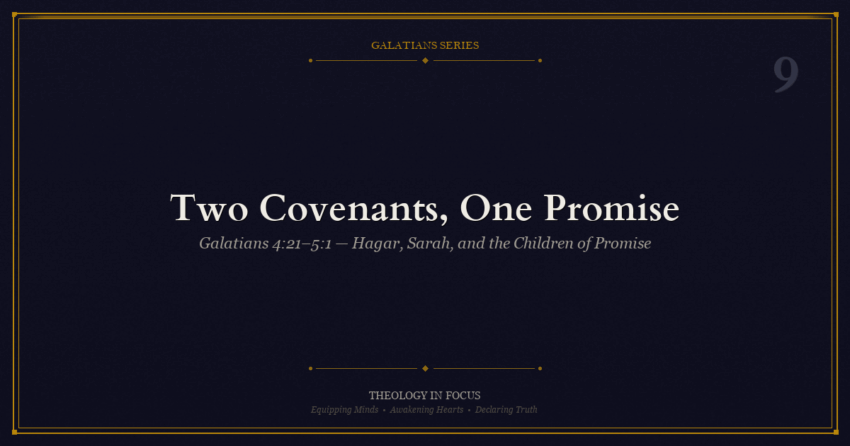
In Galatians 4:21–31, the apostle employs one of the most vivid allegories in all of Scripture. Drawing from the story of Hagar and Sarah, he contrasts two covenants, two mothers, and two kinds of children to demonstrate a truth that every Christian must grasp: inheritance belongs to those born through promise, not through law.
The Historical Foundation: Abraham’s Two Sons
To understand Paul’s allegory, one must first return to the historical narrative in Genesis. When Abraham was seventy-five years old, God promised him a son despite his advanced age and Sarah’s barrenness. For years, Abraham declared that promise faithfully. Yet as time passed, Sarah remained childless, and doubt began to take root.
Rather than waiting on God’s timing, Sarah proposed a culturally acceptable alternative. She offered her Egyptian servant Hagar to Abraham so that he might father a child through her. This practice of surrogate motherhood was well established in ancient Near Eastern custom, documented in legal texts from Nuzi and other Mesopotamian sites.1 Abraham, though initially reluctant, consented.
This decision epitomized something that would become the central issue of Paul’s letter: attempting to fulfill divine promises through human effort rather than trusting in divine grace. Ishmael was born according to the flesh, the product of human reasoning and natural ability. Abraham and Sarah tried to accomplish through their own power what only God could achieve.
But God had not forgotten His word. When Abraham was one hundred years old and Sarah was ninety, Isaac was born. He was the child of promise, coming not through human capability but through divine intervention. God declared, “I will give you a child,” and He did exactly that.
“For it is written, that Abraham had two sons, the one by a bondmaid, the other by a freewoman. But he who was of the bondwoman was born after the flesh; but he of the freewoman was by promise.” (Galatians 4:22–23, KJV)
The Allegory Unveiled: Law and Grace
Paul transforms this historical account into a theological masterpiece. Each woman represents a distinct covenant, and their children exemplify those who live under these covenantal arrangements.
Hagar corresponds to the covenant given at Mount Sinai. She represents the Mosaic law, and her children are those who seek to serve God through legal obedience and ritual performance. Paul writes plainly:
“Which things are an allegory: for these are the two covenants; the one from the mount Sinai, which gendereth to bondage, which is Agar.” (Galatians 4:24, KJV)
Sarah, by contrast, represents the covenant of promise. Her children are those who come to God through faith, trusting not in their own works but in God’s gracious initiative. This is the covenant originally given to Abraham, the covenant that declared God Himself would make all things right between Himself and sinful humanity.
These two covenants cannot be mixed. Paul insists that believers may serve God through one or the other, but not through both simultaneously. No person can have two natural mothers, and no Christian can stand in both covenants at the same time. One is either a child of law or a child of grace.
Two Jerusalems: Bondage and Freedom
Paul sharpens this contrast by introducing two Jerusalems. The “present Jerusalem,” as Paul calls it, refers to the Jewish religious system of his era, with its temple sacrifices, Levitical priesthood, and ceremonial rites still in active practice. He makes the startling declaration that this Jerusalem “is in bondage with her children” (Galatians 4:25, KJV). All who serve under that system, relying on the sacrificial order established through Moses, exist in spiritual bondage.
This is a bold theological claim, and Paul extends it beyond first-century Judaism. Wherever human performance becomes the measure of standing before God, bondage inevitably follows. When churches or denominations establish their own regulations and declare that observance of certain practices determines levels of righteousness, such systems constitute legalism. Righteousness before God is falsely measured by adherence to human customs rather than divine grace.
But Paul immediately presents the contrast:
“But Jerusalem which is above is free, which is the mother of us all.” (Galatians 4:26, KJV)
While God maintains an earthly Jerusalem, it serves only as a shadow of His true dwelling place. The heavenly Jerusalem exists in freedom, sustained not by human attempts at righteousness but by God’s own holiness. God’s holiness perpetually surpasses human holiness. This is the fundamental issue: by which standard will Christians live? Will they depend on God’s holiness received through promise, or on their own holiness manufactured through effort?
The Impossibility of Self-Righteousness
This truth warrants careful consideration. Even the holiest person imaginable falls infinitely short of God’s standard. One might multiply that holiness by a billion, then by a trillion, and it would still remain incomprehensibly distant from the righteousness that God requires. It is comparable to attempting to warm the vastness of outer space with a single match. No matter how fervently the flame burns, it is hopelessly inadequate. Human righteousness can never meet God’s demand.
Only one righteousness satisfies God’s holy requirements: His own. Nothing else approaches it. Paul himself came to this realization on the Damascus road, and he never forgot it:
“And be found in him, not having mine own righteousness, which is of the law, but that which is through the faith of Christ, the righteousness which is of God by faith.” (Philippians 3:9, KJV)
Children of Promise
With this foundation established, Paul brings the point home with a declaration of identity:
“Now we, brethren, as Isaac was, are the children of promise.” (Galatians 4:28, KJV)
This is decisive. Christians do not serve under a covenant of bondage. They live under the promise fulfilled in Christ. Isaac was not born through human striving but through divine intervention. Because of this, he was not bound to servitude. He was born free, for his mother was a free woman. In the same way, believers are born into freedom through faith in Christ, justified not by personal performance but by the righteousness of God received through grace.
Reduced to its essence, only two kinds of worshipers exist in the world. Those who serve God by grace, trusting His righteousness, belong to the covenant of promise. They are the children of the free woman. Those who attempt to serve Him through their own goodness or through meticulous observance of commands and rituals are children of the slave woman, born into bondage and destined to remain there.
Persecution and the Pattern of History
Paul identifies another enduring pattern:
“But as then he that was born after the flesh persecuted him that was born after the Spirit, even so it is now.” (Galatians 4:29, KJV)
Just as Ishmael persecuted Isaac in the Genesis account, those born in religious bondage will always persecute those born in freedom. This pattern has repeated itself throughout every era of church history. The legalistic person, whether in Paul’s day or in the present, will always find fault with those who live by grace. The charge will be one of unrighteousness, carelessness, or impurity.
The root of this hostility lies in freedom’s very nature. Christians who live free in Christ carry a lightness, joy, and assurance that those enslaved to legalism cannot tolerate. Inwardly, the legalist is jealous, though this may never be admitted. That jealousy produces condemnation. And that condemnation produces persecution.
The Command: Cast Out the Bondwoman
Paul provides the remedy with striking force:
“Nevertheless what saith the scripture? Cast out the bondwoman and her son: for the son of the bondwoman shall not be heir with the son of the freewoman.” (Galatians 4:30, KJV)
Few verses in Scripture speak with such directness. Both covenants cannot be held simultaneously. One excludes the other. One child inherits; the other does not. Salvation cannot be divided. Eternal life cannot be received in halves. God’s heavenly reward is either fully inherited or not inherited at all.
Paul’s counsel is unmistakable: cast out the religion of slavery. Put away works-based righteousness, law-keeping, and ritual observances that believers imagine make them holy. Once the slave child is driven out, the free child becomes the sole heir of the entire estate. There is then no fight, no division, no compromise.
Application: The Decisive Question
Paul closes this section with a ringing declaration of identity:
“So then, brethren, we are not children of the bondwoman, but of the free.” (Galatians 4:31, KJV)
The question this passage places before every believer is searching and personal: is the believer living as a child of Hagar or as a child of Sarah? Has Christ’s yoke been taken up, the one He promised would be easy and light? Or has religion’s yoke been shouldered instead, carrying legalism’s heavy burden?
Perhaps some have been measuring their righteousness by faithfulness, discipline, or obedience to regulations. Perhaps there has been a clinging to shadows of the true covenant, a conviction that through certain observances one was pleasing God, when in fact those things were only introduced because of unbelief. If so, the truth of this passage is both confronting and liberating: no one will ever be good enough through personal effort. But no one needs to be, because God’s righteousness, given through Christ, has already accomplished what human effort never could.
Christian identity is not found in slavery but in freedom. The call of the gospel is to rest upon the original covenant of faith, trusting in God’s promise fulfilled in Christ. This is the heritage of every believer: not bondage, but freedom; not Hagar, but Sarah; not law, but grace.
1 See the Nuzi tablets (15th century B.C.), which document the legal practice of a barren wife providing a servant as surrogate mother. Cf. Cyrus H. Gordon, “Biblical Customs and the Nuzu Tablets,” The Biblical Archaeologist 3.1 (1940): 1–12.
The Galatians Series
A verse-by-verse commentary through Paul’s letter to the Galatians
-
1. No Other Gospel
— Galatians 1:1-9 -
2. Paul's Gospel
— Galatians 1:10-2:10 -
3. The Dispute at Antioch
— Galatians 2:11-21 -
4. Justification Defended
— Galatians 2:15-21 -
5. The Jerusalem Council
— Galatians 2:1-10 -
6. Faith or Works?
— Galatians 3:1-14 -
7. Priority of the Promise
— Galatians 3:15-29 -
8. From Slaves to Sons
— Galatians 4:1-20 -
9. Two Covenants, One Promise
— Galatians 4:21-5:1
(Currently reading) -
10. Stand Firm in Freedom
— Galatians 5:1-15 -
11. Walking by the Spirit
— Galatians 5:16-26 -
12. Bear One Another's Burdens
— Galatians 6:1-10
What are your thoughts? I would love to hear from you, share your reflections in the comments below.
Continue Your Study
- → Why the Law Was Temporary, Not the Final Solution
- → Law and Gospel: Understanding Their Relationship in Galatians
- → The Faith of Abraham: Galatians and the Promise
- → The Cross and the New Creation: Paul's Final Word to the Galatians
- → Bear One Another's Burdens: Paul's Vision for Christian Community
You May Also Enjoy
 The Priority of the Promise: Why the Law Cannot Annul Grace
 From Slaves to Sons: The Radical Freedom of Adoption in Christ
 Stand Firm in Freedom: Why Grace and Legalism Cannot Coexist
 The Faith of Abraham: Galatians and the Promise
 The Gospel: The Power of God for Salvation
 The Cross and the New Creation: Paul's Final Word to the Galatians