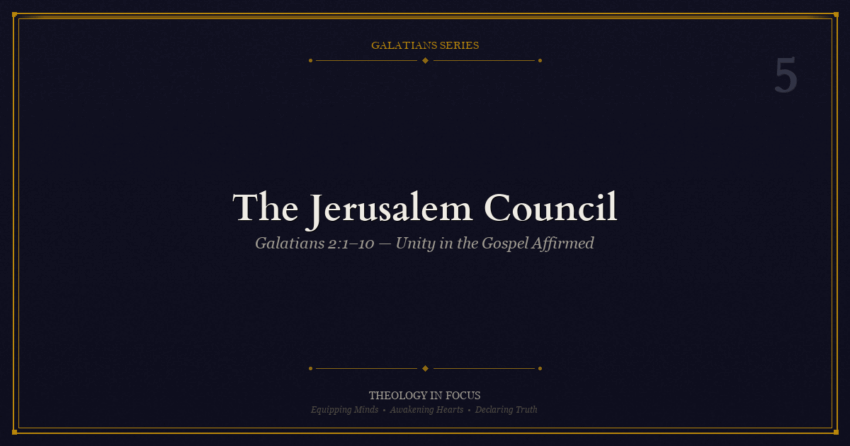
Few moments in the history of the early church carry as much weight as the Jerusalem Council. It was here that the apostles and elders gathered to settle a question that threatened to fracture the young Christian movement at its very foundations: Must Gentile believers become Jews in order to be saved? The answer they reached, under the guidance of the Holy Spirit, would define the trajectory of the gospel for every generation that followed. The account of this pivotal event is found in Galatians 2:1-10 and its parallel in Acts 15, and it remains one of the most instructive passages in all of Scripture for understanding the relationship between law and grace.
The Crisis at Antioch
The trouble began in Antioch. The church there had grown rapidly, comprised largely of Gentile believers who had come to faith through Paul and Barnabas’s ministry. Into this thriving congregation came a group of men from Jerusalem, sometimes called Judaizers, who insisted that unless these Gentile converts submitted to circumcision and the full Mosaic law, they could not be saved. The dispute was fierce. Luke records in Acts 15 that the debate became so intense the Antioch church could not resolve it on its own.
What made this controversy so explosive was the cultural divide it exposed. The Jerusalem apostles, James, Peter, and John, had been raised within a thoroughly Jewish environment. James, in particular, was renowned for his strict Torah observance. Paul, on the other hand, though trained as a Pharisee and once surpassing his contemporaries in zeal for the law, was a Hellenistic Jew from Tarsus. He moved comfortably among Gentiles. It was precisely this quality that had prompted Barnabas to recruit Paul for the work in Antioch years earlier, recognizing that his unique background equipped him to shepherd a predominantly Gentile congregation.
“Then fourteen years after I went up again to Jerusalem with Barnabas, and took Titus with me also. And I went up by revelation.” - Galatians 2:1-2a (KJV)
The Holy Spirit directed Paul to take this step. He understood that the Judaizers traced their authority back to Jerusalem, and the only way to end their interference was to present the issue openly before the very leaders from whom they claimed support.
Paul’s Gospel and the God-Fearers
To understand what was at stake, one must grasp the structure of first-century synagogue life. Every synagogue contained three distinct groups: native-born Jews, full proselytes (Gentile converts who had undergone circumcision and adopted the full Mosaic code), and God-fearers (Gentiles who admired Israel’s God but had not converted). The standard Jewish expectation required any Gentile who wished to serve the God of Israel to first become a proselyte, a second-class Jew, before even hearing the claims of the Messiah.
Paul bypassed this entirely. He declared that God-fearers could receive Christ without first becoming proselytes. They could enter the new covenant directly, by faith alone. This claim enraged the visiting Judaizers, who accused Paul of preaching a defective salvation. But Paul’s response was incisive: Why should he labor to create proselytes when synagogues in every city already contained them? His commission was to offer Christ to the nations, not to reinforce the Mosaic system.
The Private Meeting and the Public Council
Paul’s approach in Jerusalem was both strategic and humble. Before the public council convened, he met privately with Peter, James, John, and the other leaders, explaining the revelation Christ had given him. He laid out his reasoning as to why Gentiles need not pass through the proselyte door, and why imposing the law on them would nullify the grace of Christ.
“And I went up by revelation, and communicated unto them that gospel which I preach among the Gentiles, but privately to them which were of reputation, lest by any means I should run, or had run, in vain.” - Galatians 2:2 (KJV)
Why the private meeting first? Paul was being strategic. The Judaizers had been spreading the narrative that Paul was merely a subordinate of the Jerusalem apostles, that his authority derived from them, and that he had gone rogue with his teaching. If Paul debated the matter publicly from the outset, it would have played into their hands. By addressing the apostles behind closed doors, he prevented the false narrative from gaining any foothold. He wanted it clear that Christ, not the Jerusalem leaders, had commissioned him and taught him the gospel.
About a week later, the public council convened. Paul and Barnabas repeated their case before the whole Jerusalem church, now accompanied by Titus, an uncircumcised Greek believer who served as living proof of Gentile faith apart from the law. The acceptance of Titus without circumcision became the concrete validation of Paul’s gospel. As Paul later wrote:
“But neither Titus, who was with me, being a Greek, was compelled to be circumcised.” - Galatians 2:3 (KJV)
The Covenant That Came First
At the core of Paul’s argument stood a truth that the Jerusalem leaders had not fully grasped: the good news did not begin at Sinai but with Abraham. God called Abraham, who was a Gentile, and gave him a promise of grace through faith. Abraham believed, and God counted that faith as righteousness. For 430 years, Israel lived under that gracious covenant before the law was ever given at Sinai.
Paul’s insight was that this earlier covenant of promise holds legal seniority over the later Mosaic covenant. A binding contract cannot be annulled merely by drafting a new one. The Mosaic law, therefore, never replaced the Abrahamic covenant of grace. It was added because of transgressions, a temporary arrangement to govern a rebellious people until the promised Seed should come.
“For he hath made him to be sin for us, who knew no sin; that we might be made the righteousness of God in him.” - 2 Corinthians 5:21 (KJV)
Christ fulfilled every requirement of the law and then transferred His righteousness to those who believe. This divine transaction stands at the heart of the gospel. Paul insisted that because the first covenant was established on faith, Gentiles who embrace it by faith in Jesus Christ possess full legal standing before God.
Peter’s Declaration
When Paul explained this to the Jerusalem pillars, their response was remarkable. Peter stood before the public assembly and declared what he had come to understand, in part through Paul’s private instruction:
“But we believe that through the grace of the Lord Jesus Christ we shall be saved, even as they.” - Acts 15:11 (KJV)
Peter was conceding a profound truth: if Jews are ever saved, it will not be by the law. The law only proved that they were sinners. Peter recognized that the covenant Paul was preaching, the covenant God made with Abraham, was the greater covenant, and that the Gentiles were entering that promise by faith.
The Decision and the Letter
James, who had formerly been associated with those pressing for legal observance, stood with Paul and Peter. His judgment was decisive:
“Wherefore my sentence is, that we trouble not them, which from among the Gentiles are turned to God.” - Acts 15:19 (KJV)
The elders then drafted a letter to Paul’s churches, affirming his gospel and repudiating the Judaizers’ demands. The letter contained a remarkable admission: the troublemakers had gone out from Jerusalem, but “to whom we gave no such commandment” (Acts 15:24, KJV). The Jerusalem leaders had never authorized anyone to burden Gentile believers with the law. The letter laid down only four practical guidelines, matters related to table fellowship that would allow Jews and Gentiles to share meals together without unnecessary offense.
Paul and Barnabas carried this letter back to Antioch, where it was received with great joy. On his second missionary journey, Paul circulated it throughout the churches of Galatia and beyond, establishing the freedom of the gospel wherever he went.
The Danger of Adding to the Gospel
The takeaway from the Jerusalem Council is as relevant today as it was in the first century. Are you adding anything extra to the gospel, either in your own walk or in what you preach? The heart of the New Testament gospel is singular:
“For by grace are ye saved through faith; and that not of yourselves: it is the gift of God: Not of works, lest any man should boast.” - Ephesians 2:8-9 (KJV)
No one can claim, “I belong to the right group,” or “I keep the superior ordinances.” The elder saint who has served God faithfully for eighty years stands on the same ground of grace as the one who trusted Christ last night. Both are freely justified. Both stand clothed in a righteousness that is not their own.
Standing Firm Every Day
The Jerusalem Council also teaches us about the cost of standing for truth. Paul refused to yield “even for an hour” to the pressure of the Judaizers, not for his own sake, but for the sake of the Gentile believers whose freedom was at stake. His firmness preserved the gospel for future generations.
The question presses itself upon every believer: Will you stand firm in grace? Are you a Sunday Christian who becomes invisible on Monday? Do your co-workers and neighbors know that you belong to Christ? Paul’s example calls for a different path: stand firm in grace alone, through faith alone, in Christ alone.
Unity Without Uniformity
Finally, the Jerusalem Council demonstrates that the early church maintained unity without demanding uniformity. Diverse opinions coexisted under one gospel. Peter had his sphere of ministry to the Jews; Paul had his sphere among the Gentiles. Neither tried to remove the other from ministry. Each recognized that the other was a servant of God. Christ Himself warned His disciples against silencing those who served Him differently:
“Forbid him not: for there is no man which shall do a miracle in my name, that can lightly speak evil of me. For he that is not against us is on our part.” - Mark 9:39-40 (KJV)
The call is to celebrate diversity in Christ. Accept others as fellow Christians saved by the same grace. The Jerusalem Council stands as proof that the church can hold fast to the essential gospel while allowing freedom in matters that are not essential. This principle remains vital for the church today: we are one in Christ, not because we agree on every detail, but because we share the same foundation of grace through faith in Jesus Christ alone.
Christ’s finished work is sufficient. Guard the gospel from every addition.
The Galatians Series
A verse-by-verse commentary through Paul’s letter to the Galatians
-
1. No Other Gospel
— Galatians 1:1-9 -
2. Paul’s Gospel
— Galatians 1:10-2:10 -
3. The Dispute at Antioch
— Galatians 2:11-21 -
4. Justification Defended
— Galatians 2:15-21 -
5. The Jerusalem Council
— Galatians 2:1-10
(You are here) -
6. Faith or Works?
— Galatians 3:1-14 -
7. Priority of the Promise
— Galatians 3:15-29 -
8. From Slaves to Sons
— Galatians 4:1-20 -
9. Two Covenants, One Promise
— Galatians 4:21-5:1 -
10. Stand Firm in Freedom
— Galatians 5:1-15 -
11. Walking by the Spirit
— Galatians 5:16-26 -
12. Bear One Another’s Burdens
— Galatians 6:1-10
What are your thoughts? I would love to hear from you, share your reflections in the comments below.
Continue Your Study
- → Why the Law Was Temporary, Not the Final Solution
- → Law and Gospel: Understanding Their Relationship in Galatians
- → The Faith of Abraham: Galatians and the Promise
- → The Cross and the New Creation: Paul’s Final Word to the Galatians
- → Bear One Another’s Burdens: Paul’s Vision for Christian Community
You May Also Enjoy
 Justification Defended: Why the Law Cannot Save (Galatians 2:15-21)
 No Other Gospel: Paul's Uncompromising Defense of the Faith (Galatians 1:1-10)
 The Priority of the Promise: Why the Law Cannot Annul Grace
 The Cross and the New Creation: Paul's Final Word to the Galatians
 The Righteousness of God Revealed: What Paul Means in Romans 1
 Paul's Gospel: Divine Revelation, Not Human Teaching (Galatians 1:11-24)