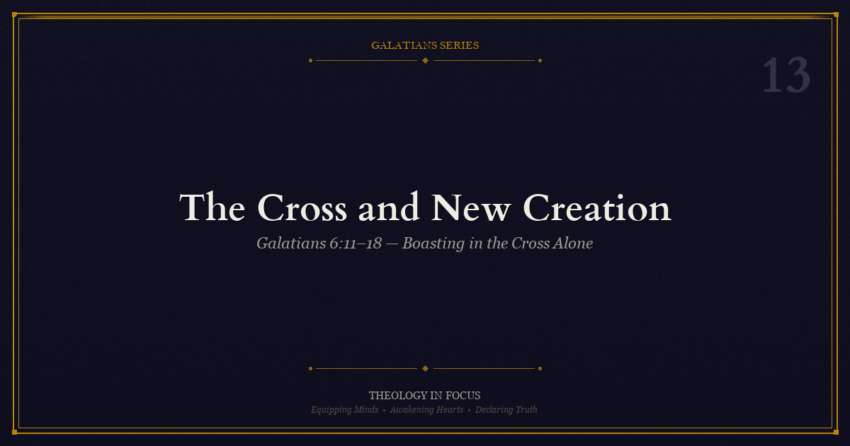
Consider the act of writing a letter to close friends. Within it, there are certain things that carry such weight that one naturally underlines the words or writes them in larger script. The purpose is to draw attention to those lines so that the reader will not miss the importance of what is being said. This is precisely what Paul does in his closing benediction to the Galatians. There is a manner of life, a way of living, that he longs for them to grasp with full seriousness. To ensure that his final words do not pass unnoticed, Paul writes them in large letters, so that the emphasis stands out with unmistakable clarity.
In Galatians 6:11–18, Paul brings his letter to a close. Throughout this epistle, he has consistently refuted the claim that Gentiles must embrace Judaism in order to be saved. Again and again, he has declared that justification comes by grace through faith in Jesus Christ, not through the law, not through circumcision, and not through works of the flesh. Now, as he concludes, Paul ties everything together and directs the eyes of the Galatians one last time to the cross of Christ.
Unmasking the False Teachers
“Ye see how large a letter I have written unto you with mine own hand.” (Galatians 6:11, KJV)
In the ancient world, writing in large letters served the same function as underlining, bolding, or highlighting does in modern writing. It was a way of saying, “Pay attention, this part matters most.” Just as John Hancock signed his name in large script on the Declaration of Independence to make a bold statement of courage, Paul enlarges his handwriting to emphasize his conviction. He declares through this visible act that he has no glory, no righteousness, and no justification in his own works. His only boast, his only confidence, is in the work of Jesus Christ on Mount Calvary.
Yet before bringing the letter to a close, Paul once more unmasks the motives of the false teachers:
“As many as desire to make a fair shew in the flesh, they constrain you to be circumcised; only lest they should suffer persecution for the cross of Christ. For neither they themselves who are circumcised keep the law; but desire to have you circumcised, that they may glory in your flesh.” (Galatians 6:12–13, KJV)
Here Paul exposes their true intentions. The Judaizers are not motivated by genuine conviction for the law. Their desire is to make a good showing in the flesh. By compelling Paul’s Gentile converts to submit to circumcision, they can parade these men as proof of their influence, tallying up numbers as though doctrinal converts were trophies. Paul sees through this. He even suggests that they do not believe their own message, for they themselves do not keep the law.
Why then are they pressing the matter? Paul states it plainly: they want to avoid persecution. To embrace the scandal of the cross would mean facing the same hostility Paul endured. To escape that suffering, they compromise. By insisting on circumcision, they retain respectability before the Jewish establishment. From Paul’s day until the present, the message of the cross has always carried with it a peculiar persecution. Simply trusting in Christ’s redemptive work, apart from anything one contributes, provokes opposition. And often that opposition does not come first from the outside world, but from within the religious community itself.
Paul’s Boast in the Cross
By contrast, Paul declares:
“But God forbid that I should glory, save in the cross of our Lord Jesus Christ, by whom the world is crucified unto me, and I unto the world.” (Galatians 6:14, KJV)
The contrast could not be sharper. The Judaizers boasted in externals, counting heads, measuring influence, and tallying converts. Paul repudiates that entirely. His words ring with determination: “Not me. Never. God forbid that I should glory, save in the cross of our Lord Jesus Christ.”
Why does Paul take this stance? Because he knew from painful experience where the other road led. As a Pharisee, he gloried in numbers, in zeal, and in outward measures of success (Philippians 3:4–6). He believed he was serving God, but in truth he was deceived, so thoroughly deceived that Christ Himself had to confront him on the Damascus road. Paul learned that boasting in external proof is a fallacy, one that blinds a person to his own error.
From the hour of his conversion onward, Paul abandoned that path. His only boast was the cross of Christ. Why the cross? Because everything external, everything of the flesh, perishes. The cross alone is eternal. Through the cross, Paul received what nothing else could provide: a new creation, a transformed life made alive in Christ; a new relationship with God, reconciliation with the Father; and a new standing before God, not based on works, but secured through Christ’s finished sacrifice.
The Great Exchange
That last point is crucial. Every person must one day stand before God the Great Judge. On that day, something must be placed upon the altar as the basis of right standing. If one offers his own life, his own works, his own righteousness, then that becomes his sacrifice. Yet the law has already declared:
“There is none righteous, no, not one.” (Romans 3:10, KJV)
No work of man can stand before the holiness of God. Paul himself came to recognize that all his works, even the very best of them, amounted to nothing but “filthy rags” (Isaiah 64:6). If Paul were to lay his own righteousness on the altar, all he could ever present would be utterly unfit to bring him into right standing before God.
This is why Paul glories only in the cross. In the cross, something greater is placed upon the altar: the righteousness of Christ Himself, offered in place of our own. Here lies the essential distinction that sets Christianity apart from every other religion in the world. Every other system bases the worshipper’s acceptance upon the worshipper’s own works. Christianity alone grounds the fitness of the worshipper not on his own credentials, but on the credentials of Another: Jesus Christ.
In the Old Testament sacrificial system, the worshipper would bring a lamb, lay hands upon it, and place it upon the altar. The lamb would then die in the worshipper’s stead. There was also a requirement that the offering be without blemish. When a man brought his lamb, the priest would never inspect the worshipper. He would not examine the man to see if he bore spots or imperfections. The priest did not even look at the worshipper. Instead, his attention was fixed entirely upon the lamb. He inspected the sacrifice, not the one bringing it. If the lamb was deemed worthy, without spot or blemish, then the worshipper could go free.
This is precisely what God has done. Christ was presented before men, before priests, before rulers, and even before His enemies, and all bore witness that no fault could be found in Him. He was deemed perfect, the sinless Lamb. God sacrificed Him for the sins of the world. The judgment did not fall upon the sinner, for God did not examine the sinner; He looked at the sacrifice and found it without blemish.
Neither Circumcision Nor Uncircumcision: A New Creation
“For in Christ Jesus neither circumcision availeth any thing, nor uncircumcision, but a new creature.” (Galatians 6:15, KJV)
Paul’s meaning is clear. Whether one embraces religious ritual, such as circumcision, or proudly rejects it in reaction, neither gives any standing before God. Ritualism gains nothing, and reactionary non-ritualism gains nothing either. Only one thing matters: being made a new creation in Christ.
This is Paul’s emphasis. To be in Christ means to be a new creation. A believer is no longer a natural man, bound by the old life, but a spiritual man, made alive in Christ. It is not a cleaned-up old life that God offers, but an entirely new life. Paul himself was not a reformed Pharisee. He was a brand-new man, created anew in Christ. That, he insists, is what is eternal. Becoming a new creation in Christ Jesus is what endures beyond death.
The Israel of God
“And as many as walk according to this rule, peace be on them, and mercy, and upon the Israel of God.” (Galatians 6:16, KJV)
Throughout the letter, Paul has been contending over this very question: who are the true children of Abraham? Who does God truly count as His own? Paul has argued emphatically that it is not those who can trace their lineage physically back to Abraham. Many tribes could trace their descent to Abraham. Ishmael himself fathered twelve tribes. Yet Paul insists that none of them are the true Israel of God by mere physical descent.
So who does God count as His own? It is those who follow the religion of Abraham, the covenant of faith. The original covenant, Paul argues, was the covenant God made with Abraham based on faith, not on works. Its foundation was simple: believing that God Himself would make all things right between Himself and the sinner. Those who hold to this faith-based covenant are the true children of Abraham. They are the true Israel of God. This includes those from the tribes of Israel and those outside of Israel altogether: Greeks, Romans, Egyptians, and Gentiles of every nation. Wherever they may be found, if they come to God by faith, Paul declares that they are the true children of Abraham.
The Marks of Jesus
“From henceforth let no man trouble me: for I bear in my body the marks of the Lord Jesus.” (Galatians 6:17, KJV)
Paul carried physical scars, the visible evidence of his labor and the price he had paid for the gospel. It was in Lystra that Paul was stoned (Acts 14:19). The stoning he endured was brutal. When it was finished, the crowd departed believing Paul to be dead. Yet life returned to him. He rose, and to the astonishment of all, went back into the city. His body bore the lasting scars of that ordeal: scars upon his face, bones that had been broken and mended. Later Paul would write, “They say of me that in person I am contemptible” (2 Corinthians 10:10). His appearance had been marred by the violence he endured.
These scars could have been used as proof of his endurance and his commitment to Christ. They could have become a boast. Yet Paul refused to glory in them. Unlike the false teachers, who came in unscarred and unpersecuted, Paul chose to boast only in the cross of Calvary, for it had made him a new creation, a new man.
Grace at the Beginning and the End
“Brethren, the grace of our Lord Jesus Christ be with your spirit. Amen.” (Galatians 6:18, KJV)
The closing is deeply fitting. Paul opens his letter with grace, argues grace throughout, and ends with grace. This is the thread that binds the entire epistle together. It must also be remembered that many of the Galatians never did turn back to Paul. Some did, but many remained with the Judaizers. Yet Paul still extended grace to them. He still wished grace upon those who had counted him their enemy. His tone was not that of a legalist, but of a spiritual father.
Application: Recentering on the Cross
The call of Galatians 6 is simple yet profound: recenter on the cross. Regardless of one’s station or stage in the Christian life, the exhortation remains the same. The believer’s life must reflect allegiance to the work of Christ, not to personal works, not to a particular church or denomination, but to Christ alone. Paul insists that only this will endure the fires of judgment.
The reality of the new creation demands that superficial religious rites, outward works, and empty customs give way to inward renewal. The essence of salvation is transformation, not ritual. And the Christian must endure with grace: extending grace to all, enduring persecution, disagreement, and opposition from friends or foes alike. This was the path of Christ. It was the path of Paul. Their renewed hearts held no desire to see their persecutors destroyed. In the Old Testament God declared, “I take no pleasure in the death of the wicked” (Ezekiel 33:11). When His life is renewed within the believer, there comes a willingness to endure with grace. His character becomes ours. His mercy becomes our response. This is the mark of the new creation.
Let the message be filled with the cross of Calvary, and let legalism, with all of its emptiness, fade away.
The Galatians Series
A verse-by-verse commentary through Paul’s letter to the Galatians
- 1. No Other Gospel | Galatians 1:1–9
- 2. Paul’s Gospel | Galatians 1:10–2:10
- 3. The Dispute at Antioch | Galatians 2:11–21
- 4. Justification Defended | Galatians 2:15–21
- 5. The Jerusalem Council | Galatians 2:1–10
- 6. Faith or Works? | Galatians 3:1–14
- 7. Priority of the Promise | Galatians 3:15–29
- 8. From Slaves to Sons | Galatians 4:1–20
- 9. Two Covenants, One Promise | Galatians 4:21–5:1
- 10. Stand Firm in Freedom | Galatians 5:1–15
- 11. Walking by the Spirit | Galatians 5:16–26
- 12. Bear One Another’s Burdens | Galatians 6:1–10
- 13. The Cross and New Creation | Galatians 6:11–18 (Current article)
What are your thoughts? I would love to hear from you, share your reflections in the comments below.
Continue Your Study
You May Also Enjoy
 The Righteousness of God Revealed: What Paul Means in Romans 1
 Justification Defended: Why the Law Cannot Save (Galatians 2:15-21)
 Lesson 5: Shepherding with a Tender Heart — 1 Thessalonians 2:7-9
 The Priority of the Promise: Why the Law Cannot Annul Grace
 Paul's Gospel: Divine Revelation, Not Human Teaching (Galatians 1:11-24)
 Lesson 2: When the Church Gets It Right — 1 Thessalonians 1:1-5