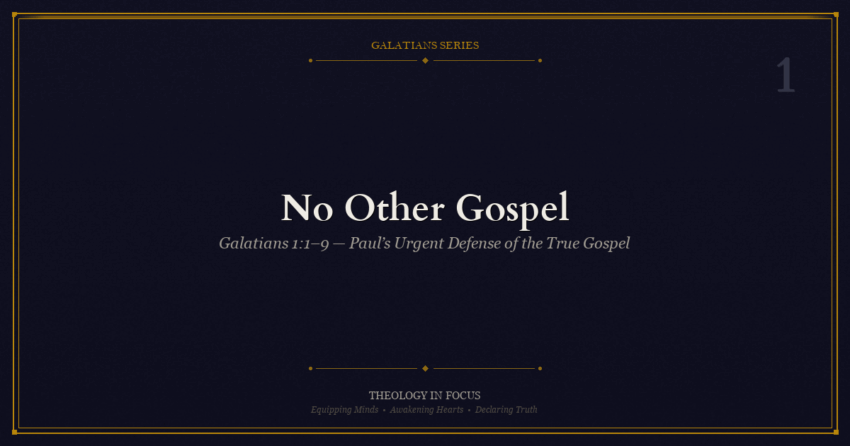
The letter to the Galatians opens not with pleasantries but with urgency. Paul, the apostle to the Gentiles, writes to churches he planted during his first missionary journey, and his tone is unlike anything else in his surviving correspondence. There is no extended thanksgiving, no warm commendation. Instead, there is astonishment, warning, and an uncompromising declaration: there is no other gospel.
What provoked this urgency? The Galatian believers, many of them former God-fearers who had embraced Christ through Paul’s preaching, were being drawn away from the gospel of grace by teachers who insisted that faith in Christ was not enough. These teachers demanded circumcision, Torah observance, and full conversion to Judaism as prerequisites for salvation. Paul recognized that what appeared to be a minor supplement to the gospel was in fact its total destruction.
Paul’s Apostolic Authority
From the very first verse, Paul establishes the divine origin of his commission:
“Paul, an apostle, (not of men, neither by man, but by Jesus Christ, and God the Father, who raised him from the dead;)” (Galatians 1:1, KJV)
This is no conventional greeting. It is a theological assertion. Paul’s opponents had attacked his credentials, claiming he was a secondary figure who lacked the authority of the original Twelve. They portrayed him as someone who had received his message secondhand from the Jerusalem apostles and then distorted it to make it more palatable to Gentile audiences.
Paul’s response is emphatic. His apostleship originated not from any human council, not from the Jerusalem church, and not from any individual apostle. It came directly from Jesus Christ and God the Father. This double source of authority, christological and theological, would sustain Paul’s ministry for the next quarter-century until his martyrdom in Rome.
Written around AD 48-49, Galatians stands as one of the earliest of Paul’s preserved letters, addressed to churches he established in southern Galatia: Pisidian Antioch, Iconium, Lystra, and Derbe. In these cities, Paul had welcomed Gentile converts into the covenant community solely through faith in Christ, without requiring adherence to Mosaic ceremonial law. This practice ignited controversy that would follow Paul throughout his entire apostolic career.
The Gospel in Miniature
Following his greeting, Paul presents the gospel’s essence in compressed form:
“Grace be to you and peace from God the Father, and from our Lord Jesus Christ, Who gave himself for our sins, that he might deliver us from this present evil world, according to the will of God and our Father: To whom be glory for ever and ever. Amen.” (Galatians 1:3-5, KJV)
This formulation is deliberate. The truth that Christ “gave himself for our sins,” with no additional requirements, becomes the theological touchstone for the entire epistle. The emphasis falls decisively on Christ’s action: He “gave himself” and He “delivers us.” Human observance of Torah contributes nothing to this deliverance. Salvation flows entirely from Christ’s self-sacrifice, not from human religious performance.
Paul’s declaration that Christ acted “according to the will of our God and Father” reveals a crucial theological principle: redemption through Christ represents no divine afterthought or emergency response to human failure. The Father’s plan of salvation existed from eternity, conceived before creation itself. This eternal perspective resurfaces later in the letter when Paul demonstrates that the promise to Abraham preceded the Law by 430 years, establishing the priority of grace over legal obligation.
The Galatian Crisis
With abrupt force, Paul expresses his astonishment at the Galatians’ defection:
“I marvel that ye are so soon removed from him that called you into the grace of Christ unto another gospel: Which is not another; but there be some that trouble you, and would pervert the gospel of Christ.” (Galatians 1:6-7, KJV)
The Greek present tense indicates an ongoing process of defection, not a completed apostasy. Paul is amazed. Scarcely eighteen months had elapsed since his departure, yet the Galatians were already abandoning the gospel. His language reveals the gravity of their error: they were deserting not merely a doctrine but “him who called you,” Christ himself.
To understand the controversy’s depth, we must recognize the social landscape of first-century Judaism. Three categories of people existed in relation to God’s covenant. First stood the Jews, born into the covenant community. Second were the proselytes, Gentiles who had undergone complete conversion through circumcision, ritual immersion, and acceptance of all 613 Mosaic commandments. Third were the God-fearers, Gentiles attracted to Jewish monotheism who attended synagogue services without fully converting.
Paul’s revolutionary message targeted this third group. He proclaimed that anyone desiring to worship God could enter His covenant community without submitting to a single Mosaic regulation. The 613 commandments that had stood as an insurmountable barrier became irrelevant for salvation. A Gentile could bypass the entire legal system and receive equal standing with Jews in God’s family through faith in Christ alone.
The Cost of Conversion
The preponderance of God-fearers over full proselytes reflected conversion’s overwhelming demands. Full conversion might force a man to divorce his unconverted wife or separate from his parents and children. Women faced similar family disruptions. Beyond these relational losses, male converts faced the physical ordeal of adult circumcision, while all converts assumed the weight of commandments so exacting that even lifelong Jews struggled under their burden.
Peter himself admitted this reality at the Jerusalem Council: “Now therefore why tempt ye God, to put a yoke upon the neck of the disciples, which neither our fathers nor we were able to bear?” (Acts 15:10, KJV). If Jews themselves, raised from childhood in Torah observance, found the Law’s demands overwhelming, how could Gentile converts hope to succeed?
This context illuminates why Paul’s message resonated so powerfully among God-fearers. While most Jews rejected him outright and proselytes saw little advantage in abandoning their hard-won status, God-fearers discovered in Paul’s gospel a divine invitation they had scarcely dared imagine. They responded in extraordinary numbers, embracing a salvation that elevated them to full membership in God’s people without additional barriers.
The Gospel’s Inviolability
When the Judaizers arrived in Galatia with their credentials and their demand for Torah observance, they launched a systematic assault on Paul’s credibility. “Paul is not a true apostle,” they declared. “He was not among the Twelve. The Jerusalem leadership will soon correct his errors.”
Paul’s response demolishes their entire hierarchical argument with breathtaking boldness:
“But though we, or an angel from heaven, preach any other gospel unto you than that which we have preached unto you, let him be accursed.” (Galatians 1:8, KJV)
With this single declaration, Paul bypasses all claims to human authority. The credentials of James, Peter, John, the Judaizers, or even Paul himself become irrelevant. The only standard is the gospel originally delivered to the Galatians. Even if an angel from heaven were to descend with alterations, that messenger would bring not blessing but curse.
Paul reinforces this through deliberate repetition:
“As we said before, so say I now again, If any man preach any other gospel unto you than that ye have received, let him be accursed.” (Galatians 1:9, KJV)
The double pronouncement of anathema represents the strongest possible condemnation in Paul’s vocabulary. Only one gospel exists, one path to salvation, one piece of genuinely good news. To depart from it means embracing destruction.
The Servant’s Priority
Paul then poses a rhetorical question that exposes the heart of the conflict:
“For do I now persuade men, or God? or do I seek to please men? for if I yet pleased men, I should not be the servant of Christ.” (Galatians 1:10, KJV)
This question responds to the Judaizers’ accusation that Paul had watered down the gospel to attract Gentile converts. Paul inverts their charge entirely: if he sought human approval, he would have remained within Judaism’s comfortable boundaries rather than enduring persecution for preaching a law-free gospel.
Had Paul sought human approval, he would never have relinquished his privileged position among the Pharisees. As he later testifies, he counted everything he once valued as loss “for the excellency of the knowledge of Christ Jesus my Lord” (Philippians 3:8, KJV). No one abandons elite status merely to gain favor with a marginalized religious sect. Paul forsook everything to please God alone.
From the world’s perspective, Paul had descended from respected Pharisee to itinerant preacher of a crucified criminal. Yet from God’s perspective, he had ascended to the highest calling possible. The metrics by which humanity and God measure worth are completely inverted. Christ himself established this principle: “How can ye believe, which receive honour one of another, and seek not the honour that cometh from God only?” (John 5:44, KJV).
The Unchanging Good News
Paul defines the gospel with clarity elsewhere in his writings: “For he hath made him to be sin for us, who knew no sin; that we might be made the righteousness of God in him” (2 Corinthians 5:21, KJV). God treated the sinless Christ as sin incarnate, enabling Him to treat sinful humanity as righteous through faith. Christ’s sinless life merited eternal glory; humanity’s sinful existence earned eternal death. At Calvary, Jesus made the exchange. He received our penalty while we receive His reward. Death claimed Him as He bore our judgment, but the grave could not retain Him. Once the debt was satisfied, He rose triumphant.
This exchange, and this alone, constitutes the gospel. Any message that supplements or diminishes this truth represents not good news but its perversion. Works-based religion insists people can earn God’s favor through religious observance. The prosperity gospel promises material blessing in exchange for financial offerings. Social gospels prioritize temporal transformation over eternal reconciliation. Each system that mingles human performance with Christ’s completed work falls under Paul’s anathema.
Application for Today
As we consider Galatians 1:1-10, we should marvel at our possession of this singular, unchanging gospel. The Galatians nearly exchanged this treasure for slavery. Contemporary believers face the same temptation in different forms, as human nature persistently seeks to contribute something to its own salvation.
Yet Paul’s message rings across the centuries with undiminished clarity: salvation comes through Christ’s work alone, received by faith alone, to God’s glory alone. This gospel that transformed a Pharisee into an apostle, that welcomed Gentile God-fearers as full members of God’s family, that broke down every barrier between humanity and God, this gospel remains our sole hope and supreme treasure. Any addition to it is not an improvement but a corruption. Any alteration is not a refinement but a betrayal. There is, and there can be, no other gospel.
The Galatians Series
A verse-by-verse commentary through Paul’s letter to the Galatians
-
1. No Other Gospel
— Galatians 1:1-9
(You are here) -
2. Paul’s Gospel
— Galatians 1:10-2:10 -
3. The Dispute at Antioch
— Galatians 2:11-21 -
4. Justification Defended
— Galatians 2:15-21 -
5. The Jerusalem Council
— Galatians 2:1-10 -
6. Faith or Works?
— Galatians 3:1-14 -
7. Priority of the Promise
— Galatians 3:15-29 -
8. From Slaves to Sons
— Galatians 4:1-20 -
9. Two Covenants, One Promise
— Galatians 4:21-5:1 -
10. Stand Firm in Freedom
— Galatians 5:1-15 -
11. Walking by the Spirit
— Galatians 5:16-26 -
12. Bear One Another’s Burdens
— Galatians 6:1-10
What are your thoughts? I would love to hear from you, share your reflections in the comments below.
Continue Your Study
- → Why the Law Was Temporary, Not the Final Solution
- → Law and Gospel: Understanding Their Relationship in Galatians
- → The Faith of Abraham: Galatians and the Promise
- → The Cross and the New Creation: Paul’s Final Word to the Galatians
- → Bear One Another’s Burdens: Paul’s Vision for Christian Community
You May Also Enjoy
 The Cross and the New Creation: Paul's Final Word to the Galatians
 Paul's Gospel: Divine Revelation, Not Human Teaching (Galatians 1:11-24)
 The Righteousness of God Revealed: What Paul Means in Romans 1
 Lesson 5: Shepherding with a Tender Heart — 1 Thessalonians 2:7-9
 Justification Defended: Why the Law Cannot Save (Galatians 2:15-21)
 Lesson 4: Leading from the Fire — 1 Thessalonians 2:1-6