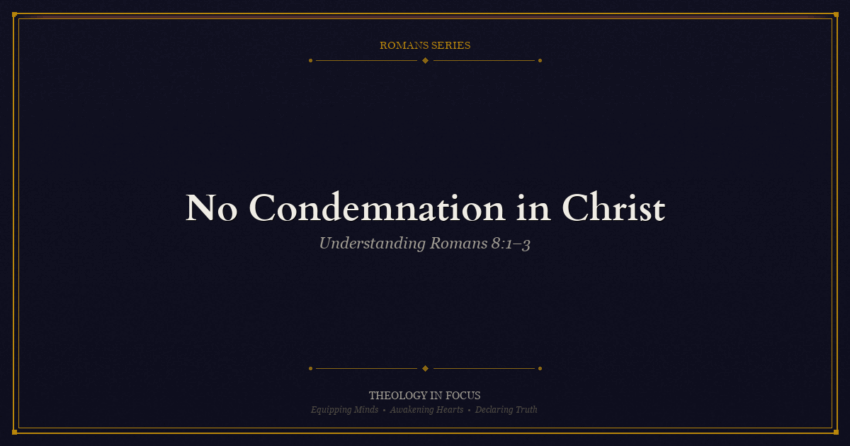
Romans 8 opens with what may be the most comforting sentence in all of Scripture. After seven chapters of building an argument that moves from universal human guilt to the impossibility of self-righteousness to the agonizing internal war between flesh and spirit, Paul arrives at a verdict that reverberates through the ages. It is not a suggestion. It is not a hope. It is a judicial pronouncement from the courtroom of heaven: there is no condemnation for those who are in Christ Jesus.
“There is therefore now no condemnation to them which are in Christ Jesus, who walk not after the flesh, but after the Spirit.” (Romans 8:1, KJV)
The Weight of “Therefore”
Every serious student of Romans knows that when Paul says “therefore,” he is drawing a conclusion from everything that preceded it. And what preceded Romans 8:1 was not a light journey. Paul began in Romans 1 with the Gentile world under the wrath of God. In Romans 2, he turned the spotlight on the moralist and the Jew, showing that religious privilege does not exempt anyone from judgment. In Romans 3, he declared the entire human race guilty before God, with every mouth stopped. In Romans 4 and 5, he established justification by faith alone, grounded in the work of Christ alone. In Romans 6, he addressed the believer’s union with Christ in death and resurrection. And in Romans 7, he laid bare the agonizing struggle of the believer who, though justified, still wars against indwelling sin.
That struggle in Romans 7 is real and painful. Paul cries out, “O wretched man that I am! who shall deliver me from the body of this death?” (Romans 7:24, KJV). It is a groan from the depths of the soul, the cry of a man who knows he is saved and yet feels the relentless pull of remaining sin. If Romans had ended at chapter 7, the Christian life would be a tragedy. But it does not end there. The “therefore” of Romans 8:1 answers the cry of Romans 7:24. Deliverance has come. Condemnation has been removed. And the basis of that removal is not the believer’s performance but the person and work of Jesus Christ.
What Condemnation Means
To appreciate what it means to have no condemnation, one must understand what condemnation entails. In the biblical context, condemnation is a legal term. It is the verdict of a court that finds the defendant guilty and sentences him to punishment. It is not merely disapproval. It is not merely disappointment. It is the full weight of divine justice brought to bear against sin, culminating in the eternal separation of the sinner from the presence of God.
Every human being, apart from Christ, stands under this condemnation. Not because God is cruel, but because God is just. Sin is an offense against an infinitely holy God, and justice requires that it be punished. The wages of sin is death (Romans 6:23). That is not a threat. It is a fact. It is the necessary consequence of rebellion against the Creator of the universe.
When Paul declares that there is “no condemnation” for those in Christ, he is saying that the legal verdict has been reversed. Not because the sin was overlooked. Not because God decided to be lenient. But because the penalty was paid in full by a substitute. Christ bore the condemnation that His people deserved, and having borne it, there is none left for them. The account has been settled. The debt has been discharged. The sentence has been served, not by the guilty party, but by the righteous Son of God in their place.
What the Law Could Not Do
Paul immediately explains why this verdict of “no condemnation” could never have come through the law:
“For what the law could not do, in that it was weak through the flesh, God sending his own Son in the likeness of sinful flesh, and for sin, condemned sin in the flesh.” (Romans 8:3, KJV)
The law was not defective. Paul has already established that the law is holy, just, and good. The problem was not with the law. The problem was with the flesh, with fallen human nature that could not keep the law’s demands. The law could command righteousness, but it could not produce it. It could define sin, but it could not defeat it. It could condemn the sinner, but it could not save him.
This is the fatal flaw in every system of religion built on human performance. Whether it is the meticulous Pharisaism of the first century or the moralistic therapeutic deism of the twenty-first, the result is the same: the flesh is too weak to meet the standard. The law reveals the disease but cannot cure it. It pronounces the diagnosis but offers no remedy.
But what the law could not do, God did. He did not lower the standard. He did not relax the requirements. He did not grade on a curve. He sent His own Son. He sent Him in the likeness of sinful flesh, taking on true humanity in the incarnation. And He sent Him as an offering for sin, to do what no animal sacrifice, no human effort, and no legal code could ever accomplish. God condemned sin in the flesh of His Son so that sin would no longer have the power to condemn those who are in Him.
Forensic Justification: The Legal Ground
The doctrine at the heart of this passage is what theologians call forensic justification. It is forensic because it is a legal declaration. It is not a description of the believer’s internal moral state. It is a pronouncement of the believer’s legal standing before God.
In justification, God declares the sinner righteous. Not because the sinner has become righteous in practice, but because the righteousness of Christ has been credited, imputed, to the sinner’s account. It is an act of divine reckoning. God looks at the believer and sees not the believer’s sin but the Son’s righteousness. The believer’s sin was placed on Christ at the cross. Christ’s righteousness is placed on the believer at the moment of faith. This is the great exchange, the foundation of the gospel.
“For he hath made him to be sin for us, who knew no sin; that we might be made the righteousness of God in him.” (2 Corinthians 5:21, KJV)
This is why the verdict of “no condemnation” is so secure. It does not depend on the believer’s sanctification, which is progressive and incomplete in this life. It depends on Christ’s finished work, which is perfect and complete forever. The believer who struggles with sin, who falls and rises, who fights the flesh daily, can still stand before God without condemnation, not because the struggle does not matter, but because the legal ground of acceptance was established at the cross, not in the Christian’s daily performance.
In Christ Jesus: The Sphere of Safety
The critical phrase is “in Christ Jesus.” This is not a loose metaphor. It is a description of union with Christ, the believer’s incorporation into the person and work of the Redeemer. To be in Christ is to be identified with Him in His death, burial, and resurrection. It is to share in His legal standing before the Father. It is to be covered by His righteousness and sheltered by His sacrifice.
Outside of Christ, there is nothing but condemnation. The wrath of God remains on every person who has not trusted in the Son (John 3:36). But in Christ, the wrath has been exhausted. The penalty has been paid. The curse has been borne. There is no condemnation left, not because condemnation was unjust, but because it was already executed on the cross.
This is the gospel in its purest expression. It is not a call to try harder. It is not an invitation for the sinner to present oneself as worthy. It is the announcement that God has done what no one could ever do. He has removed the condemnation of the guilty by placing it on His Son. And now, by faith, the believer stands in the sphere of no condemnation, clothed in a righteousness that is not one's own, accepted by a God whose justice has been fully satisfied.
The Assurance This Gives
If Romans 8:1 is true, and it is, then the believer has an unshakable ground of assurance. Not assurance based on feelings, which fluctuate. Not assurance based on performance, which falters. Assurance based on the accomplished work of Jesus Christ and the unchanging verdict of the Judge of all the earth.
When the conscience accuses, the answer is: no condemnation. When the enemy whispers failure, the answer is: no condemnation. When the weight of remaining sin presses down, the answer is: no condemnation. Not because sin does not matter, but because sin has been dealt with. Christ has borne it. The law’s demands have been met. And the believer stands, not in his own righteousness, but in the righteousness of the Son of God, forever beyond the reach of condemnation.
Dr. Peter J. Carter is a theologian, author, and the founder of Theology in Focus. He holds a D.Min. with a concentration in theology and apologetics and has spent over two decades teaching, preaching, and writing to make theology accessible to every believer.
What are your thoughts? I would love to hear from you, share your reflections in the comments below.
Continue Your Study
You May Also Enjoy
 The Righteousness of God Revealed: What Paul Means in Romans 1
 Lesson 6: Called into His Kingdom and Glory — 1 Thessalonians 2:10-12
 Lesson 5: Shepherding with a Tender Heart — 1 Thessalonians 2:7-9
 Lesson 2: When the Church Gets It Right — 1 Thessalonians 1:1-5
 An Introduction to the Book of Romans: The Gospel in Full
 The Cross and the New Creation: Paul's Final Word to the Galatians